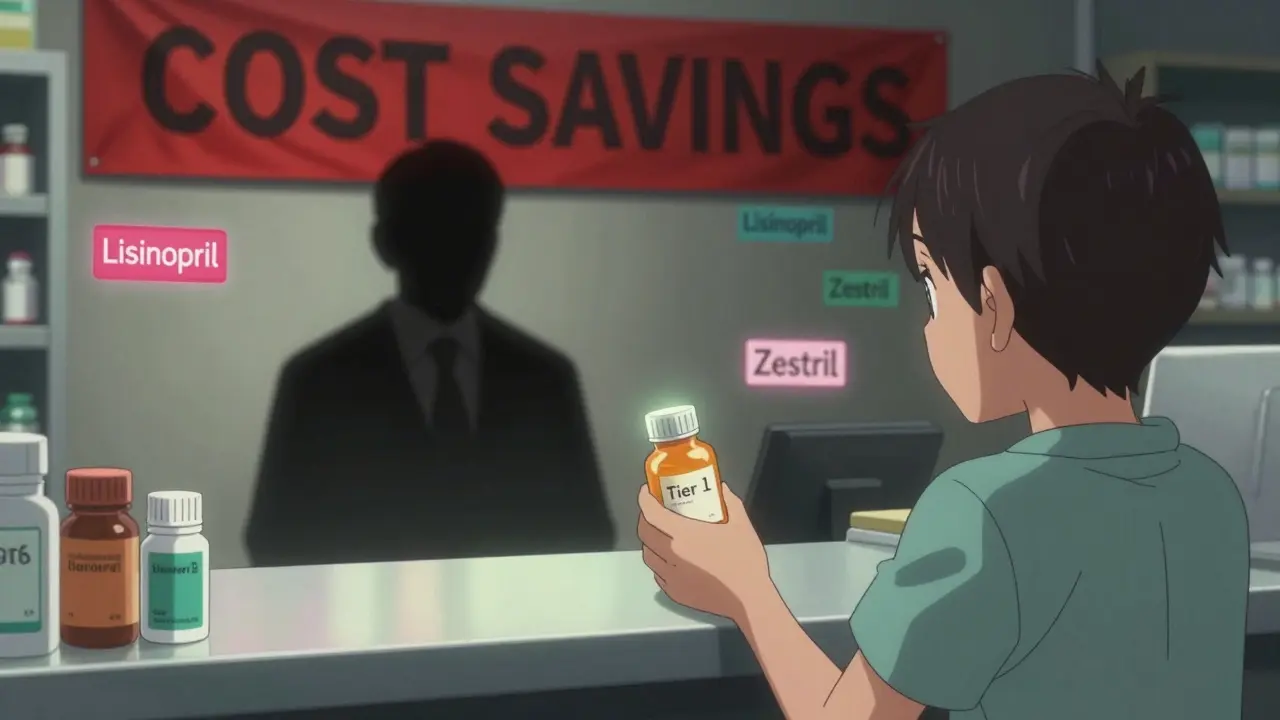
Every time you fill a prescription, your insurer already made a decision before you even walked into the pharmacy. That decision? Whether your drug is on their preferred generic list - and what you’ll pay for it. This isn’t random. It’s a system built over decades to cut costs, and it’s shaping everything from your monthly bills to whether your doctor can prescribe exactly what they think you need.
How Insurers Decide What’s "Preferred"
Insurers don’t pick generic drugs by chance. They use a formal process called a formulary, which is essentially a ranked list of medications. The top tier - Tier 1 - is where preferred generics live. These are drugs that work just like their brand-name versions but cost 80% to 85% less, according to the FDA. For example, generic lisinopril for high blood pressure might cost $6 for a 30-day supply, while the brand-name Zestril could run $120. That’s not a small difference - it’s the reason insurers push these drugs so hard. The list isn’t made by insurance agents. It’s built by panels of doctors and pharmacists who review safety, effectiveness, and price. The goal? To get the same results at the lowest possible cost. When a drug has six or more generic competitors, prices can drop by up to 95%, as the FDA found in 2022. That’s why insurers favor generics with lots of makers - more competition means even lower prices.The Tiered System: What You Pay Depends on the Level
Most insurance plans use a tiered system, usually with three to five levels. Tier 1 is all preferred generics. You’ll pay $5 to $15 for a 30-day supply. Tier 2 includes some brand-name drugs and higher-cost generics - your copay jumps to $25-$50. Tier 3 is for non-preferred brand-name drugs, where you might pay $50-$100. Tier 4? That’s where specialty drugs like biologics live, often costing hundreds or even thousands per month. Here’s the catch: even if a brand-name drug and a generic are in the same tier, the brand might still cost $349 while the generic is $197. But because both have the same flat copay, you won’t see the difference - until you switch plans. That’s why checking your formulary every year during open enrollment matters. A drug that was Tier 1 last year might be Tier 3 this year, and your bill could double overnight.Why Generic Substitution Isn’t Always Simple
Most people assume generics are perfect swaps. And for the most part, they are. The FDA requires them to be bioequivalent - meaning they work within 80-125% of the brand’s effect. Studies show 98.5% of approved generics meet this standard. But not all drugs play nice. For drugs like warfarin, used to prevent blood clots, doctors sometimes resist switching. Why? Because tiny changes in dosage can lead to dangerous side effects. The American College of Clinical Pharmacy found 23% of physicians avoid generic substitution for these narrow-therapeutic-index drugs. Insurers don’t always understand that risk. They see two pills with the same name and assume they’re interchangeable. Another issue? Biosimilars. These are cheaper versions of complex biologic drugs like Humira. But here’s the problem: the original drug makers offer co-pay cards that cut your out-of-pocket cost to $5 a month. Biosimilar makers don’t. So even though Amjevita (Humira’s biosimilar) costs $850 a month versus $1,200 for Humira, your actual payment might be the same - or even higher - because you lose the manufacturer’s discount.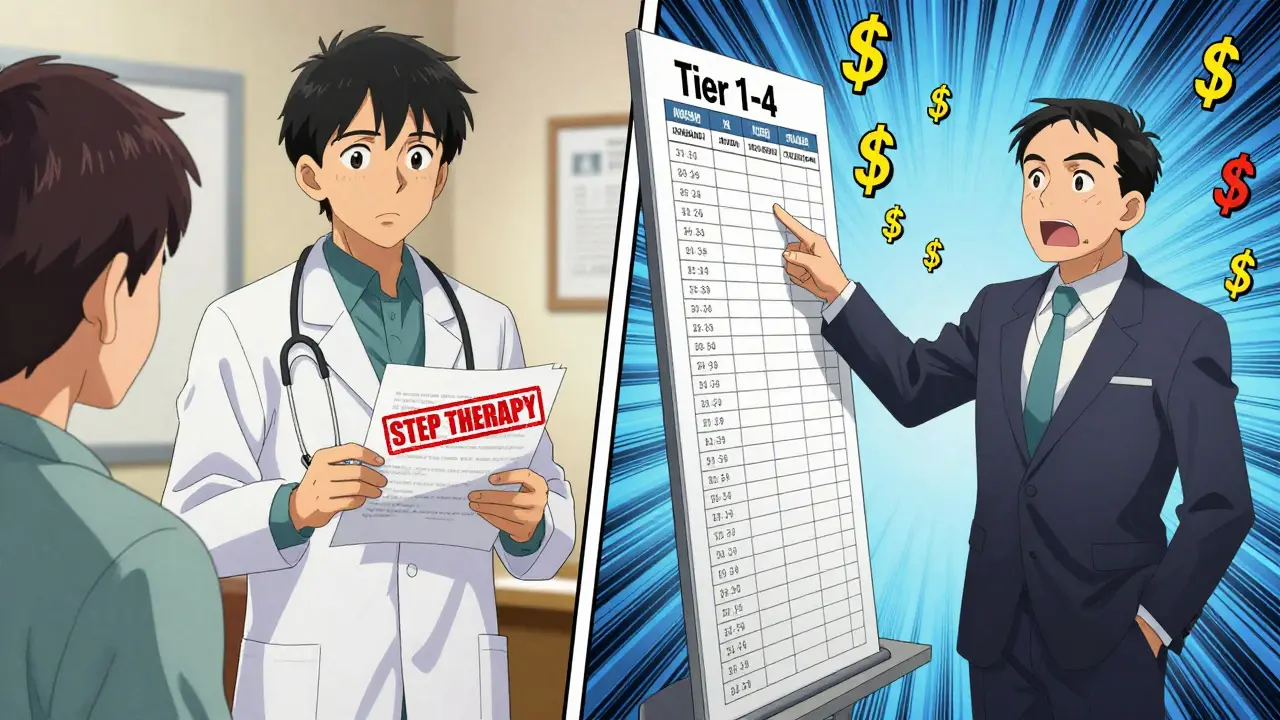
What Happens When Your Doctor Says No
Your doctor might prescribe a brand-name drug because it’s the best fit for your body. But if it’s not on your plan’s preferred list, the pharmacy won’t fill it. That’s when you hit a wall called “prior authorization.” Your doctor has to submit paperwork proving you’ve tried the generic first, or that it didn’t work. In 42% of cases, physicians report delays in treatment - especially for chronic pain, depression, or autoimmune conditions - because insurers force patients to fail on cheaper options first. This is called “step therapy,” and it’s a major pain point. But here’s good news: if your doctor appeals, the approval rate is 68%, according to the Kaiser Family Foundation. You need a letter explaining why the generic won’t work for you. Some patients report success after just one call from their doctor’s office. Others need multiple rounds of paperwork. Either way, don’t give up.How Much Money Are Insurers Saving?
The numbers are staggering. In 2023, generic drugs made up 90% of all prescriptions filled in the U.S. - but only 23% of total drug spending. That’s because generics cost so little. The Health Care Cost Institute found that on average, patients save $194 per prescription when switching from brand to generic. Across the entire system, generic drugs save the U.S. healthcare system $1.68 trillion every year, according to Harvard’s Dr. Aaron Kesselheim. That’s more than the GDP of most countries. But that savings comes with trade-offs. When 1.2% of those substitutions go wrong - because of rare side effects or miscommunication - it costs $4.7 billion in emergency care and hospitalizations. Insurers aren’t just saving money. They’re also shifting risk. If you’re on a high-deductible plan, you’re paying more out of pocket for brand-name drugs. That means you’re more likely to skip doses or stop taking your medicine entirely. That’s not a win for anyone.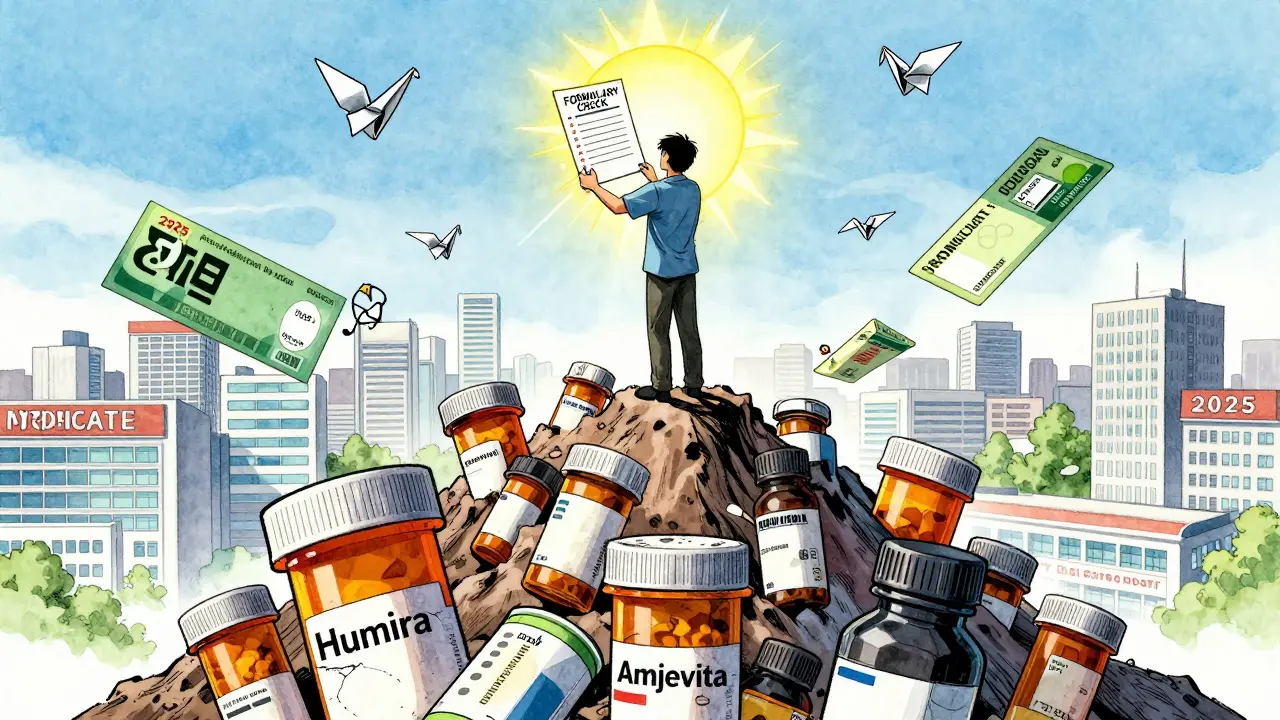
What You Can Do to Save Money - and Avoid Surprises
You don’t have to be powerless in this system. Here’s how to take control:- Check your formulary every year - during open enrollment. Use your plan’s online tool or call customer service. Ask: “Is my medication on Tier 1?”
- Ask your pharmacist - 89% of states let them automatically substitute generics unless your doctor says “dispense as written.” But 37% of patients don’t even know this option exists.
- Use GoodRx or SingleCare - sometimes the cash price at Walmart or CVS is cheaper than your insurance copay. Compare before you pay.
- Appeal if denied - 68% of appeals succeed. Get your doctor to write a letter explaining medical necessity.
- Don’t assume biosimilars are cheaper - check if your manufacturer’s co-pay card disappears when you switch.
Patients who spend just 45 minutes a year reviewing their formulary reduce their medication costs by 32%, according to SmithRx. That’s not a lot of time for a big payoff.

12 Comments
Darren LinksJanuary 23, 2026 AT 17:19
So let me get this straight - we’re celebrating drug companies getting richer by forcing people onto generics like they’re some kind of public service? Lol. The real scam is that the same corporations that own the brand names also own the generics. They just repackage the same crap under a new label and call it ‘savings.’
And don’t get me started on ‘bioequivalent.’ That’s just corporate-speak for ‘close enough so we don’t get sued.’ I’ve seen people have seizures switching from brand to generic warfarin. But hey, $6 vs $120, right? Who cares if you end up in the ER?
They call it ‘cost control.’ I call it patient exploitation dressed up as economics. And the FDA? They’re just the PR department for Big Pharma. Wake up, people.
Kevin WatersJanuary 24, 2026 AT 03:10
This is actually one of the most clear-headed breakdowns I’ve read on formularies. A lot of people don’t realize how much they’re saving - $194 per script on average? That’s like getting a free month of Netflix every quarter.
And yeah, step therapy sucks, but the appeal rate is 68% - that’s better than most insurance battles. If your doc writes a letter, push it. I had a friend on Humira who switched to Amjevita and saved $800/month after the appeal. No drama, just paperwork.
Pro tip: Use GoodRx before you even check your copay. Sometimes the cash price is lower than your insurance rate. I’ve done it twice this year. Small effort, big win.
Kat PetersonJanuary 25, 2026 AT 02:31
OMG I JUST REALIZED MY INSURANCE DID THIS TO ME 😭 I WAS ON LISINOPRIL FOR 3 YEARS AND THEY SWAPPED ME TO A GENERIC I HAD NEVER HEARD OF AND I FELT LIKE I WAS DROWNING IN SLOW MOTION 😵💫
Like… why does my body have to be a lab experiment?? I cried in the pharmacy. I’m not a number. I’m a PERSON. And now I’m scared to take ANYTHING because I don’t know what’s gonna be ‘preferred’ next 😭😭😭
Also… who’s making these rules?? Are they even doctors?? Or just some guy in a cubicle who hates fun?? 🤔
Jamie HooperJanuary 25, 2026 AT 03:25
Yeah mate, the whole system’s a mess. I got my script for sertraline switched last year and ended up with a generic that made me feel like a zombie on a treadmill. Told the doc, they said ‘it’s the same chemical’ - yeah, but my brain ain’t a chemistry set.
And don’t even get me started on those co-pay cards. They’re like bait-and-switch with extra steps. I thought I was saving, turns out I was just paying more later. Classic PBM shenanigans.
Check your formulary every year? Yeah right. Most folks don’t even know what a formulary is. It’s not their fault - the system’s designed to confuse.
Husain AttherJanuary 25, 2026 AT 18:23
This is a well-researched and balanced perspective on a complex issue. The economic logic behind formularies is sound - generics reduce systemic burden and increase accessibility. However, the human impact cannot be reduced to statistics alone.
In India, where I am from, generic drugs are the norm, and patients often rely on them out of necessity. Yet, even here, quality control varies. The key lies in transparency and physician-patient communication, not just cost reduction.
It is encouraging to see the 2025 Medicare changes aligning biosimilars with originators. This may reduce confusion and encourage adoption without compromising safety.
Helen LeiteJanuary 26, 2026 AT 11:22
THEY’RE POISONING US WITH GENERIC DRUGS 😱 I SAW A VIDEO ON TIKTOK WHERE A GUY GOT A GENERIC AND HIS EYES TURNED BLUE 😵💫 THEY’RE USING THE DRUGS TO CONTROL OUR MINDS - IT’S A BIG PHARMA ILLUMINATI CONSPIRACY 🤫👁️🗨️
Also the FDA is owned by the shadow government and they don’t want you to know that generics have microchips inside to track your emotions. I know because my cousin’s neighbor’s dog got sick after eating a pill.
CALL YOUR SENATOR NOW OR YOU’LL BE NEXT 💉🔥
Izzy HadalaJanuary 27, 2026 AT 23:51
While the economic rationale for tiered formularies is well-documented, the empirical literature on therapeutic substitution outcomes remains fragmented. A 2021 JAMA Internal Medicine meta-analysis noted that while 98.5% of generics meet bioequivalence thresholds, the clinical equivalence of narrow therapeutic index agents - particularly anticoagulants and antiepileptics - is not uniformly established across patient subpopulations.
Furthermore, the assumption that increased generic competition directly correlates with improved patient adherence is confounded by socioeconomic variables. Patients on high-deductible plans may reduce dosage frequency due to cost, irrespective of formulary tier.
Future policy should prioritize outcome-based tiering, as proposed by the Institute of Medicine, rather than price-based tiering alone.
Karen ConlinJanuary 29, 2026 AT 03:46
Hey everyone - I’ve been on 7 different meds over the last 5 years and I’ve learned one thing: YOU ARE THE ADVOCATE FOR YOUR OWN BODY. No one else will fight for you like you can.
Yes, the system is broken. Yes, insurers care about profit. But guess what? You still have power. Call your pharmacy. Ask your doctor to write the letter. Use GoodRx. Check your formulary. Do it in 10 minutes while you’re waiting for your coffee.
I turned my $150/month bill into $12 by switching tiers and appealing once. It took two calls. I didn’t cry. I didn’t rage. I just did the work. And you can too. You’re not powerless. You’re just uninformed. Let’s fix that together.
asa MNGJanuary 30, 2026 AT 23:36
so like… i just found out my insurance swapped my adderall generic and now i feel like a ghost?? 🫠
also why does my doc have to write a novel just to get me the drug i’ve been on for 8 years??
and who the f is this ‘pbm’?? are they like… the guy behind the curtain??
also i think they’re using the generics to spy on us. i keep getting ads for blood pressure meds after i take mine. 😳
someone help. i’m scared. 🥺
Sushrita ChakrabortyJanuary 31, 2026 AT 01:30
While the article presents a comprehensive overview of the formulary system, it is imperative to acknowledge that the implementation of generic substitution policies must be harmonized with regional healthcare infrastructure disparities. In low-resource settings, even bioequivalent generics may suffer from inconsistent manufacturing standards, rendering them clinically unpredictable.
Moreover, the reliance on patient self-advocacy - while commendable - places undue burden on individuals who lack health literacy, time, or access to medical professionals. Structural reform, rather than individual vigilance, is required to ensure equitable outcomes.
Additionally, the exclusion of biosimilar co-pay cards from out-of-pocket maximums constitutes a regulatory loophole that merits immediate legislative attention.
Josh McEvoyJanuary 31, 2026 AT 18:44
bro i switched to a generic for my anxiety med and now i feel like i’m in a slow-mo dream 😵💫
also my pharmacist didn’t even tell me they switched it. i just got a different pill and thought i was losing my mind.
why is this even allowed???
also… anyone else feel like the whole system is just a big game of musical chairs with our meds?? 🤔
send help. or at least a meme.
Heather McCubbinFebruary 1, 2026 AT 20:13
They say generics save money but what they really save is their conscience
Doctors know what’s best but they’re silenced by spreadsheets
Patients are just pawns in a game where the only winner is the insurance CEO driving his Tesla to his private island
It’s not about health it’s about control
You think you’re choosing your meds but you’re just picking from the prison menu
Wake up sheeple
The system is rigged
And they’re laughing all the way to the bank