
Biotin Interference Calculator
Biotin Interference Calculator
Enter your biotin dose and test type to see if your results could be inaccurate.
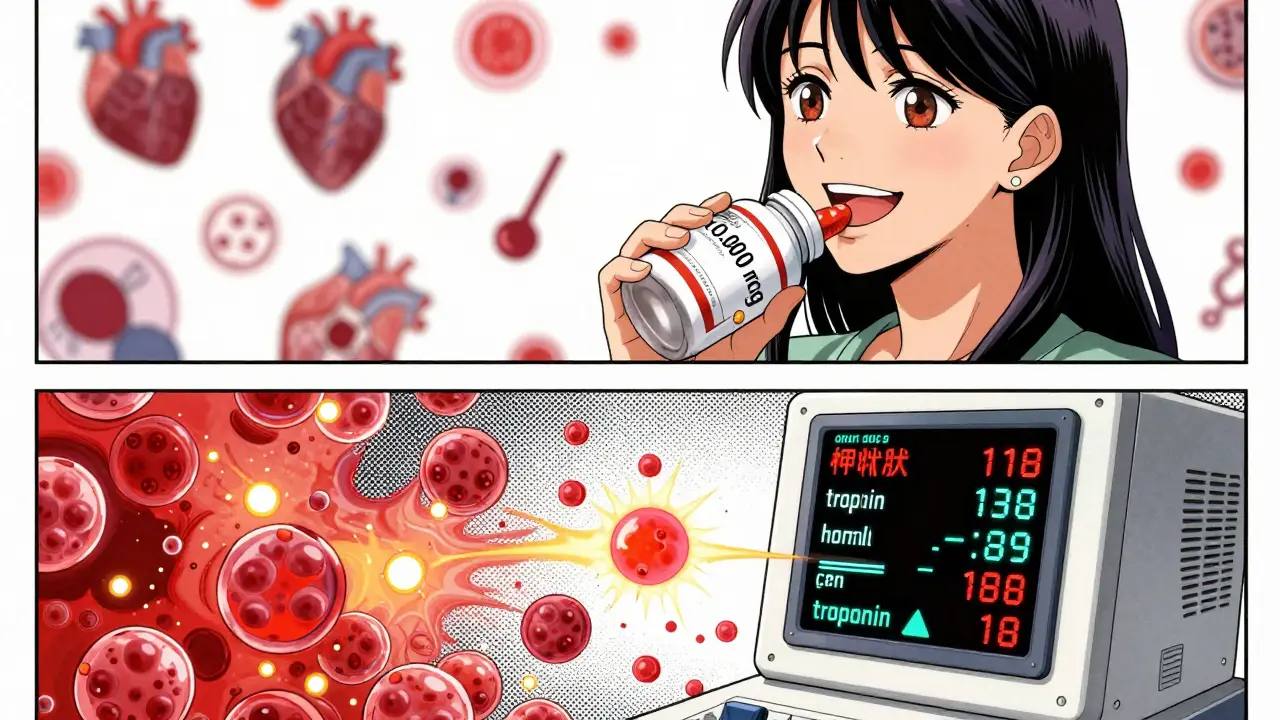
Imagine going to the hospital with chest pain. Your doctor orders a troponin test to check for a heart attack. The result comes back normal. You’re sent home. Two days later, you’re back - this time, you don’t leave. The truth? Your biotin supplement made the test lie. You had a heart attack, but the numbers didn’t show it.
This isn’t a horror story. It’s happened. And it’s more common than you think.
Biotin - also called vitamin B7 - is everywhere. You’ll find it in hair, skin, and nail supplements. It’s in prenatal vitamins. It’s in multivitamins labeled "for energy" or "for glow." Most people think it’s harmless. Some even take 10,000 micrograms a day, thinking more is better. But here’s the catch: high-dose biotin doesn’t just help your hair. It can wreck your lab results - and that can kill you.
How Biotin Messes With Lab Tests
Most blood tests you get at the hospital use a technology called biotin-streptavidin binding. It’s like a molecular glue. Biotin sticks tightly to streptavidin, and labs use that bond to grab hold of tiny amounts of hormones, proteins, or enzymes in your blood. It’s super sensitive. That’s why it’s used in 70% of all automated lab tests.
But if you’ve taken a high-dose biotin supplement, your blood is flooded with extra biotin. When the lab runs your test, all that extra biotin in your sample competes with the biotin the test is supposed to use. It’s like trying to find one specific key in a drawer full of identical keys. The machine gets confused. And the result? It’s wrong.
Some tests show falsely low results. Others show falsely high ones. And there’s no warning on the report. No flag. No note. Just numbers that look perfectly normal - even when they’re dangerously off.
Tests Most Affected by Biotin
Not all tests are equally vulnerable. But some are especially risky:
- Troponin I and T - the gold standard for detecting heart attacks. Biotin can make these numbers drop to normal levels, even when your heart is damaged. This is the most dangerous interference. There are documented cases of people dying because their heart attack was missed.
- Thyroid tests - TSH, free T4, free T3. High-dose biotin can make TSH look artificially low, tricking doctors into thinking you have hyperthyroidism. Some patients have been misdiagnosed with Graves’ disease, had radioactive iodine treatment, or even had their thyroid removed - all because of a supplement.
- Parathyroid hormone (PTH) - used to check calcium levels. False readings can lead to unnecessary surgery or incorrect treatment for bone disorders.
- Cortisol - a stress hormone. Wrong results can lead to misdiagnosis of adrenal disorders.
- FSH and LH - fertility hormones. False values can send people down the wrong path for infertility treatment.
- Vitamin D - some tests show falsely high levels, making it look like you’re getting enough when you’re not.
The FDA says these aren’t rare glitches. They’re predictable. About 80% of the high-volume lab tests used in U.S. hospitals rely on this biotin-based tech. That means millions of results every year could be skewed.
How Much Biotin Is Too Much?
Your body only needs about 30 micrograms (mcg) of biotin a day. That’s what the National Academies recommend. Most multivitamins have 30-300 mcg - fine. No problem.
But here’s where things go off the rails:
- Many hair, skin, and nail supplements contain 5,000 to 10,000 mcg - that’s 167 to 333 times the daily requirement.
- Some people take 300 milligrams (300,000 mcg) a day for multiple sclerosis - that’s 10,000 times more than you need.
- Studies show interference can happen at doses as low as 5 mg (5,000 mcg) per day.
And here’s the kicker: most supplement labels don’t warn you. A 2022 study looked at 200 top-selling biotin products. Only 37% mentioned that biotin can interfere with lab tests. Most people have no idea.
Who’s at Risk?
It’s not just people on extreme doses. You don’t have to be taking 300 mg to be at risk.
- Women taking hair, skin, and nail supplements - especially those aged 20-39. About 15% of this group uses biotin supplements.
- Pregnant women on prenatal vitamins with high biotin content.
- People with multiple sclerosis on MD1003 (a high-dose biotin therapy).
- Anyone who’s been told to "take biotin for better nails" - even if they’ve only been taking it for a few weeks.
The biggest danger? You feel fine. You’re not sick. You’re just trying to look better. But your blood is lying to your doctor.
How Long Does Biotin Stay in Your System?
Biotin doesn’t stick around forever. But it doesn’t vanish overnight either.
Its half-life - how long it takes for half the dose to clear - is 8 to 24 hours. That means:
- After 24 hours, about half the biotin is gone.
- After 48 hours, most of it’s out - but not always enough.
- For accurate thyroid or troponin tests, labs recommend stopping biotin for 3 to 7 days.
Quest Diagnostics says wait 8 hours. Labcorp says 48-72 hours. Vanderbilt Medical Center says 3 days for most tests, 7 days for thyroid. Why the difference? Because different labs use different machines - and some are more sensitive than others.
Bottom line: if you’re taking more than 5 mg a day, and you’re getting blood work done soon, stop the supplement - and tell your doctor.

What Doctors and Labs Are Doing
Doctors are waking up. But too slowly.
A 2020 study found that 43% of physicians had never heard biotin could mess with lab tests. That’s not just ignorance - it’s a safety gap.
Labs are responding. Since 2020, 89% of U.S. clinical labs have added biotin interference protocols. Some now screen samples for high biotin levels. Others have switched to newer machines that block biotin interference - like Siemens’ Biotin-Blocking Technology, which cuts interference by 90%.
The FDA now requires test manufacturers to warn about biotin interference on their packaging. Health Canada and the European Medicines Agency now require supplement labels to say: "May interfere with laboratory tests" if they contain more than 100 mcg of biotin.
But here’s the problem: those warnings aren’t on the supplement bottles most people buy. They’re on the lab test kits - not the pill you take at breakfast.
What You Should Do
If you take biotin - even if you think it’s just for your hair - here’s what to do:
- Check your supplement label. Look for the amount of biotin. If it’s over 5,000 mcg (5 mg), you’re at risk.
- Stop taking it. If you’re scheduled for blood work, stop biotin at least 3 days before. For thyroid or cardiac tests, wait 7 days.
- Tell your doctor. Say it clearly: "I take biotin supplements. I stopped them X days ago." Don’t assume they know. Most don’t.
- Ask if your test is affected. If you’re getting thyroid, troponin, cortisol, or hormone tests, ask: "Could biotin interfere with this?" If they say no, ask them to double-check.
- Don’t restart until after your results. Even if you feel fine, wait until after your lab work is done and your doctor has reviewed the results.
If you’ve had weird lab results - like a suddenly low TSH with no symptoms, or a normal troponin despite chest pain - ask: "Could this be biotin?" It’s a simple question that could save your life.
Why This Keeps Happening
The biotin supplement market is booming. It hit $358 million in 2022 and is expected to grow over 7% a year through 2030. Most of that growth comes from beauty and wellness products - not medical use.
Companies market biotin as a safe, natural way to get glowing skin and strong nails. They don’t mention the risks because they don’t have to. The FDA doesn’t regulate supplements like drugs. Labels don’t need to prove safety - only that they don’t claim to treat disease.
Meanwhile, the lab industry is stuck with old tech. Biotin-streptavidin tests are cheap, accurate, and fast. Replacing them across thousands of labs takes years and millions of dollars.
Until then, the burden falls on you - the patient.
You’re the one who has to know your supplement dose. You’re the one who has to remember to stop it. You’re the one who has to speak up.
Because no one else will.

11 Comments
Shae ChapmanDecember 29, 2025 AT 18:24
OMG I just realized I’ve been taking 10k mcg of biotin for my nails 😱 I thought it was just a "glow boost"... I’m scheduled for a thyroid test next week. I’m canceling it and quitting cold turkey. My hair might fall out but my life? Worth it. 🙏
henry mateoDecember 30, 2025 AT 14:38
wait so biotin messes with troponin? i had a normal result last month after chest pain and they said i was fine... now im scared. i took a biotin pill like 3 days before. should i go back? i dont wanna be that guy who overreacts but also... what if?
Aayush KhandelwalDecember 31, 2025 AT 01:49
Let’s not reduce this to a mere nutrient interference narrative. The biotin-streptavidin axis is a microcosm of our broader diagnostic industrial complex-where cost-efficiency trumps patient safety, and regulatory inertia is weaponized by supplement conglomerates. We’re not just talking about false positives; we’re talking about epistemic violence in clinical chemistry. The real villain isn’t biotin-it’s the commodification of health without accountability. 🧬
Sandeep MishraDecember 31, 2025 AT 19:12
Hey, I get it-people just want to look good. I used to take biotin too. But here’s the thing: your body doesn’t need a truckload of it. Think of it like pouring gasoline on a candle. You’re not making it brighter-you’re just risking a fire. If your doctor doesn’t know this, ask them to Google "biotin interference lab tests." It’s not complicated. And if they blow you off? Find a new one. Your life > your glow-up.
Joseph CorryDecember 31, 2025 AT 20:38
How is this even a story? People take 10,000x the RDA of everything now-vitamin C, magnesium, zinc. This isn’t a systemic failure; it’s the inevitable consequence of wellness culture’s descent into pseudoscientific narcissism. The real tragedy? People think they’re optimizing their health when they’re just performing it for Instagram. The lab isn’t lying. You are.
Colin LJanuary 1, 2026 AT 08:08
Okay, so I read this whole thing and I’m just sitting here wondering-how many people have died because they took biotin and their doctor didn’t know? Like, really? Because I had a cousin who had chest pain, went to the ER, got a normal troponin, got sent home, and died two days later. And she was taking that "hair, skin, nails" gummy every morning. And now I’m just… I don’t know. I feel sick. I’m going to call my doctor right now and ask if my last bloodwork was compromised. I need to know. I need to know. I need to know.
Hayley AshJanuary 2, 2026 AT 21:18
Wow what a shocker. Biotin messes with tests. Who knew? Next you'll tell us water can cause false positives in drug screens. Maybe we should ban all supplements since apparently we're all too dumb to read labels. Oh wait-we don't have to. Because the FDA doesn't regulate them. And that's fine. Because if you're dumb enough to take 10k mcg of biotin you probably also think "natural" means "safe" and "organic" means "magic"
kelly tracyJanuary 3, 2026 AT 09:45
They don’t warn you because they don’t care. Companies make billions selling this junk. Doctors are too lazy to ask. Labs are too cheap to upgrade. And you? You’re just the dumbass who swallowed the lie because you wanted perfect nails. Congrats. You’re now part of the problem. Stop taking it. Now. And stop acting like you’re some wellness warrior. You’re just a walking lab error.
srishti JainJanuary 4, 2026 AT 06:41
my doctor never asked if i took biotin. i told him after my tsh looked weird. he said "oh yeah that happens." like it's no big deal. how is that not malpractice?
Cheyenne SimsJanuary 4, 2026 AT 18:22
As an American citizen with a responsibility to uphold scientific integrity, I must emphasize that the absence of federal regulation on dietary supplements is a national disgrace. The FDA’s passive stance on biotin labeling constitutes a dereliction of duty. We must demand mandatory disclosure on all consumer-facing packaging, regardless of marketing claims. This is not a wellness issue-it is a public health emergency.
Nadia SpiraJanuary 5, 2026 AT 11:40
Let’s be real-biotin isn’t the villain. It’s the symptom. We live in a society that treats health like a cosmetic upgrade, not a biological covenant. We’re all just trying to outrun entropy with gummies and glow serums, while ignoring the systems that keep us sick. The lab didn’t lie. We did. We lied to ourselves every time we clicked "add to cart" thinking we were healing. We weren’t. We were just buying placebo with a vitamin label. And now the bill’s coming due.