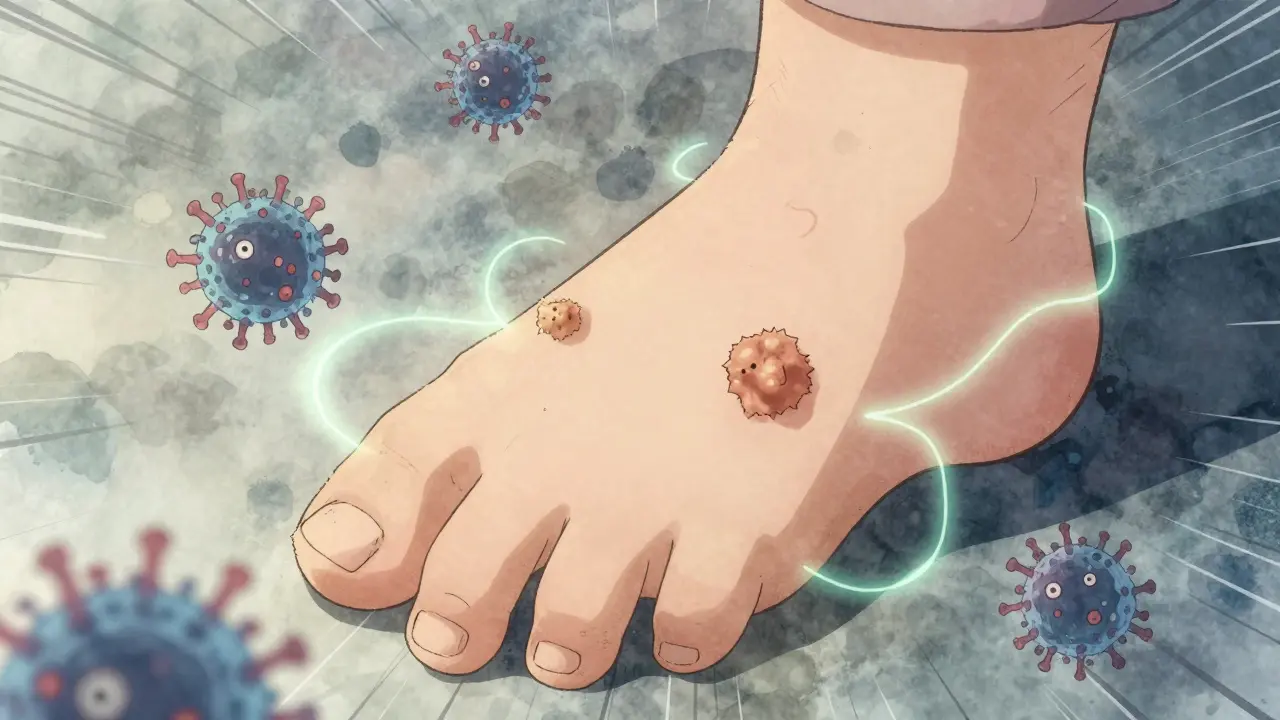
Most people think of warts as harmless bumps on the skin - maybe a rough patch on a child’s hand or a stubborn spot on the sole of the foot. But behind that simple appearance is a real viral infection: HPV. Human papillomavirus doesn’t just cause genital warts or cervical cancer. It’s also the reason millions of people wake up every morning with a wart they didn’t have yesterday.
Over 100 types of HPV exist, and each one has its favorite spot on the body. Types 1, 2, and 4 like to settle on fingers and knuckles, giving us those classic common warts. Type 3 and 10 prefer the face and forehead, creating flat, barely raised bumps called flat warts. And if you’ve ever had a painful, deep wart under your foot that makes walking feel like stepping on a pebble? That’s a plantar wart, usually caused by types 1, 2, 4, 60, or 63.
Here’s the thing most people don’t realize: up to 24% of children and 5% of adults carry non-genital warts. In Australia, that’s hundreds of thousands of people. The numbers are similar across Europe and North America. And while about 60-70% of warts go away on their own within two years, most people don’t wait. They want them gone - fast. Because they hurt. They itch. Or worse, they’re embarrassing.
What Causes Warts to Spread?
HPV doesn’t jump from person to person like a cold. It needs a break in the skin. A tiny cut from shaving, a hangnail, even a blister from ill-fitting shoes - that’s all it takes. Once the virus gets in, it hides in the top layers of skin, multiplying slowly. You might not see anything for weeks. Then - boom - a wart appears.
And once it’s there, it can spread. Scratching or picking at a wart can transfer the virus to other parts of your body. That’s why some people wake up with five new warts on their hand after only having one on their finger. It’s also why sharing towels, razors, or even flip-flops in public showers can lead to outbreaks.
Hygiene isn’t just about cleanliness - it’s about stopping the chain. Dry your feet thoroughly after swimming. Don’t bite your nails if you have warts around them. Cover warts with a waterproof bandage when swimming or using shared facilities. These aren’t just suggestions. They’re critical steps to prevent it from getting worse.
Topical Treatments: The First Line of Defense
If you’ve ever walked into a pharmacy and seen a shelf full of wart removers, you’ve seen the most common first approach: salicylic acid. It’s in patches, gels, and liquids. Over-the-counter versions range from 17% to 40% concentration. The science behind it is simple: it softens the dead skin around the wart, letting you file it away slowly. Each day, you soak the area, gently scrape off the dead layers with a pumice stone or emery board, then apply the acid.
Studies show it works - but only if you stick with it. One 1976 study of over 1,800 patients found an 84% success rate for plantar warts when used consistently. But that’s over 6 to 12 weeks. No quick fixes. No magic. Just patience and daily effort.
Another option is trichloroacetic acid (TCA), used mostly in clinics. Dermatologists apply it directly after filing down the wart. Sometimes they even prick the wart with a needle to let the acid sink deeper. It burns the infected tissue, causing the wart to die and fall off. Side effects? Pain, burning, and sometimes dark spots on the skin. But for stubborn warts on palms or soles, it’s often more effective than home treatments.
Cryotherapy: Freezing the Problem Away
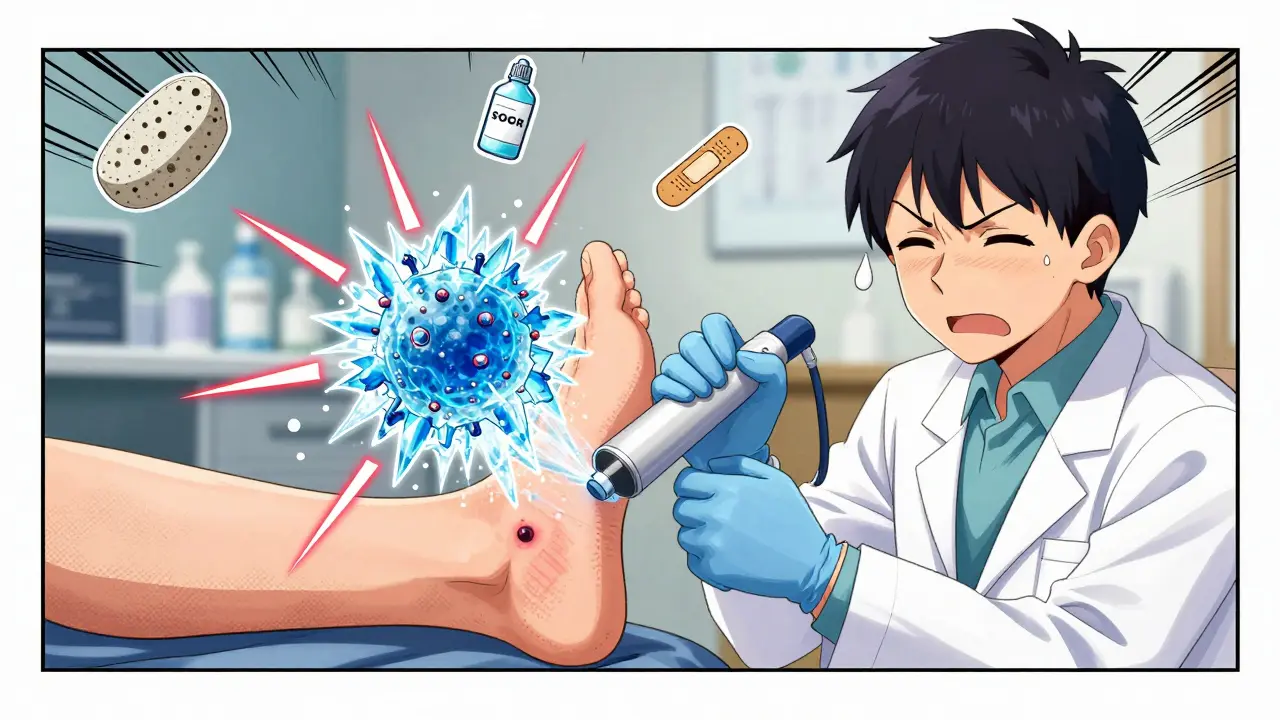
Most clinics offer cryotherapy - freezing warts with liquid nitrogen. It’s fast, it’s common, and it’s one of the few treatments backed by solid research. A 2023 review of seven studies involving nearly 1,000 patients found cryotherapy and salicylic acid had nearly identical success rates after 12 weeks. Neither was clearly better.
But here’s the catch: timing matters. The 1976 Bunney study showed something surprising. When treatments were spaced four weeks apart, cure rates for hand warts dropped from 75% to 40%. The sweet spot? Every 2 to 3 weeks. Most people need 3 to 6 sessions. Each freeze lasts 10 to 20 seconds - long enough to freeze tissue 2-3mm below the surface. That’s important. If you don’t go deep enough, the virus survives.
After treatment, the area turns white, then blisters. A scab forms. It falls off in a week or two. You might feel a pinch during the freeze, but it’s over fast. Many patients tolerate it better than daily acid applications. But it’s not perfect. It can leave scars. It hurts more on sensitive skin. And if you’re treating warts on the face or genitals, your doctor will be extra careful.
When Home Treatments Fail: Stronger Options
Some warts just won’t quit. They come back. They multiply. They get bigger. That’s when doctors turn to stronger tools.
Imiquimod cream is one of them. It’s not a direct killer. Instead, it tricks your immune system into attacking the wart. You apply it three times a week for weeks or months. It causes redness and swelling - which is actually a good sign. It means your body is fighting back. Studies show it works when salicylic acid and freezing didn’t. It’s especially useful for flat warts and warts that keep returning.
Then there’s electrosurgery. A small needle burns the wart off. It’s done under local numbing. It’s quick. One or two sessions usually do it. But it leaves a scar. So it’s not used on the face or visible areas unless absolutely necessary.
Laser treatment, like the VBeam pulse dye laser, targets the blood vessels feeding the wart. The wart turns dark purple or black after treatment, then flakes off. It’s precise. It’s expensive. And it’s usually reserved for warts that have survived every other treatment.
One thing you’ll hear from dermatologists: avoid surgical removal. Cutting out a wart sounds logical, but it often leads to more warts growing back around the scar. The virus is still there. Removing the surface doesn’t remove the root.
Why So Many Treatments - And So Little Proof?
Here’s the uncomfortable truth: most wart treatments aren’t backed by strong science. A 2022 review from the Royal Australian College of General Practitioners looked at 15 different treatments - silver nitrate, cantharidin, phenol, zinc, even citric acid. Only salicylic acid and cryotherapy had solid, head-to-head comparisons. The rest? Mostly guesswork.
That’s why two doctors might treat the same wart in totally different ways. One swears by freezing. Another prefers acid. A third tries imiquimod first. There’s no official protocol. No one-size-fits-all. The best treatment depends on where the wart is, how long it’s been there, how much it hurts, and what you can tolerate.
And here’s something else: combination therapy works better than any single method. The same 1976 study found that using liquid nitrogen and salicylic acid together led to a 78% cure rate - higher than either alone. No one’s pushing this combo in pharmacies, but some dermatologists do it. They freeze the wart, then send you home with acid to keep treating it.
What Works Best? A Simple Guide
Let’s cut through the noise. Here’s what actually helps, based on real data:
- For small, new warts on hands or feet: Start with 17-40% salicylic acid. Apply daily. File gently. Be patient. Give it 12 weeks.
- If it’s not improving after 6 weeks: Visit a dermatologist. Cryotherapy is your next step. Usually 3-6 sessions, spaced 2-3 weeks apart.
- For flat warts on the face or neck: Imiquimod cream. It’s slow, but it’s less likely to scar. Use it as directed - don’t rush it.
- For stubborn, recurring warts: Combination therapy (freeze + acid) or laser. Ask your dermatologist.
- Avoid: Cutting, burning, or peeling off warts yourself. You’ll only make it worse.
And remember: warts are contagious. Even while you’re treating them, you can still spread them. Wash your hands after touching them. Don’t share towels or shoes. Cover them when possible. Your immune system might clear it eventually - but why wait?
What’s Next?
Researchers are looking at smarter ways to fight HPV. New immunotherapy drugs. Better acid blends. Even vaccines that target non-genital wart strains. But for now, the tools we have are simple - and they work if used right.
Warts aren’t dangerous. But they’re annoying. And they don’t have to be permanent. The key isn’t finding the ‘best’ treatment. It’s finding the one you’ll stick with. Consistency beats intensity every time.
Do warts go away on their own?
Yes, about 60-70% of viral warts disappear within two years without any treatment. This happens when your immune system recognizes and clears the HPV infection. But many people choose to treat them sooner because they hurt, spread, or cause embarrassment. Waiting isn’t wrong - but it’s not always practical.
Can I treat warts at home safely?
Absolutely - salicylic acid is the most common and safest home option. Use it daily after soaking and filing the wart. Don’t use it on your face, genitals, or near the eyes. Stop if you get severe pain, blistering, or signs of infection. Avoid using sharp tools to cut or scrape warts - that increases the risk of spreading the virus or scarring.
Is cryotherapy painful?
It feels like a quick, sharp sting - like a rubber band snapping against your skin. The cold numbs the area fast, and the whole process lasts less than 30 seconds. Most people tolerate it well. Children and people with low pain tolerance may feel more discomfort, but it’s usually brief. Afterward, the area may blister or turn dark, but that’s normal.
Why do warts come back after treatment?
Warts return because the virus isn’t fully eradicated. Even if the visible part is gone, tiny infected cells may remain under the skin. That’s why treatments need to be repeated and why consistency matters. Also, if you don’t practice good hygiene - like touching the wart then scratching elsewhere - you can re-infect yourself. Reinfection from others is less common but still possible in shared spaces like gyms or pools.
Are there any new treatments on the horizon?
Yes. Researchers are testing new topical immunomodulators that trigger a stronger immune response than imiquimod. Some are looking at targeted antiviral creams that block HPV replication. Others are studying combination devices - like laser plus acid - to reduce treatment time. A vaccine for non-genital wart strains is also in early trials. But none are widely available yet. For now, proven methods like salicylic acid and cryotherapy remain the standard.
Warts are more than a skin issue - they’re a viral invasion that most people underestimate. But with the right approach, they’re not a life sentence. You don’t need to suffer for months. You don’t need expensive treatments. You just need to know what works - and stick with it.

14 Comments
Steven PamFebruary 23, 2026 AT 20:37
I had a plantar wart that lasted over a year. Tried everything - salicylic acid, duct tape, even tea tree oil. Nothing worked until I went to a dermatologist and got cryotherapy. Three sessions, spaced out, and poof - gone. No scar, no pain after the first week. Honestly, if you’ve had it longer than 6 months, just suck it up and get it frozen. Your future self will thank you.Timothy HaroutunianFebruary 24, 2026 AT 08:50
This whole post reads like a pharmaceutical brochure. Let’s be real - most of these treatments are barely better than placebo. Salicylic acid? You’re just sanding off skin while the virus laughs in the basal layer. Cryotherapy? Same thing. The real issue is that our immune systems are shot from processed food and screen time. No one talks about the root cause - gut health. Fix that, and your body handles HPV like it’s a bad roommate. But sure, keep buying creams from CVS.Erin PinheiroFebruary 26, 2026 AT 01:42
i just dont get why people dont just use apple cider vinegar?? its like 3 bucks and works way better than all this fancy nonsense. i had a wart on my finger for 8 months, soaked it in acv every night, covered it with a bandaid, and poof - gone in 3 weeks. no doctor, no pain, no $$$ spent. why is everyone so obsessed with spending money on this??Michael FItzpatrickFebruary 26, 2026 AT 04:54
Let’s reframe this: warts aren’t a nuisance - they’re a message. Your body’s saying, ‘Hey, you’ve been ignoring your immune system.’ The fact that 60-70% disappear on their own? That’s not luck - that’s your T-cells doing their damn job. So don’t just treat the wart. Treat yourself. Sleep more. Reduce stress. Eat real food. Maybe skip the 3 a.m. TikTok scroll. Your skin will thank you. And if you still need to zap it? Combine acid and cryo. It’s not magic - it’s synergy.Brandice ValentinoFebruary 27, 2026 AT 02:04
Honestly, I find it hilarious that people treat warts like they’re some sort of medical emergency. It’s a virus. It’s not cancer. I let mine sit for 18 months. They vanished. No one in my family even noticed. Meanwhile, you’ve got people spending hundreds on ‘specialized’ treatments. It’s like buying a $200 facial cleanser because you have a pimple. The real tragedy? The time wasted on fear instead of indifference.Larry ZerpaFebruary 28, 2026 AT 00:39
Let’s address the elephant in the room: the 84% success rate for salicylic acid? That study was from 1976. No double-blind trials. No modern controls. And cryotherapy? The 2023 review you cited? It included studies where patients weren’t even followed up properly. This whole post is a polished pile of anecdotes dressed up as science. Real evidence? We have zero standardized protocols. Why? Because HPV is too messy to monetize. So we get feel-good guides with bullet points instead of data.tia novialiswatiMarch 1, 2026 AT 20:47
I’m so glad you wrote this! 🙌 I had flat warts on my forehead for years and was so self-conscious. Tried imiquimod - it burned like heck for weeks, but honestly? Worth it. My skin cleared up and I didn’t even need makeup anymore. You’re right - patience is everything. Don’t give up. You’ve got this. 💪Lillian KnezekMarch 3, 2026 AT 08:32
You know what they don’t tell you? The government and Big Pharma are suppressing real cures. I read a study from 2018 where a natural compound from a Brazilian plant wiped out HPV in 72 hours. But it was buried. Why? Because you can’t patent a plant. They’d rather sell you $50 jars of acid and freeze your skin. The real solution? Stop trusting doctors. Start researching. You’re being lied to.Maranda NajarMarch 4, 2026 AT 12:28
I am absolutely horrified by the casual dismissal of HPV as a mere 'cosmetic nuisance.' This is not a trivial skin condition - it is a systemic immunological affront. Each wart is a silent declaration of your body’s vulnerability. To treat it with topical acids is to perform a superficial gesture against a deeply entrenched biological betrayal. One must ask: what else is your immune system surrendering? Are you sleeping? Are you hydrated? Are you breathing clean air? Or are you, like so many, numbing your existence with screen time and sugar? The wart is merely the tip of the iceberg - a crimson flag of systemic neglect.Christopher BrownMarch 6, 2026 AT 00:49
Americans overcomplicate everything. In my village in Pakistan, we rub garlic on it for a week. Done. No clinics. No creams. Just garlic and common sense.Sanjaykumar RabariMarch 7, 2026 AT 00:50
I think HPV is linked to 5G. I read it on a forum. People get warts after they use phones too much. The radiation weakens skin. I stopped using my phone for a month and my wart disappeared. Coincidence? I think not.Kenzie GoodeMarch 8, 2026 AT 04:29
I’ve been through all of this. I started with acid, then cryo, then imiquimod. I almost gave up. But what helped me most was not the treatment - it was changing how I thought about it. I stopped seeing warts as ugly. I started seeing them as temporary. That mental shift made me stick with the process. And yeah - they’re gone now. It took patience. But I’m proud I didn’t give up.Dominic PunchMarch 9, 2026 AT 06:33
I’ve been a GP for 22 years. Let me cut through the noise: salicylic acid and cryotherapy are the only two things with reproducible data. Everything else? Anecdotes wrapped in marketing. I’ve seen patients waste thousands on lasers and herbal tinctures while ignoring the proven path. If you’re reading this and you’ve got a wart - start with the acid. File daily. Be consistent. Don’t chase the shiny new thing. Medicine isn’t about trends - it’s about what works. And this does.Khaya StreetMarch 11, 2026 AT 04:05
I’ve treated over 300 patients with warts. The biggest mistake? People try one method for two weeks and quit. You wouldn’t stop brushing your teeth after three days. Same logic. The real problem isn’t the virus - it’s our impatience. Consistency > intensity. Always.