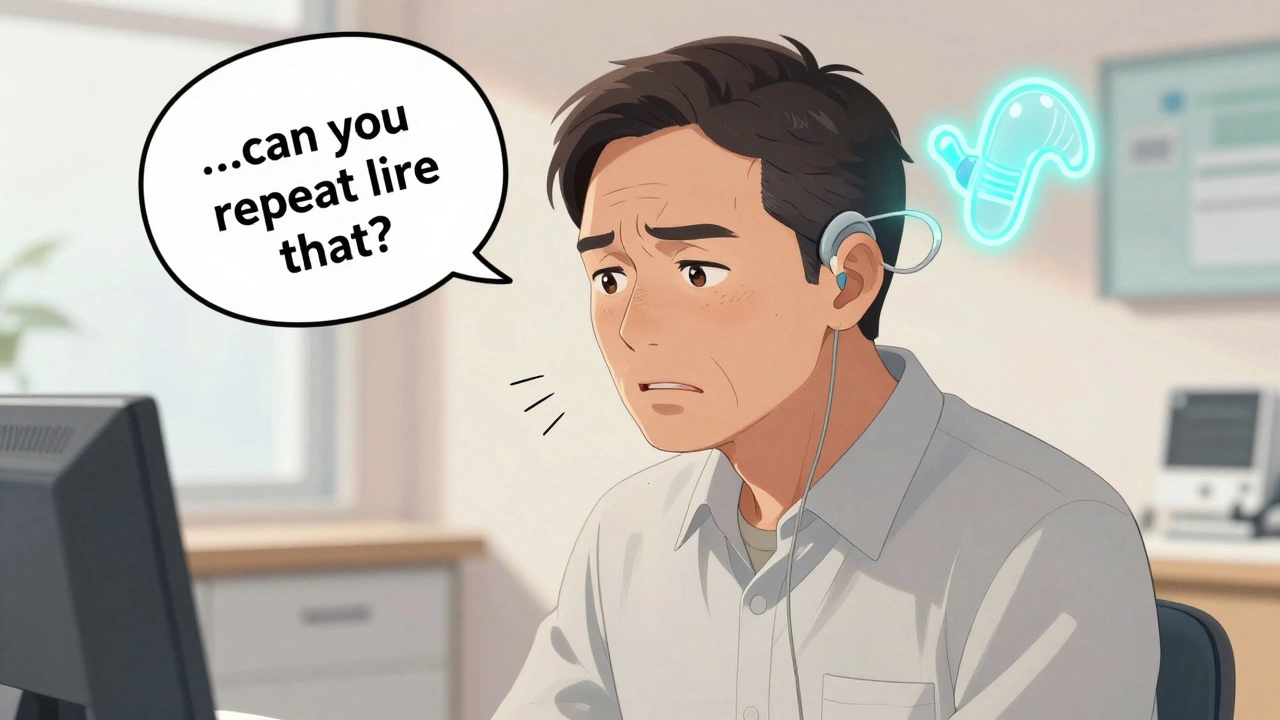
Most people think cochlear implants are only for those who are completely deaf. That’s not true anymore. If you’re still struggling to understand conversations-even with hearing aids-you might be a candidate. The rules changed in 2023, and now the focus isn’t on how much you can hear, but on how much you can understand.
What Changed in Cochlear Implant Guidelines?
Back in the 1990s, cochlear implants were seen as a last resort. You had to be nearly totally deaf, with no benefit from hearing aids at all. Today, that’s outdated. The American Cochlear Implant Alliance (ACIA) released new guidelines in November 2023 that completely rewrote the playbook. Now, if you understand fewer than 50% of words in quiet while wearing properly fitted hearing aids, you should be referred for evaluation. That’s it. No need to wait until you can’t hear a thing. This shift came because researchers realized that waiting too long harms your brain’s ability to process sound. The auditory nerve doesn’t just go quiet-it starts to degenerate. The longer you go without clear sound input, the harder it becomes for the implant to work well later. That’s why experts now say: don’t wait until you’re desperate. If hearing aids are no longer giving you clear speech, it’s time to talk to a specialist.How Do You Know If You’re a Candidate?
The evaluation isn’t just about turning up the volume. It’s about testing how well your brain understands speech when it’s amplified. Here’s what the process looks like:- Audiometric testing: You’ll get a full hearing test, both with and without hearing aids. Your pure-tone average (PTA) at 500, 1000, and 2000 Hz is measured, but now it’s not the main factor.
- Sentence recognition tests: The gold standard is the AzBio sentence test. You’ll listen to sentences in quiet and then in noise. If you score below 50%, you’re in the candidate range.
- Hearing aid verification: Many people are turned away because their hearing aids aren’t properly fitted. Real-ear measurements ensure your aids are delivering sound correctly-otherwise, the test results are meaningless.
- Imaging: A CT or MRI scan checks the structure of your inner ear. Are the cochleae intact? Is there bone growth or scarring? This helps surgeons plan the procedure.
- Functional assessment: Tools like the SSQ (Speech, Spatial and Qualities of Hearing Scale) ask you how well you hear in real life: at restaurants, in cars, with multiple people talking. Some people score well in quiet rooms but can’t follow a family dinner. That’s a red flag.
What About Age? Am I Too Old?
Age doesn’t disqualify you. The old myth that older adults don’t benefit from cochlear implants is false. A major clinical trial called ERID (NCT02075229) followed adults over 65 with aided sentence scores between 40% and 60%. These patients didn’t meet traditional Medicare criteria-but after implantation, 78% of them improved to over 50% word recognition. Many reported being able to talk on the phone again, something they hadn’t done in years. Even people who’ve had severe hearing loss for 15 or 20 years can still do well. One study in Ear and Hearing found that outcomes were just as strong for those implanted after a decade of deafness, as long as they had good cognitive function and committed to rehabilitation. The key isn’t how long you’ve been deaf-it’s how much your brain still remembers how to process sound.
What Are the Real Outcomes?
The numbers speak for themselves. A 2022 study of 1,247 cochlear implant recipients showed an average improvement of 47.3 percentage points in sentence recognition. That means someone who understood 30% of sentences before surgery might understand 77% after. Eighty-nine percent of patients reported substantial improvement in daily communication. The biggest wins? Talking on the phone. Ninety-two percent of users in one survey said they could now use the phone with family or friends. Listening fatigue dropped by 87%. No more sitting in the corner at parties, pretending you heard everything. No more asking people to repeat themselves five times before giving up. But it’s not perfect. Sixty-three percent of users still find music hard to enjoy. Some say voices sound robotic or artificial at first. That’s normal. The brain needs time to adapt. Most people adjust within 6 to 12 months with consistent listening practice and therapy.Why Are So Few People Getting Implants?
Despite 38 million American adults having disabling hearing loss, only about 128,000 cochlear implants were done in 2022. That’s less than 1% of those who could benefit. Why? First, most primary care doctors don’t know the updated criteria. A 2021 JAMA Otolaryngology survey found only 32% of GPs could correctly identify who qualifies. They still think, “Wait until they’re completely deaf.” Second, there’s no standard referral path. Audiologists and ENTs are trained, but your family doctor isn’t. You have to know to ask. Third, there’s a stigma. Some people feel implants are “too extreme.” But think about it: if you had vision loss, you wouldn’t wait until you were blind to get glasses. Hearing loss is the same. It’s a sensory issue, not a moral one. And financially, it pays off. Untreated hearing loss costs the U.S. economy $56 billion a year in lost productivity and increased healthcare use. Cochlear implants have a 3:1 return on investment-better jobs, fewer falls, lower dementia risk.What Happens After the Surgery?
Surgery takes 2-4 hours and is usually outpatient. Recovery is quick-most people are back to normal in a week. But the real work starts after the device is turned on, usually 3-6 weeks later. You’ll need regular mapping sessions with your audiologist. The device isn’t like glasses-you don’t just flip a switch and hear perfectly. The processor needs fine-tuning over time. You’ll also need auditory training. That means listening exercises: identifying sounds, recognizing speech in noise, practicing phone calls. Some clinics offer group rehab sessions. Others use apps with built-in training modules. The goal is to retrain your brain to interpret electrical signals as meaningful sound. It’s not magic-it’s practice.
Who Shouldn’t Get an Implant?
Not everyone is a candidate. If your hearing loss is caused by problems in the auditory nerve or brain (like auditory neuropathy or severe cognitive decline), the implant won’t help. If you have active middle ear infections or severe medical conditions that make surgery risky, you’ll need to delay. But here’s the thing: even if you’re not a candidate, the evaluation is still valuable. You’ll get a full hearing baseline. You’ll know exactly where you stand. And if your hearing gets worse later, you’ll have a head start.What’s Next for Cochlear Implants?
The FDA is currently reviewing new labeling that would officially expand eligibility to include people with aided word recognition scores as high as 50%. That change is expected in 2025. Research is also moving toward objective tests. Instead of relying only on speech tests, doctors are using brainwave measurements (cortical auditory evoked potentials) to predict who will benefit. Early results show 89% accuracy-meaning we might soon be able to say, “Your brain is ready for this,” even before you try a hearing aid. By 2030, experts predict cochlear implants will be standard care for anyone with bilateral hearing loss over 55 dB and speech recognition under 60%-even if they still have some natural hearing. That could open the door for millions more people.What Should You Do Now?
If you or someone you know uses hearing aids but still misses words, avoids social situations, or feels exhausted after conversations, don’t wait. Ask for a cochlear implant evaluation. You don’t need a referral from your doctor-many clinics accept self-referrals. The evaluation is free in most cases, especially if you have Medicare or private insurance. And even if you’re not a candidate, you’ll walk away with a clearer picture of your hearing health. You don’t have to live with hearing loss that’s stealing your connections. The technology is here. The guidelines are updated. The time to act is now-not when it’s too late.Can you still use hearing aids after getting a cochlear implant?
Yes. Many people use a hearing aid in the non-implanted ear, especially if it still has some useful hearing. This is called bimodal hearing. Some implants also support hybrid technology, which preserves low-frequency natural hearing while using electrical stimulation for high frequencies. Your audiologist will help you find the best combination.
How long does it take to get used to a cochlear implant?
Most people notice improvement within the first few weeks, but full adaptation takes 6 to 12 months. The brain needs time to learn how to interpret the new electrical signals. Consistent listening practice, speech therapy, and using the device daily are key. Don’t expect instant perfection-it’s a process, not a switch.
Are cochlear implants covered by insurance?
Yes. Medicare, Medicaid, and most private insurers cover cochlear implants when criteria are met. Coverage includes surgery, the device, and follow-up care. The 2023 guidelines are now widely accepted by payers, so if you meet the 50% word recognition threshold, approval is highly likely.
Can children get cochlear implants?
Absolutely. Children as young as 9 months old can receive implants. Early implantation (before age 2) leads to near-normal speech and language development. The FDA approved implants for children in 1990, and today they’re standard care for severe-to-profound hearing loss in kids.
Do cochlear implants restore normal hearing?
No. They don’t restore natural hearing. Instead, they provide a representation of sound that the brain learns to interpret. Most users understand speech well, especially in quiet, and can use the phone. Music and complex sounds may still sound different, but many users report significant improvements over time with training.
What if I’m not a candidate-should I still get evaluated?
Yes. Even if you’re not a candidate now, the evaluation gives you a detailed hearing baseline. You’ll know your current abilities, what’s working, and what’s not. If your hearing worsens in the future, you’ll have a record to compare against. And you’ll have a clear plan for next steps. There’s no downside to getting checked.

15 Comments
vinoth kumarDecember 2, 2025 AT 00:16
Finally, someone broke down the real criteria without jargon. I’ve been telling my dad for years his hearing aids aren’t doing their job-he’s missing half the conversation at family dinners. We’re scheduling his eval next week.
bobby chandraDecember 2, 2025 AT 07:56
This is the most comprehensive, beautifully structured explainer on cochlear implants I’ve ever read. The shift from pure-tone thresholds to speech-in-noise recognition? Genius. The brain doesn’t need volume-it needs clarity. And the ERID trial data? Absolute gold. If your doctor still thinks ‘wait until you’re deaf,’ they’re practicing medicine from 1998.
shalini vaishnavDecember 3, 2025 AT 16:28
Why are Americans so slow to adopt proven technology? In India, we’ve had cochlear implants for children since 2005. The government even subsidizes them. Here, people wait until they’re isolated, depressed, and losing their jobs-all because of outdated myths and lazy doctors. It’s not just medical negligence-it’s cultural blindness.
Archie singhDecember 4, 2025 AT 14:07
Don’t believe the hype. The ‘50% word recognition’ rule is a corporate ploy by Cochlear Ltd. to expand their market. The FDA hasn’t even approved it yet. And those ‘78% improvement’ stats? Cherry-picked from a cohort that already had decent cognition. Most people over 70 just get frustrated and quit using the device. Don’t fall for the sales pitch.
Gene LinetskyDecember 6, 2025 AT 06:32
They’re lying about the 2023 guidelines. The real reason they changed it? Medicare started paying for them. The same people who told you to wait until you were deaf are now pushing implants like a subscription service. They don’t care if you’re a candidate-they care if you’re a customer. Watch the ads. They’re everywhere now.
Kidar SalehDecember 6, 2025 AT 08:47
Brilliantly articulated. I’ve worked in audiology for 22 years across the UK and the US, and this shift is long overdue. The moment someone says ‘I’m tired of pretending I heard you,’ that’s the moment they need to be evaluated. It’s not about hearing-it’s about connection. And connection is human.
Chloe MadisonDecember 7, 2025 AT 03:43
If you’re reading this and you’re hesitating-please, just book the appointment. No judgment. No pressure. Just a simple phone call to a cochlear center. You’ll get a free, no-obligation assessment. And even if you’re not a candidate? You’ll finally understand why your ears feel so tired after lunch. Knowledge is power. And you deserve to hear your grandchildren laugh.
Myson JonesDecember 7, 2025 AT 21:32
Thank you for writing this. I’m a 68-year-old retiree who thought I was just ‘getting old.’ Turns out, I’ve been missing 60% of conversations since 2019. My wife stopped talking to me at dinner because I kept saying ‘what?’ I got my implant in March. Now I hear my cat purring. I didn’t even know she did that. It’s not magic. It’s medicine.
parth pandyaDecember 8, 2025 AT 02:29
hey i got mine in 2021 and its life changing but the mapping is a pain in the ass. my audiologist keeps changing the settings and now my voice sounds like a robot. but i can talk on the phone now so i dont complain. also dont forget to clean the mic every day or it gets clogged
Albert EsselDecember 9, 2025 AT 06:29
One thing I wish more people understood: cochlear implants don’t fix hearing loss-they rebuild the bridge between sound and understanding. It’s not about replacing ears. It’s about retraining the brain. That’s why rehabilitation isn’t optional-it’s the core of the treatment. Patience and practice make all the difference.
James KerrDecember 9, 2025 AT 20:05
my uncle got one last year. he was so nervous. now he’s calling his grandkids every Sunday just to hear them talk. he says it’s the first time in 10 years he didn’t feel like a ghost at family gatherings. no big words needed. just… he’s back.
Ignacio PachecoDecember 10, 2025 AT 18:43
So let me get this straight: if you can’t understand 50% of sentences in quiet, you get a $100k brain surgery… but if you can’t afford your hearing aids, you’re just out of luck? Funny how the system works.
Jim SchultzDecember 12, 2025 AT 06:06
Oh, great. Now they’re lowering the bar even further. Next thing you know, they’ll be implanting people who just hate loud parties. This isn’t medicine-it’s a corporate expansion play disguised as compassion. And don’t get me started on the ‘hybrid’ nonsense. It’s a gimmick with electrodes.
Vincent SoldjaDecember 13, 2025 AT 01:16
Interesting. But I’ve seen too many patients with implants who still can’t follow TV. The data looks good on paper. Real life? Different story.
Makenzie KeelyDecember 13, 2025 AT 12:55
THIS. This is the information we need to be screaming from the rooftops. Primary care doctors are failing us. Insurance companies are dragging their feet. And patients? They’re suffering in silence because no one told them there’s hope. Please share this. Someone you love needs to read this today.