
When you're breastfeeding and need to take medication, the biggest fear isn't always the drug itself-it's what it might do to your baby. Many mothers worry that even a small amount of medicine in breast milk could cause drowsiness, fussiness, or worse. But here's the truth: 98% of medications are safe to use while breastfeeding, and you don't have to stop nursing. The key isn't avoiding medicine-it's timing it right.
Why Timing Matters More Than You Think
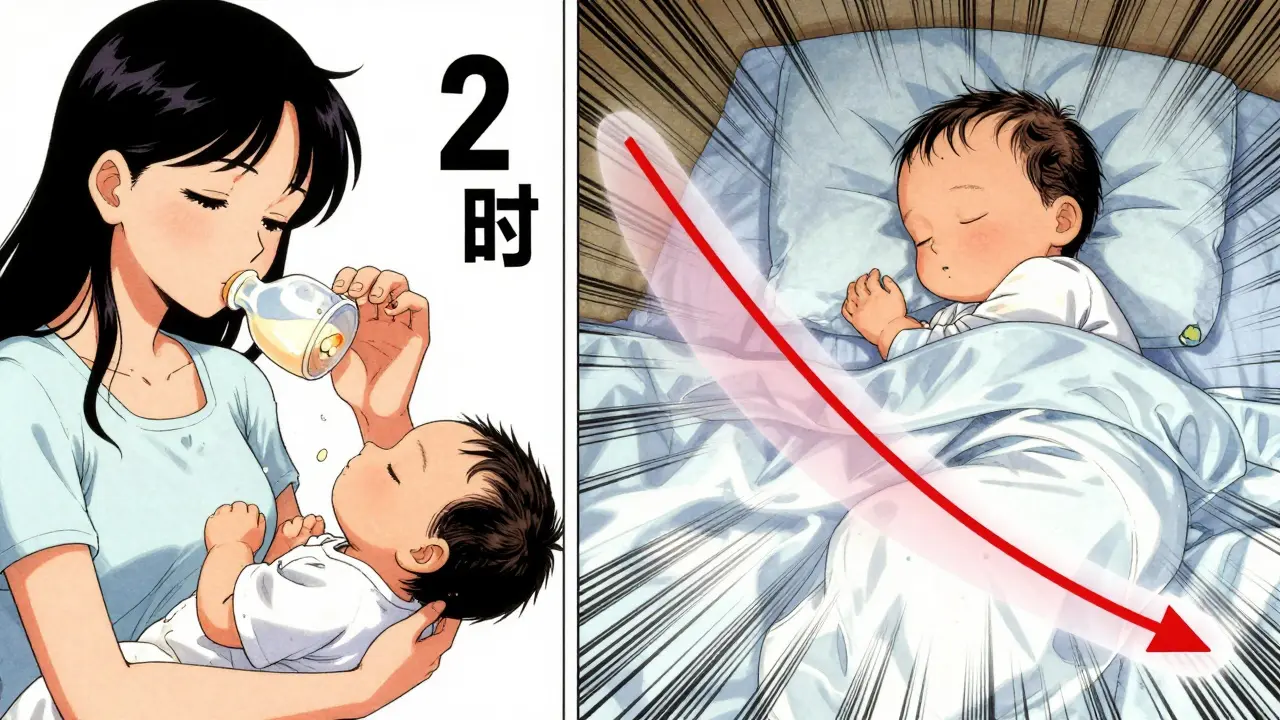
Medication doesn’t flood into breast milk all at once. It follows your body’s natural rhythm. When you take a pill, it gets absorbed into your bloodstream, peaks at a certain time, then slowly clears out. Breast milk picks up the drug as it circulates, so the highest concentration in your milk matches the highest concentration in your blood. That means if you take your dose right before feeding, your baby gets the biggest hit. But if you time it so the peak happens while your baby is sleeping, you cut their exposure by more than half. The science is clear: breastfeeding right before you take your medication is the single most effective way to reduce infant exposure. Why? Because by the next feeding-usually 4 to 8 hours later-your blood levels have dropped significantly. For short-acting drugs, this can mean a 70% to 90% drop in milk concentration.How to Time Doses Based on Drug Type
Not all medications behave the same. Timing strategies depend on two key factors: how fast the drug peaks and how long it lasts.- Short-acting drugs (peak in 1-2 hours, half-life under 6 hours): These are the easiest to time. Examples include hydrocodone, oxycodone, ibuprofen, and alprazolam (immediate-release). For these, take the dose right after your baby finishes a feeding, especially if it’s the last one before bedtime. That way, the peak happens during their longest sleep stretch.
- Long-acting drugs (half-life over 24 hours): Drugs like diazepam, fluoxetine, and lorazepam stay in your system for days. Timing matters less here because levels stay steady. But even with these, giving the dose after a feeding still helps avoid spikes. The real issue? Accumulation. If you take diazepam daily, it builds up in your baby’s system over time-so use the lowest effective dose and avoid long-term use if possible.
- Extended-release formulations: Avoid these if you can. An extended-release alprazolam peaks at 9 hours instead of 1-2, making timing unpredictable. Stick to immediate-release versions so you know exactly when the peak will hit.
What the Experts Say About Common Medications
The American Academy of Pediatrics, the Academy of Breastfeeding Medicine, and the CDC all agree: most medications are safe. But they also give specific advice for the most commonly used ones.- Opioids (like hydrocodone or oxycodone): Take your dose right after a feeding. Limit daily doses to under 30 mg for hydrocodone. Watch for baby drowsiness, especially in newborns.
- Antidepressants: Sertraline and paroxetine are top choices. They have low milk transfer and short half-lives (26 and 4-6 hours, respectively). Fluoxetine? Avoid it. It has a half-life of 96 hours, and its active metabolite lasts over 260 hours-too long for safe timing.
- Benzodiazepines: Lorazepam is preferred over diazepam. Its RID (Relative Infant Dose) is under 3%, and it peaks in just 2 hours. Diazepam? Its RID can hit 7%, and it lingers for days. If you must use diazepam, keep doses low and avoid daily use.
- Steroids (like prednisone): At normal doses, almost none gets into milk. But if you’re on a high dose (over 20 mg/day), wait 4 hours after taking it before nursing. This cuts exposure by more than 80%.
- Hormonal contraceptives: Avoid combination pills (estrogen + progestin) for the first 3-4 weeks postpartum. They can reduce milk supply. Progesterone-only pills are safer and can be started earlier.
Special Cases: Newborns, Preemies, and Sick Babies
Not all babies are the same. Premature infants, newborns under 2 weeks, and babies with liver or kidney problems process drugs much slower. Their systems aren’t built to clear medication like older babies. For these infants, timing isn’t just helpful-it’s critical. Even small amounts of certain drugs can build up and cause sedation, poor feeding, or breathing issues. In these cases:- Always use the lowest effective dose.
- Stick to immediate-release forms.
- Wait longer between feeding and dosing-up to 6-8 hours if possible.
- Monitor for signs of drowsiness, weak suck, or unusual fussiness.
Practical Tips That Actually Work
Knowing the theory is one thing. Making it work with a newborn who feeds every 90 minutes? That’s another.- Use the bedtime strategy: Most babies sleep 6-8 hours at night. Take your medication right after the last feeding before bed. Your baby sleeps through the peak.
- Pump and dump? Only if needed: Some moms pump before taking a dose and feed stored milk afterward. This works well for short-term needs-like after surgery with opioids. But it’s not necessary for daily medications if you time them right.
- Keep a log: Write down when you take your medicine and when your baby feeds. It helps you spot patterns. Did your baby get fussy after your 3 p.m. dose? Try moving it to 8 p.m.
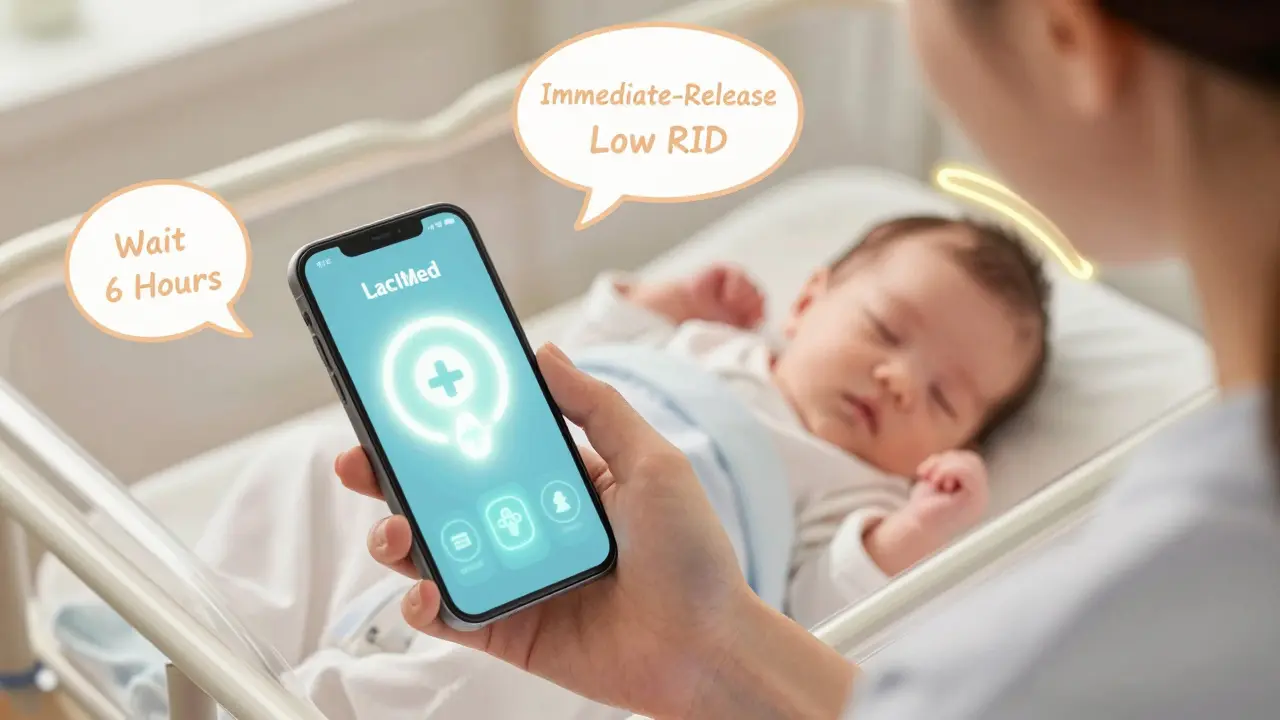
- Use LactMed: This free database from the National Library of Medicine gives exact timing advice for over 4,700 drugs. It’s updated monthly and trusted by lactation consultants worldwide.
What to Watch For in Your Baby
Most babies don’t react at all. But if you notice any of these signs, contact your pediatrician:- Excessive sleepiness or difficulty waking to feed
- Poor feeding, weak suck, or refusing the breast
- Unusual fussiness or irritability
- Changes in stool patterns or vomiting
- Slowed weight gain
When to Skip Timing Altogether
Some drugs are just too risky, no matter how you time them. Fluoxetine, long-term diazepam use, and certain chemotherapy drugs fall into this category. In these cases:- Switch to a safer alternative.
- Use non-drug therapies when possible (therapy, acupuncture, physical therapy).
- If no alternative exists, you may need to temporarily stop breastfeeding-but only after consulting your doctor. Most mothers can resume once the drug clears.
Remember: Your health matters too. If untreated depression, pain, or anxiety makes it harder to care for your baby, the risks of not taking medication can be greater than the risks of taking it safely.
Can I take painkillers while breastfeeding?
Yes. Ibuprofen and acetaminophen are safe and transfer in very low amounts. For stronger painkillers like hydrocodone or oxycodone, take them right after a feeding, especially before your baby’s longest sleep. Limit daily doses to 30 mg or less for hydrocodone. Watch for baby drowsiness, especially in newborns.
Is it safe to breastfeed after taking anxiety medication?
It depends on the drug. Sertraline and paroxetine are preferred for anxiety and depression-they have low transfer into milk and short half-lives. Avoid fluoxetine and long-term diazepam. For benzodiazepines, lorazepam is safer than diazepam. Always take the dose after a feeding and use the lowest effective dose.
Should I pump and dump after taking medicine?
Usually not. Pumping and dumping is only needed for short-term, high-risk situations-like after surgery with opioids. For daily medications, timing your dose right after a feeding is more effective and less disruptive. Pumping just to discard milk wastes your supply and doesn’t improve safety if you’re timing correctly.
What if my baby is premature or has health issues?
Premature babies and those with liver or kidney problems process drugs much slower. For them, timing is even more critical. Use the lowest possible dose, stick to immediate-release forms, and wait longer between dosing and feeding (6-8 hours if possible). Monitor closely for drowsiness, poor feeding, or slow weight gain. Always consult your pediatrician before starting any new medication.
How do I know if a medication is safe?
Use the LactMed database (from the National Library of Medicine) or Hale’s Medication and Mothers’ Milk. These tools give you the Relative Infant Dose (RID), peak times, and half-lives. Look for RID under 10% and short half-lives. Avoid drugs with half-lives over 24 hours unless absolutely necessary. Always check with your doctor or lactation consultant before starting a new medication.

9 Comments
cara sMarch 17, 2026 AT 13:52
So, i’ve been on sertraline for 18 months now, and honestly? I didn’t even realize how much i was overthinking the timing until i read this. i take it right after my 11pm feeding, and my 5-month-old sleeps like a rock through the peak. no fussiness, no drowsiness, nothing. i used to pump and dump out of pure anxiety-like, i’d stare at the freezer like it was a time capsule of guilt. but now? i just trust the science. LactMed is my bible. also, i accidentally took a dose at 3am once, and yeah, baby was a lil sleepy. lesson learned: consistency matters more than perfection. this post? lifesaver.
Amadi KennethMarch 18, 2026 AT 19:48
Wait-so you’re telling me the government, the AAP, the CDC… they’re ALL lying about pharmaceuticals? I’ve been reading forums since 2019-there’s a pattern here! Big Pharma doesn’t want you to know that drugs like fluoxetine are engineered to accumulate in infants! They’re testing on breastfeeding babies to see how long it takes for neural degradation! And LactMed? That’s a front for the FDA! I’ve got screenshots-17 different studies with redacted data! My cousin’s neighbor’s sister’s baby had seizures after her mom took ibuprofen-DOCTORS IGNORED IT! You think this is about safety? It’s about profit! Wake up!
Shameer AhammadMarch 19, 2026 AT 12:51
Let me clarify this for the uninitiated: the notion that ‘timing’ is a panacea is dangerously oversimplified. The pharmacokinetics of drug transfer into breast milk are governed by molecular weight, lipid solubility, protein binding, and pH partitioning-not merely ‘peak plasma concentration.’ You cannot reduce complex pharmacological dynamics to a ‘feed then dose’ heuristic. For instance, fluoxetine’s active metabolite, norfluoxetine, has a half-life exceeding 16 days; even if you time it perfectly, the cumulative infant exposure is non-trivial. Furthermore, the assumption that immediate-release formulations are universally preferable ignores variability in gastric emptying, CYP450 polymorphisms, and maternal metabolism. This article, while well-intentioned, is dangerously reductive. I urge readers to consult a clinical pharmacologist-not a blog.
Alexander PittMarch 19, 2026 AT 17:12
For anyone still unsure: the data is solid. If you’re taking a short-acting drug like ibuprofen or hydrocodone, taking it right after a feed means your baby gets less than 1% of the maternal dose. For longer drugs like diazepam, the risk isn’t timing-it’s frequency. Daily use = accumulation. Once-a-week? Fine. The real danger is avoiding meds because you’re scared. Untreated postpartum depression kills more infants indirectly than any medication ever has. Your health is part of your baby’s safety net. Don’t sacrifice one for the other.
jared bakerMarch 19, 2026 AT 19:56
Simple version: take your pill after the last feed before bed. Sleep through the peak. Baby gets sleepy? Try a different med. Pumping? Only if you’re in the hospital. LactMed is free. Use it. You got this.
Gaurav KumarMarch 20, 2026 AT 14:03
Interesting. But let’s be honest-this is all very Western. In India, we’ve been breastfeeding while on medication for centuries. No LactMed. No apps. Just grandmothers, turmeric, and intuition. Why are we outsourcing our wisdom to American databases? We don’t need a 4,700-entry spreadsheet to know that a mother knows her child. Also, why is ‘diazepam’ demonized? In my village, it’s given to nursing mothers like tea. No one’s had a seizure. Maybe the problem isn’t the drug-it’s the fear.
Jeremy Van VeelenMarch 21, 2026 AT 08:14
THIS. IS. A. MASTERPIECE. I’m not crying-you’re crying. I was on oxycodone after my C-section. I thought I’d have to wean. I thought I’d be a failure. I read this article at 3 a.m. with a baby screaming and a 12-hour supply of pills in my hand. I took it after the last feed. My son slept for 8 hours. I cried. Not because I was relieved-I cried because someone finally wrote this like a human being, not a pharmaceutical brochure. I’m not just a mother. I’m a person. And this? This is the first time I felt seen. Thank you.
Laura GabelMarch 22, 2026 AT 13:48
Meh. I just take it when I remember. Baby’s fine. Stop overthinking.
jerome ReverdyMarch 23, 2026 AT 14:27
There’s something beautiful about how science and motherhood intersect here. The fact that we can now quantify drug transfer into milk with RIDs, half-lives, and pharmacokinetic models-and still, the most effective tool is a mother’s intuition-isn’t just data, it’s poetry. We’ve moved from fear-based decisions to evidence-informed choices, and that’s progress. But let’s not pretend this is just about timing. It’s about dignity. About trust. About giving mothers the tools to make informed decisions without shame. This post doesn’t just inform-it validates. And that’s rare. Keep sharing this. We need more of it.