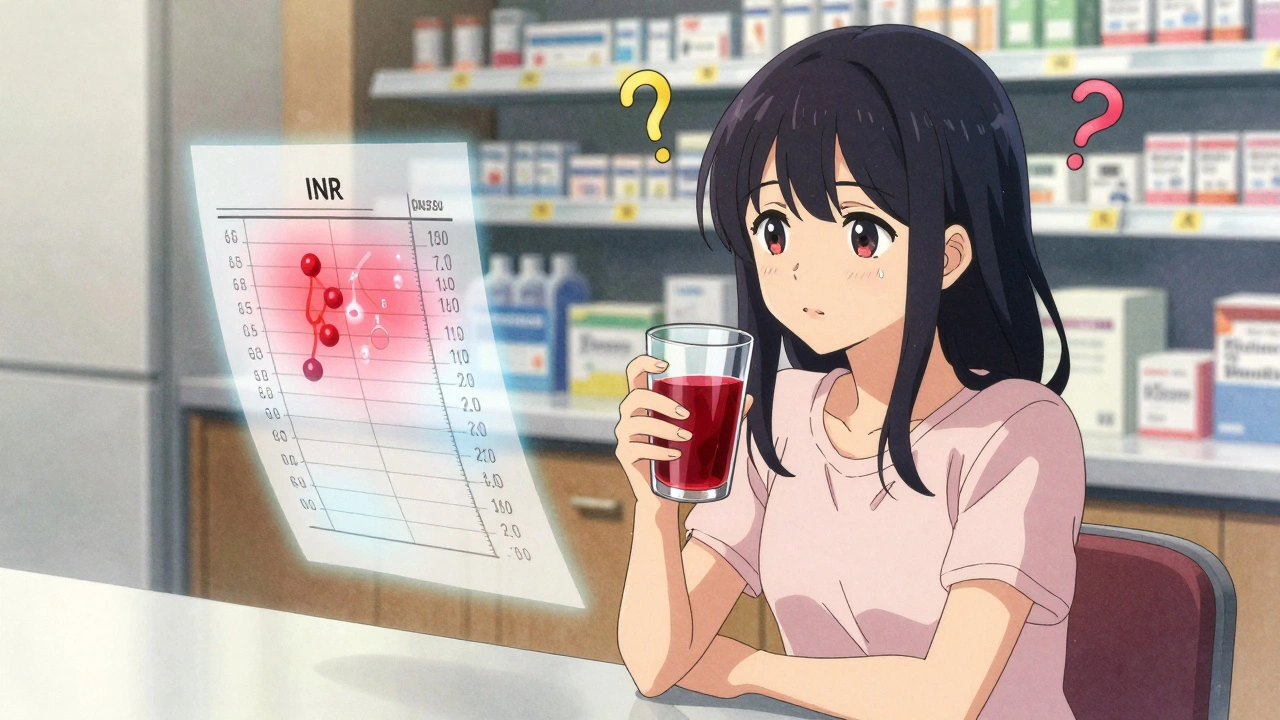
Cranberry Medication Interaction Checker
0oz
8oz
32oz
For decades, cranberry juice has been a go-to remedy for preventing urinary tract infections (UTIs). But if you’re on medication-especially blood thinners like warfarin-you’ve probably heard conflicting advice: avoid it at all costs or it’s perfectly safe. So what’s the truth? The answer isn’t simple, and the fear around cranberry juice and medications is often bigger than the actual risk.
Where Did the Fear Come From?
The alarm started in 2003, when a Canadian doctor reported a patient on warfarin who had a sudden spike in INR levels after drinking cranberry juice daily. INR measures how long it takes your blood to clot. A high INR means your blood is thinning too much, which can lead to dangerous bleeding. That single case triggered a wave of headlines, warnings, and pharmacy notices. Suddenly, cranberry juice was labeled a silent killer for people on blood thinners. But here’s the catch: that case was an outlier. Since then, more than a dozen controlled studies have looked at this exact issue-and most found no meaningful effect. A 2009 study from the University of Western Ontario gave 12 healthy adults 250ml of cranberry juice three times a day for two weeks while they stayed on warfarin. Their INR levels didn’t budge. Another review of 11 case reports and 4 clinical trials found that while 8 case reports suggested a problem, the actual studies showed no change in clotting time. So why do pharmacists still warn patients? Because the risk, while rare, isn’t zero. And when it does happen, it can be serious. That’s why caution still exists-even when the evidence is weak.Cranberry Juice vs. Warfarin: The Real Story
Warfarin is a tricky drug. It has a narrow therapeutic window, meaning the difference between an effective dose and a dangerous one is small. It’s broken down by the liver using an enzyme called CYP2C9. Cranberry juice contains compounds-mainly proanthocyanidins and flavonoids-that can inhibit CYP2C9 in test tubes. That sounds scary, right? But what happens in a lab doesn’t always happen in your body. The key issue is concentration. Most cranberry juice you buy in the supermarket is only about 27% cranberry. The rest is water, sugar, and flavoring. That dilution matters. Studies using this kind of juice almost never show interactions. But concentrated cranberry supplements? Those can contain 36mg or more of proanthocyanidins per serving-far higher than what you’d get from a glass of juice. These are the products that might actually affect drug metabolism. The American College of Clinical Pharmacy says: avoid cranberry products if you’re on warfarin. But they also admit: no large, well-designed study has proven a consistent interaction. The European Medicines Agency lists cranberry as a “substance with potential for clinically relevant interactions.” The U.S. FDA doesn’t require any warning labels on cranberry juice. That’s not an accident. It’s because the science is messy. Bottom line: If you’re on warfarin, don’t suddenly start drinking 32oz of cranberry juice every day. But if you’ve been drinking one glass a week for years and your INR is stable? Don’t panic. Talk to your pharmacist. Don’t quit cold turkey-just be consistent.What About Other Medications?
Most people worry about warfarin. But what about antibiotics, statins, or even anxiety meds? Here’s where things get clearer. Take amoxicillin and cefaclor-two common antibiotics used for UTIs. A 2009 study tested 18 women who took these drugs with or without cranberry juice. Even though cranberry juice can theoretically interfere with how drugs are absorbed in the gut, the actual blood levels of the antibiotics didn’t change. No difference in effectiveness. No increased side effects. Same goes for statins like atorvastatin, beta-blockers, and most antidepressants. Multiple studies have looked at these and found no clinically relevant interaction. The liver enzymes they rely on (CYP3A4, CYP2D6) may be inhibited by cranberry in a petri dish, but not in your bloodstream at normal consumption levels. Alprazolam (Xanax) is a different story. It’s broken down by CYP3A4-the same enzyme cranberry juice might affect. So theoretically, you could have higher levels of Xanax in your blood, leading to drowsiness or dizziness. But here’s the kicker: no human study has ever shown this actually happens. It’s a theory without proof. The real danger isn’t the juice. It’s the supplements. Concentrated cranberry pills, powders, and extracts are unregulated. A single capsule might pack the equivalent of a whole pint of juice. That’s why the Mayo Clinic recommends avoiding supplements unless you’ve talked to your pharmacist.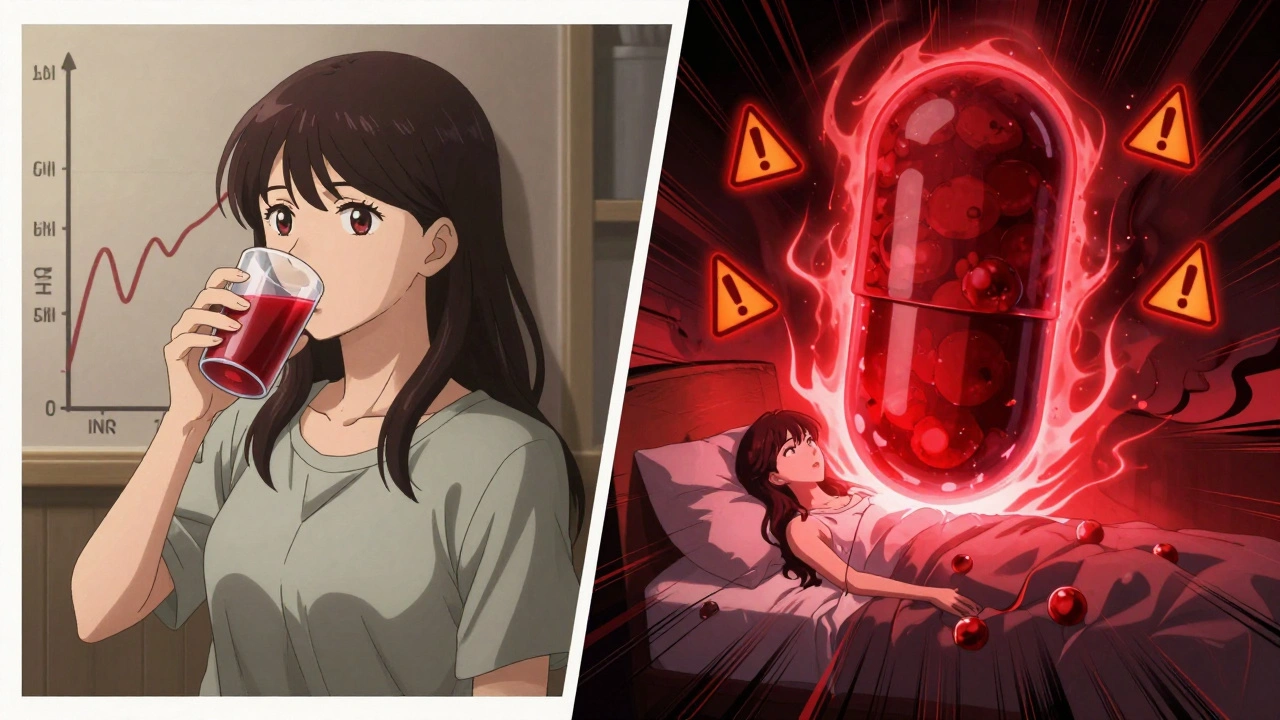
Why Do People Still Think It’s Dangerous?
Part of the problem is confusion with grapefruit juice. Grapefruit is a known drug interaction monster. It blocks enzymes so powerfully that it can cause serious side effects with over 85 medications, including statins and blood pressure drugs. The FDA even has a published list of these interactions. Cranberry isn’t grapefruit. But because both are “fruit juices” and both get mentioned in the same breath, people lump them together. A 2022 Johns Hopkins survey found that 83% of people taking cranberry supplements didn’t even know they might interact with medications. That’s not ignorance-it’s misinformation. Another reason? Confirmation bias. If someone on warfarin drinks cranberry juice and their INR goes up, they’ll blame the juice. They won’t remember they started eating more leafy greens the same week, or that they missed a dose of warfarin, or that they got the flu. The body is complex. One variable doesn’t explain everything. And then there’s the pharmacy culture. Many pharmacists, trained to err on the side of caution, tell patients to avoid cranberry juice entirely. It’s easier than explaining the nuance. But that creates unnecessary fear. Women who use cranberry juice to prevent recurring UTIs-about 20% of women experience them-are now avoiding a safe, natural option because they’re scared of a myth.What Should You Actually Do?
Here’s the practical, evidence-based advice:- If you’re on warfarin: Stick to one 8oz glass of regular cranberry juice per day, if at all. Avoid supplements. Keep your intake consistent. Don’t suddenly switch from no juice to three glasses a day. Get your INR checked more often if you start or stop drinking it.
- If you’re on antibiotics, statins, blood pressure meds, or antidepressants: You’re fine. One glass of juice won’t hurt. No need to avoid it.
- If you’re on a direct oral anticoagulant (DOAC) like apixaban or rivaroxaban: Current evidence shows no interaction. These drugs aren’t metabolized the same way as warfarin. But if you’re unsure, ask your doctor. A 2023 clinical trial is still ongoing to confirm this.
- If you’re taking cranberry supplements: Stop. Unless you’ve discussed it with your pharmacist, these aren’t worth the risk. They’re not regulated, doses vary wildly, and the potential for interaction is higher.


10 Comments
Matt DeanDecember 2, 2025 AT 20:29
Let me get this straight - we’re still having this conversation in 2025? People are scared of cranberry juice like it’s liquid砒霜. The real danger is pharmacists who’d rather say 'avoid everything' than explain science. I’ve been drinking cranberry juice with warfarin for 7 years. My INR? Stable. My doctor? Happy. Stop scaring people with ghost stories from 2003.
And yeah, supplements? Yeah, those are sketchy. But juice? It’s fruit. With sugar. And taste. Stop treating it like a controlled substance.
Walker AlveyDecember 3, 2025 AT 23:20
Oh wow. Someone actually wrote a 2000 word essay to tell us cranberry juice isn’t going to kill us. Groundbreaking. Next you’ll tell us water doesn’t cause drowning if you drink too much too fast. I mean, sure, the science says it’s fine. But what about the one person who died? The one case? The one time the universe said 'nah, not today'? That’s all it takes for a pharmacy to put a warning label. You want evidence? Look at the fear. That’s the real data point.
Bee FloydDecember 4, 2025 AT 08:48
There’s something deeply human about how we turn harmless things into monsters when meds are involved. Cranberry juice, grapefruit, even garlic - we treat them like rogue agents in a spy movie. But the body’s not a lab. It’s messy, adaptive, and way more forgiving than we give it credit for.
I’ve got a friend on warfarin who drinks a glass of juice every Sunday with pancakes. Her INR’s been stable for 5 years. Meanwhile, her pharmacist still gives her the side-eye. Maybe the real issue isn’t the juice - it’s our need to control everything, even what we sip with breakfast.
Jeremy ButlerDecember 4, 2025 AT 18:38
It is incumbent upon the medical community to maintain a posture of prudence in the face of pharmacokinetic uncertainty. While the preponderance of clinical evidence does not substantiate a clinically significant interaction between cranberry juice and warfarin, the theoretical possibility of CYP2C9 inhibition necessitates a precautionary approach. The absence of definitive harm does not equate to the presence of definitive safety.
Furthermore, the heterogeneity of commercial cranberry products introduces an unquantifiable variable. The regulatory vacuum surrounding dietary supplements exacerbates this concern. Therefore, while not categorically contraindicated, cranberry juice consumption in patients on anticoagulant therapy remains an area requiring individualized risk-benefit assessment under professional supervision.
Courtney CoDecember 6, 2025 AT 05:24
But what if it’s YOU? What if you’re the one person it happens to? I had a cousin who drank cranberry juice and ended up in the ER bleeding from her gums. She didn’t even know she was on the edge. Now she’s scared to even eat an orange. And you’re just sitting there saying 'it’s fine'? What if your logic doesn’t save someone? What if your calm words don’t stop the bleeding?
I’m not saying don’t drink it. I’m saying don’t be so sure. Don’t be so smug. Someone’s life could be hanging on your confidence.
Shashank ViraDecember 6, 2025 AT 10:25
Ah, the great Western medical delusion - reducing complex physiological systems to binary 'safe' or 'dangerous' labels. In Ayurveda, we understand that food and medicine are not separate. Cranberry is a vata-pitta reducer, a mild diuretic. Its interaction with warfarin is not an 'error' - it is a dialogue between two energetic forces.
But you, in your reductionist paradigm, demand a clinical trial. You want a number. You want a chart. You want to quantify the soul of a fruit. How tragic. The body is not a spreadsheet. It is a symphony. And you, my dear rationalist, are deaf to its music.
Adrian BarnesDecember 6, 2025 AT 10:40
Let’s cut through the fluff. This entire article is a masterclass in how to sanitize fear with pseudo-science. You cite studies, but ignore the fact that case reports exist for a reason - they’re the canaries in the coal mine. You say 'no large study proves interaction' - but you also admit the risk isn’t zero. So why are you telling people it’s fine? Because it’s easier than saying 'we don’t know enough, so proceed with extreme caution'? That’s not advice. That’s negligence dressed up in APA citations.
And don’t get me started on the 'just be consistent' advice. Consistency doesn’t prevent chaos. It just makes the chaos predictable. And predictable doesn’t mean safe.
Jaswinder SinghDecember 6, 2025 AT 21:46
Bro. I’m from India. We drink aam panna, neem juice, turmeric milk with every medicine. No one freaks out. But here? You treat cranberry juice like a grenade. I’ve seen people quit it cold turkey because their pharmacist said so. Then they get UTIs again. Then they’re on antibiotics every month. That’s the real cost. You’re trading a tiny theoretical risk for a guaranteed health spiral.
Just talk to your doc. Don’t let fear make you stupid.
Eric VlachDecember 7, 2025 AT 12:33
My grandma’s on warfarin. She drinks one glass of cranberry juice every night with her tea. She’s 82. She’s active. Her INR’s been 2.3 for 4 years. She doesn’t know what CYP2C9 is. She just knows it helps her not get sick. I told her to stop. She said 'if it ain’t broke, don’t fix it.' She’s right. We overthink everything. We make simple things complicated because we’re scared of being wrong.
Just be consistent. Don’t go from zero to three glasses. Don’t start taking pills without telling your doc. That’s it. That’s the whole thing.
Souvik DattaDecember 8, 2025 AT 04:31
Science evolves. Truth is not static. What was feared in 2003 is now understood as a myth in 2025. But human nature clings to fear because it feels safer than uncertainty. We’d rather follow a rigid rule than navigate nuance. That’s why this article matters - not because it tells you what to do, but because it reminds you that wisdom lies in listening, not in shouting louder than the alarm bells.
So if you’re on warfarin, drink your juice. But don’t drink it like it’s a cure. Drink it like it’s a gift. And always, always, talk to your pharmacist. Not because they’re the final authority - but because they’re your ally in a world full of noise.