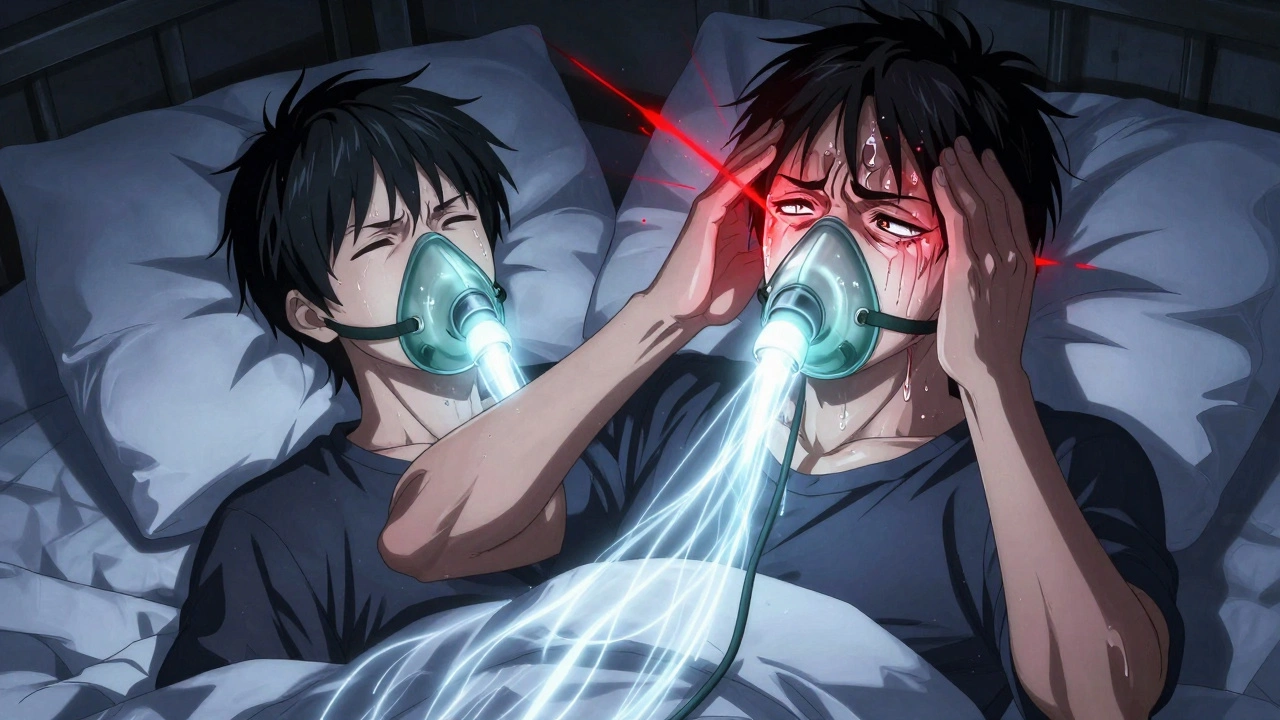
Imagine waking up in the middle of the night with a pain so intense it feels like someone is drilling a hole into your eye. It’s not a migraine. It’s not a sinus headache. It’s a cluster headache - one of the most excruciating conditions known to medicine. People who live with it call it the "suicide headache." And for many, the only thing that brings real, fast relief is oxygen therapy.
What Exactly Is a Cluster Headache?
Cluster headaches aren’t just bad headaches. They’re a neurological disorder that strikes in cycles - sometimes daily for weeks or months, then vanishing for months or years. The pain is always on one side of the head, usually around the eye or temple. It hits hard and fast, peaking within minutes. Attacks last between 15 and 180 minutes, and they often happen at the same time every day - sometimes even waking you up at the same minute each night.Along with the pain, you might notice one or more of these on the same side as the headache: watery eye, stuffy or runny nose, drooping eyelid, or a flushed face. You won’t want to lie still. Most people pace, rock, or even bang their head because sitting still makes it worse.
It affects about 1 in 1,000 people. Men are three times more likely to get them than women. While the exact cause isn’t fully understood, scientists believe it’s tied to the hypothalamus - the part of the brain that controls your body’s internal clock. That’s why attacks often happen at night or at the same time each season.
Why Oxygen Therapy Works
In the 1950s, Dr. Harold Wolff discovered something surprising: breathing pure oxygen could stop a cluster headache in its tracks. Today, that’s still the gold standard.When you breathe 100% oxygen through a non-rebreather mask at 12 to 15 liters per minute, it floods your bloodstream with oxygen. This quickly reduces inflammation in the trigeminal-autonomic reflex pathway - the nerve circuit that’s firing out of control during an attack. The result? Pain drops dramatically, often within 10 to 15 minutes.
Studies show 78% of people get pain-free or nearly pain-free relief with oxygen therapy. Compare that to sumatriptan injections, which work for about 74% of people but come with chest tightness, dizziness, or heart palpitations in nearly a third of users. Oxygen? No side effects. No drug interactions. No risk to your heart.
That’s why the American Academy of Neurology and the European Headache Federation both give oxygen therapy their highest recommendation - Level A evidence. It’s the only non-drug treatment with that status.
How to Use Oxygen Therapy Right
Using oxygen wrong can mean no relief at all. Here’s what actually works:- Get a prescription for medical-grade oxygen. Your doctor will write it for ICD-10 code G44.0 (cluster headache).
- Use a non-rebreather mask with a reservoir bag - not a simple nasal cannula. The mask must seal tightly around your nose and mouth.
- Set the flow rate to 12 to 15 liters per minute. Lower flow rates (like 6 L/min) often don’t work.
- Start breathing oxygen the moment you feel the attack begin. Delay even 10 minutes, and it may not help.
- Breathe deeply and steadily for 15 to 20 minutes. Don’t stop early, even if the pain eases. Finish the full session.
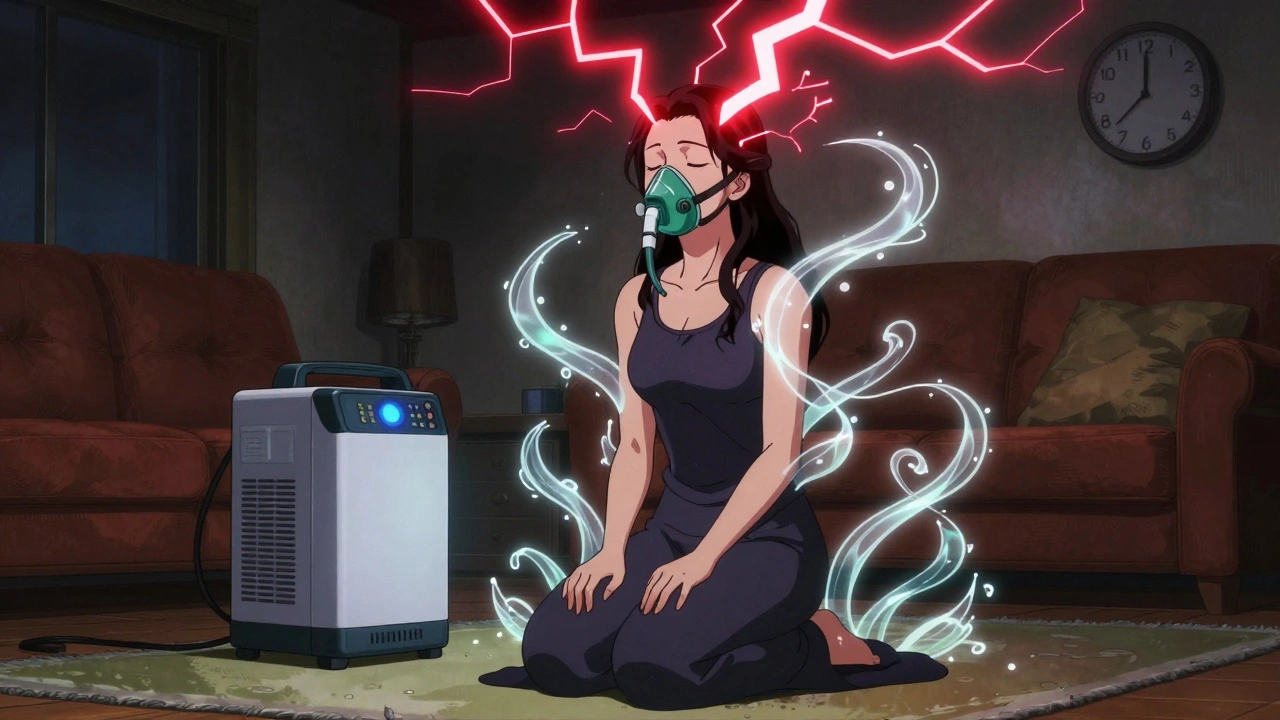
Many people keep their oxygen setup in multiple places - by the bed, in the living room, even at work. If you wait until you’re in agony to grab it, you’ve already lost precious time.
Portable oxygen concentrators like the Inogen One G5 (weighing just 4.8 pounds) make this easier. Newer devices like the FDA-cleared O2VERA (released in 2023) are designed specifically for cluster headaches, delivering 15 L/min in a compact unit.
Who Doesn’t Respond to Oxygen?
Oxygen therapy works for most - but not everyone. About 20% of people don’t get relief, even when they use it perfectly. Research shows these factors make it less likely to work:- You’ve never smoked (surprisingly, smokers often respond better)
- You have constant, ongoing head pain between attacks
- Your attacks last longer than 180 minutes
If oxygen doesn’t work for you, don’t give up. Triptans like sumatriptan injections or nasal zolmitriptan are still options - though they carry risks for people with heart conditions. Newer treatments like gammaCore (a nerve stimulator worn on the neck) are helping those who don’t respond to oxygen.
Insurance and Access Problems
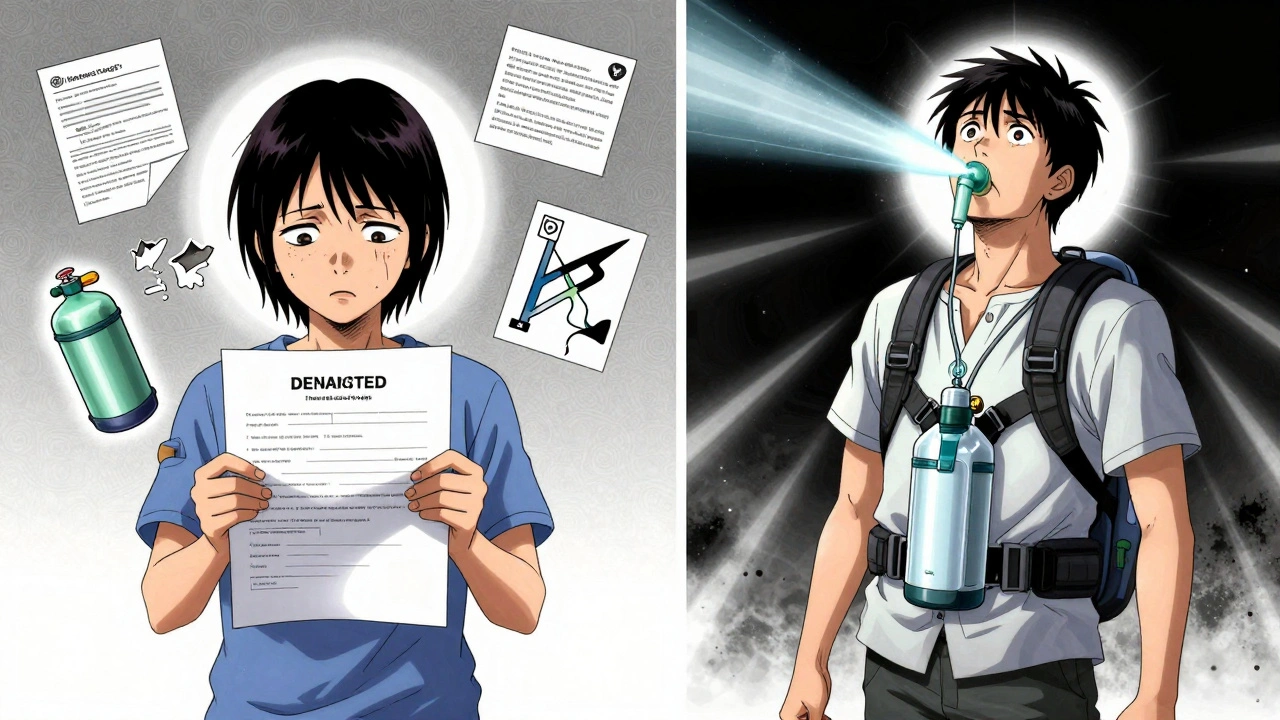
Here’s the ugly truth: even though oxygen therapy is proven, safe, and cost-effective, getting it is a nightmare.In the U.S., Medicare only covers oxygen for cluster headaches if you’ve tried and failed two different triptans, and your attacks happen at least once a week. Even then, 41% of initial claims get denied - up from 33% just two years ago.
Private insurers are inconsistent. UnitedHealthcare approves about 68% of claims. Aetna? Only 42%. Many people pay out of pocket - $1,200 to $2,500 for a concentrator, or $150 to $300 a month to rent one.
Patients in rural areas are hit hardest. Only 28% have immediate access compared to 63% in cities. That’s why groups like Clusterbusters have pushed for state laws - 22 states now require insurance to cover oxygen for cluster headaches.
Real Stories from People Living With It
On Reddit’s r/ClusterHeadaches community, over 1,200 people shared their oxygen experiences. Seventy-two percent said it gave them “significant or complete relief.” One user wrote: “12 L/min with a non-rebreather mask gets me pain-free in 8 to 10 minutes. Before this, I was at a 9/10 pain level. Now I can breathe again.”But others describe the struggle: “My insurance denied my oxygen for six months. I had to use a friend’s machine. I lost sleep, missed work, and felt like I was dying every night.”
Some people report something unexpected - oxygen doesn’t just stop the attack. It reduces how often they happen. One patient said: “Oxygen cut my attacks from eight per day to two during a cycle. I didn’t expect that.”
What’s Next for Treatment?
The field is moving fast. The European Medicines Agency approved a new nasal delivery system in 2024 that delivers oxygen through a cannula - not a mask - with 89% effectiveness. Three clinical trials are testing demand-valve masks that release oxygen only when you inhale, cutting treatment time and saving oxygen.Doctors are also looking at how to predict who will respond to oxygen before the first attack. If we can identify those who won’t benefit, we can steer them to other treatments sooner.
For now, oxygen remains the most reliable, safest, and fastest way to stop a cluster headache. It’s not perfect. Access is hard. But for those who can use it right, it’s life-changing.
What You Should Do Now
If you think you have cluster headaches:- See a headache specialist - not just your GP. They know the difference.
- Ask for oxygen therapy as your first treatment. Don’t wait for triptans to fail.
- Get a prescription and start the insurance process early. It can take weeks.
- Buy or rent a portable oxygen concentrator with a non-rebreather mask. Keep it charged and ready.
- Join a patient group like Clusterbusters. They offer free guides, support, and help fighting insurance denials.
Cluster headaches don’t go away on their own. But with the right treatment, they don’t have to control your life either.
Can oxygen therapy prevent cluster headaches from happening?
Oxygen therapy doesn’t prevent attacks from starting - it stops them once they begin. For prevention, doctors prescribe daily medications like verapamil, lithium, or topiramate. Oxygen is strictly for acute relief during an attack.
Is it safe to use oxygen therapy at home?
Yes, when used correctly. Medical oxygen is not flammable, but oxygen supports combustion. Keep oxygen equipment away from open flames, cigarettes, or sparks. Never use oil-based lotions on your face while using oxygen. Follow all safety instructions from your provider.
Why do I need a non-rebreather mask instead of a nasal cannula?
A nasal cannula delivers only 40-60% oxygen, even at high flow rates. A non-rebreather mask with a reservoir bag delivers close to 100% oxygen because it traps the gas and prevents you from breathing in room air. Without it, you won’t get the concentration needed to stop the attack.
How long does it take to get oxygen therapy approved by insurance?
It can take 2 to 6 weeks. You’ll need a doctor’s prescription, a diagnosis confirmation, and often proof that other treatments failed. Some DME suppliers help with paperwork. If denied, appeal - many approvals happen on the second try.
Can I use oxygen therapy with other medications?
Yes. Oxygen therapy has no drug interactions. Many people use it alongside preventive meds like verapamil or as a backup if a triptan doesn’t work fast enough. It’s safe to combine with most treatments.
What if oxygen doesn’t work for me?
You’re not alone - 1 in 5 people don’t respond. Talk to your specialist about alternatives: injectable sumatriptan, intranasal zolmitriptan, or neuromodulation devices like gammaCore. Newer options like sphenopalatine ganglion stimulation are also being studied.

10 Comments
wendy bDecember 11, 2025 AT 16:13
soooooo... oxygen is the only thing that works?? like, wow. i thought we were past this in 2024. i mean, i get it, it's non-pharm, but still... why is this even a debate? i've seen people on twitter crying because their insurance denied them a machine. like, it's literally just air. with extra oxygen. how is this not covered by every plan??
Reshma SinhaDecember 13, 2025 AT 01:24
From a clinical neurology standpoint, the efficacy of hyperbaric oxygen therapy in modulating the trigeminal-autonomic reflex arc is well-documented in peer-reviewed literature. The 78% response rate aligns with the 2022 Cochrane meta-analysis. What's more concerning is the systemic failure in DME access protocols - particularly in rural Medicaid populations. We need policy-level intervention, not just anecdotal advocacy.
Lawrence ArmstrongDecember 13, 2025 AT 21:32
Just wanted to say - oxygen saved my life. 🙏 I used to have 6-8 attacks a night. Now? I keep my Inogen by my bed. 15 L/min. Non-rebreather. 12 minutes. Done. 🤘 No more crying in the dark. If you're reading this and you think it won't work - try it. Really. It's not magic. It's science. And it works.
Donna AndersonDecember 15, 2025 AT 03:48
omg yes!! i got mine through medicaid after 4 months of begging. the rep said no, then i sent them the aan guidelines and they approved it. i cried. like, actual tears. oxygen is the only thing that doesn't make me feel like i'm dying. also, don't use nasal cannulas. they're useless. mask only. trust me.
Levi CooperDecember 16, 2025 AT 11:36
Interesting how the U.S. still can't get basic medical care right. In Germany, oxygen is covered automatically. In Canada, they just give you the machine. Here? You need to prove you're dying before they'll even look at you. It's not healthcare - it's a business. And people are suffering because of it.
sandeep sanigarapuDecember 17, 2025 AT 20:28
Cluster headaches are real. Oxygen is not a cure. But it is a lifeline. I have seen patients who could not walk, could not speak, during attacks. After oxygen - they sit up. They smile. That is medicine. Simple. Effective. Human.
nikki yamashitaDecember 19, 2025 AT 08:07
Yessss!! I just got my machine last month and I’m already feeling like a new person. I used to dread bedtime. Now I just grab my mask and breathe. It’s like hitting a reset button. Also - buy the O2VERA if you can. It’s tiny. Like, phone-sized. Game changer.
Adam EverittDecember 20, 2025 AT 07:42
it's funny how oxygen - the most basic element - is the only thing that actually works. we've got nanobots, ai diagnostics, gene therapies... and yet the answer is just... air. with more o2. i guess sometimes the universe doesn't need complexity. just... breath.
Rob PurvisDecember 21, 2025 AT 01:52
Important note: If you're using oxygen, make sure your mask seals properly - even a tiny leak drops the concentration below therapeutic levels. Also, never use petroleum-based products on your face - oxygen + Vaseline = fire hazard. I've seen it happen. It's not a joke. And if your insurance denies you, appeal - twice. I had to appeal three times before they approved mine. Don't give up.
Ashley SkippDecember 22, 2025 AT 12:40
Everyone's acting like oxygen is some miracle cure. I've used it for years. It doesn't work for everyone. My attacks last 3 hours. I've tried everything. Oxygen? Doesn't touch it. And now I'm stuck paying $200 a month to rent a machine that does nothing for me. So don't preach. Not everyone gets relief.