Hatch-Waxman Act: How Generic Drugs Got Their Footing in the U.S. Market
When you pick up a generic version of a brand-name drug and pay a fraction of the price, you’re seeing the impact of the Hatch-Waxman Act, a 1984 U.S. law that created a legal pathway for generic drugs to reach the market without repeating expensive clinical trials. Also known as the Drug Price Competition and Patent Term Restoration Act, it’s the reason millions of Americans can afford blood pressure pills, antibiotics, and antidepressants today.
The law didn’t just make generics possible—it forced a trade-off. Drugmakers got extra patent time to make up for delays caused by FDA reviews, while generic companies could file for approval as soon as a patent expired or was challenged. This created a race: brand-name companies tried to extend monopolies, and generics rushed in to undercut them. The result? Over 90% of U.S. prescriptions are now filled with generics, saving the system over $300 billion a year. But it wasn’t smooth. Patent thickets, litigation, and "pay-for-delay" deals kept some drugs expensive longer than they should’ve been.
Related to this are the FDA approval, the process that verifies generics are as safe and effective as their brand-name counterparts, and the role of drug patents, legal protections that give innovators exclusive rights to sell a drug for a set time. Without Hatch-Waxman, generics would’ve had to run full clinical trials—making them too costly to produce. Instead, they prove bioequivalence: same active ingredient, same dose, same effect. This is why your generic metformin works just like Glucophage. And why companies like Teva, Sandoz, and Mylan became giants—they didn’t invent new drugs, they made old ones affordable.
Today, the Hatch-Waxman Act still shapes who gets access to medicine. When a new biologic drug hits the market, the law’s rules get stretched thin—leading to delays in biosimilar approvals. Meanwhile, patent challenges and generic entry timelines are still hotly contested in courtrooms. But the core idea remains: innovation shouldn’t come at the cost of access. The posts below dig into how this law connects to real-world issues—like why some generics are scarce, how companies game the system, and how patients benefit (or don’t) when patents expire. You’ll find real stories behind the numbers: from workers’ compensation formularies to global drug pricing, from generic substitution rules to the fight over affordable HIV meds. This isn’t just policy—it’s about who gets treated, and who pays.
Tentative approval from the FDA allows generic drug makers to prepare for market entry while waiting for patents to expire. Learn how patent litigation, amendment deadlines, and timing decisions determine whether a generic drug launches on day one or months late.
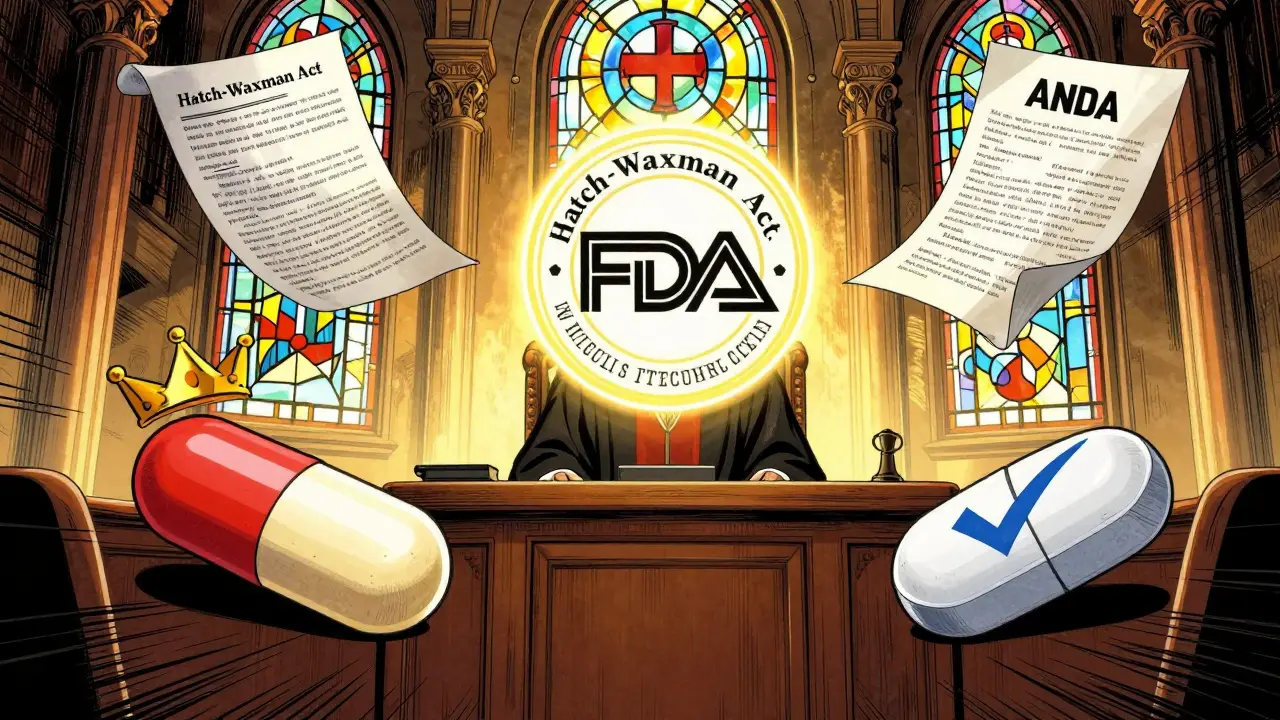
Learn how the FDA authorizes generic drugs through the Hatch-Waxman Act and ANDA pathway. Understand bioequivalence, approval timelines, patent challenges, and why generics are safe, effective, and 80-85% cheaper.
Generic drugs now make up over 90% of U.S. prescriptions, saving billions annually. Their history spans from 19th-century drug standards to the Hatch-Waxman Act and modern supply chain challenges.
