
When you're checking if a generic drug is safe to substitute for a brand-name version, or if a biosimilar biologic carries the same risks as its reference product, you're not guessing-you're using official data. The FDA’s Orange Book and Purple Book are the two most important tools for this job. They don’t give you side effect lists or patient stories. Instead, they tell you what the FDA has officially decided about safety, equivalence, and withdrawal status. If you work in pharmacy, prescribing, or drug manufacturing, skipping these resources means working blindfolded.
What the Orange Book Actually Tells You About Safety
The FDA Orange Book, officially called Approved Drug Products with Therapeutic Equivalence Evaluations, is the go-to source for small-molecule drugs-think pills, capsules, and injections made with chemical compounds. It’s been around since 1985, and it’s updated every month. As of September 2023, it lists over 20,000 approved drug products. But here’s what most people miss: it doesn’t just list generics. It tells you which ones have been pulled from the market for safety reasons. That’s in Section II: Discontinued Drug Products. If a drug was withdrawn because it caused liver damage, increased heart attack risk, or had contaminated batches, it’s flagged there. The footnote says: “Federal Register determination that product was discontinued or withdrawn for safety or efficacy reasons.” You won’t find that in a pharmacy’s computer system unless someone checks the Orange Book directly. Therapeutic equivalence codes are another safety layer. The first letter tells you if a generic is safe to swap. An “A” code means the FDA has confirmed it’s therapeutically equivalent-same active ingredient, same dose, same performance, same safety profile. But if you see a “B” code, that’s a red flag. It means the generic hasn’t been proven equivalent. Some B-coded products are still on the market because they’re not yet evaluated, not because they’re unsafe. But you need to know the difference before you fill a prescription.How the Purple Book Protects Patients Using Biologics
Biologics-drugs made from living cells like antibodies, vaccines, or hormones-are more complex than pills. They can’t be copied exactly. That’s why the FDA created the Purple Book in 2014. It tracks licensed biological products, including biosimilars and interchangeable ones. A biosimilar isn’t a generic. It’s a highly similar version of a biologic reference product. To get approved, the manufacturer must prove there are no clinically meaningful differences in safety, purity, or potency. That’s not marketing speak-it’s a legal requirement. The Purple Book shows which products have passed this test. If a biosimilar says “Yes” under “Biosimilarity or Interchangeability,” it means the FDA has reviewed clinical data showing its safety profile matches the original. Here’s the key: the Purple Book groups biosimilars under their reference product. So if you look up Humira, you’ll see all the biosimilars that have been approved as equivalent to it. That’s a huge time-saver. Instead of checking five different product monographs, you see all safety comparisons in one place. But here’s the catch: the Purple Book doesn’t track real-world adverse events. If a biosimilar starts showing more cases of severe infections in the wild, that data goes into the FDA’s FAERS system-not the Purple Book. You still need to check MedWatch alerts separately.Where the Books Fall Short-And What to Do About It
Neither book gives you detailed adverse event reports. The Orange Book won’t tell you how many patients had kidney issues with a certain generic. The Purple Book won’t list how many people developed antibodies to a biosimilar. For that, you need the FDA Adverse Event Reporting System (FAERS) or MedWatch. Also, the Purple Book updates every 60 days. That’s slower than the Orange Book’s 30-day cycle. In late 2022, a biosimilar for insulin was approved, but the safety data didn’t appear in the Purple Book for another seven weeks. During that gap, some pharmacists were unaware it had been cleared. That’s why experts recommend cross-referencing with FDA safety communications. Another limitation: therapeutic equivalence codes in the Orange Book can be confusing for narrow therapeutic index (NTI) drugs-like warfarin, levothyroxine, or digoxin. These drugs have tiny margins between effective and toxic doses. Even small differences in absorption can be dangerous. The FDA doesn’t assign “A” codes to all NTI generics. Some are coded as “B” even if they’re approved. Pharmacists often manually check bioequivalence studies for these, because the code alone isn’t enough.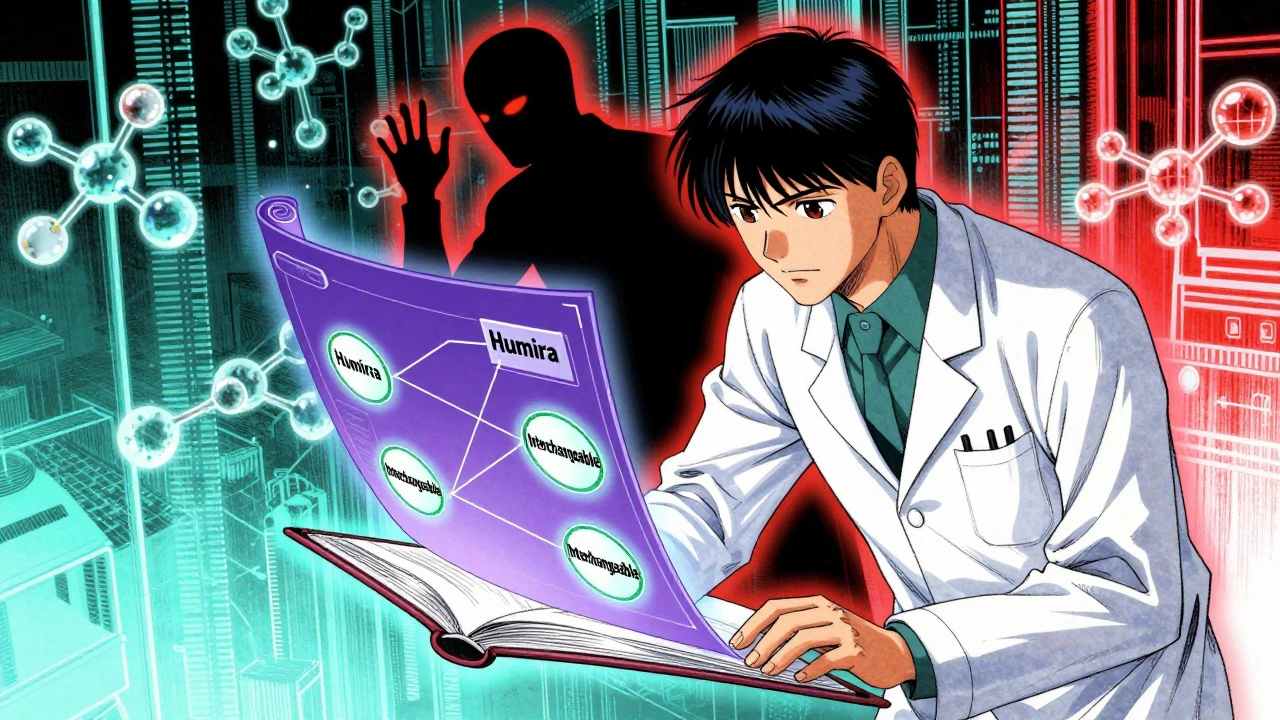
How to Search the Orange Book for Safety Withdrawals
Go to the FDA’s Orange Book website. Click on “Search Drug Products.” In the filter options, select “Discontinued Drug Products.” Then choose “Safety” under “Reason for Discontinuation.” You’ll see a list of drugs pulled for safety reasons. As of September 2023, there were 127 such products. Click on any product. Look at the “Active Ingredient” and “Manufacturer” fields. Compare them to what’s on your pharmacy’s formulary. If you see a match, pause before dispensing. Check the FDA’s Drug Safety Communications page to see if there’s a current alert. Pro tip: Bookmark the “How to Read the Orange Book” guide. It’s updated every March and explains codes, abbreviations, and how to interpret discontinued listings.How to Use the Purple Book to Compare Biosimilar Safety
On the Purple Book page, use the search bar to find the reference product-say, Enbrel or Remicade. Once you find it, scroll down to the “Biosimilar Products” section. Each biosimilar will show its approval date and whether it’s labeled “Interchangeable.” Interchangeable means the FDA believes you can switch back and forth between the biosimilar and the original without increasing safety risks. That’s a higher bar than just being biosimilar. Only 40+ products have this status as of late 2023. If you’re a clinician, use this to explain to patients why a biosimilar is safe. If you’re a pharmacist, use it to justify substitutions. If you’re a payer, use it to decide which biosimilars to cover.Real-World Use Cases from the Field
A hospital pharmacist in Ohio caught a dangerous error last year. A patient was being switched from a brand-name anticoagulant to a generic. The pharmacy system showed both as “A” coded. But when she checked the Orange Book, the generic was listed as discontinued for safety reasons. The brand was still active. She flagged it. The patient avoided a serious bleeding event. In a biotech company, a regulatory team used the Purple Book to confirm that a new biosimilar for rheumatoid arthritis had the same safety profile as its reference product. They included that data in their FDA submission. It cut their review time by three months. On Reddit’s r/Pharmacy, users report that 37% of community pharmacists struggle with interpreting therapeutic equivalence codes for NTI drugs. That’s why many now use apps that pull data directly from the Orange Book and flag risky substitutions in real time.
What You Need to Know to Use These Tools
You don’t need a pharmacy degree to use them, but you do need to know a few basics:- “A” = safe to substitute; “B” = not proven equivalent
- “Biosimilar” = similar, but not identical
- “Interchangeable” = FDA says you can switch back and forth safely
- Discontinued = pulled for safety or effectiveness
- Both books are free and updated monthly
Why These Books Are Non-Negotiable in 2025
In 2023, 98% of U.S. pharmacies used the Orange Book daily. 76% of biopharma companies cited the Purple Book in regulatory filings. That’s not because they’re optional-it’s because they’re the only official source for equivalence and safety status. The 2020 Orange Book Transparency Act forced the FDA to make safety withdrawals clearer. The 2021 Purple Book Modernization improved search filters. And in 2023, the FDA started adding “Safety Signal” flags to the Orange Book-highlighting products with emerging concerns before they’re officially pulled. These tools are evolving. By 2025, the FDA plans to use machine learning to link FAERS data directly to entries in both books. That means safety alerts could appear faster. If you’re not using them, you’re not just missing data-you’re risking patient safety. And in healthcare, that’s not an option.Is the Orange Book the same as the Purple Book?
No. The Orange Book covers small-molecule drugs (pills and traditional generics), while the Purple Book covers biological products like antibodies and vaccines. The Orange Book tells you if a generic is therapeutically equivalent to the brand. The Purple Book tells you if a biosimilar has been proven safe and similar to its reference biologic. They’re two separate tools for two different types of drugs.
Can I trust a generic drug just because it’s on the market?
No. Some generics are approved but later withdrawn for safety reasons. The Orange Book’s Discontinued Section lists these drugs. Always check it before substituting, especially for drugs with narrow therapeutic windows like warfarin or thyroid hormone. A drug can be legally sold even if it’s flagged for safety concerns in the Orange Book-so don’t assume availability means safety.
What does an “A” code mean in the Orange Book?
An “A” code means the FDA has determined the generic drug is therapeutically equivalent to the reference listed drug. That includes having the same active ingredient, strength, dosage form, route of administration, and bioequivalence. It also means the FDA has found no safety differences in clinical use. “A” coded drugs can be substituted without consulting the prescriber.
Does the Purple Book list all biosimilars in the U.S.?
Yes. The Purple Book is the official, comprehensive list of all licensed biological products, including biosimilars and interchangeable products. It’s maintained by the FDA and updated every 60 days. If a biosimilar is approved and on the market in the U.S., it will appear in the Purple Book under its reference product.
How often are the Orange Book and Purple Book updated?
The Orange Book is updated monthly, usually on the first business day of each month. The Purple Book is updated every 60 days. Both are free and available on the FDA’s website. For safety-critical decisions, always check the most recent version-especially if you’re dealing with a recently approved product or one with recent safety alerts.
Do I need to use both books if I work with biologics?
You primarily need the Purple Book for biologics. But if a biologic has a small-molecule component (like a conjugated drug), you might need to cross-reference the Orange Book too. For example, some antibody-drug conjugates have a chemical payload that’s listed in the Orange Book. Always check both if you’re unsure. The FDA now allows cross-searching between the two databases, so you can look up a product in one and see if it’s linked to the other.
Next Steps for Better Safety Decisions
If you’re just starting out:- Bookmark the Orange Book and Purple Book websites.
- Run a quick search for a drug you commonly prescribe or dispense. Look for discontinued status or biosimilar listings.
- Sign up for FDA Drug Safety Communications to get alerts on products flagged in either book.
- Take the free FDA training webinar-no cost, no registration fee, just practical guidance.
- Set a monthly reminder to check the updated lists for any new withdrawals or biosimilars.
- Train your team on how to interpret therapeutic equivalence codes and biosimilarity labels.
- Integrate the books into your pharmacy’s clinical decision support system-if you haven’t already.

15 Comments
Girish PadiaDecember 2, 2025 AT 20:56
I've seen too many pharmacists rely on their EHR to auto-substitute generics. The Orange Book isn't just a reference-it's a lifeline. That discontinued drug flagged for liver toxicity? It was still showing up in our system until someone actually checked. Don't be that person who assumes 'available' means 'safe'.Saket ModiDecember 2, 2025 AT 22:01
lol why even bother? I just trust the pharmacy. If it's on the shelf, it's fine. 🤷♂️Chris WallaceDecember 4, 2025 AT 06:26
I’ve been using the Orange Book for years now, mostly out of habit-but honestly, it’s saved me more than once. I remember one time a patient was on a generic warfarin that had an 'A' code, but when I dug into the footnote, it was flagged for inconsistent bioequivalence in a 2021 study. Turned out the manufacturer changed the coating. The system didn’t show it. I called the prescriber. Patient’s INR stayed stable. These tools aren’t glamorous, but they’re quiet heroes.Sandi AllenDecember 5, 2025 AT 14:38
The FDA? Please. They're in bed with Big Pharma. The Orange Book? A placebo for safety. That 'discontinued for safety' flag? It's buried so deep you need a PhD to find it. And the Purple Book? They only update it every 60 days-while biosimilars are already being injected into patients. They're hiding the real data. I've seen the FAERS reports-thousands of adverse events that never make it into these 'official' lists. This is a cover-up.John WebberDecember 7, 2025 AT 00:33
i never knew the orange book had a section for discontinued drugs. i just thought if its sold its ok. also what even is a biosimilar? is it like a copy of a drug but made by robots? i think i need to read this again but my phone keeps autocorrecting purple book to purple cow lolShubham PandeyDecember 7, 2025 AT 20:20
Orange Book = essential. Purple Book = overhyped. Most of us just use apps that pull the data anyway.Elizabeth FarrellDecember 9, 2025 AT 19:12
I want to say thank you for writing this. I work in a rural clinic where we don’t have a clinical pharmacist on staff, and I’ve been terrified of making a substitution error. This breakdown made me feel less alone. I just signed up for the FDA webinar-I’m going to bring it to our next staff meeting. We’re all just trying to do right by our patients, and tools like this make that possible.Sheryl LynnDecember 11, 2025 AT 00:28
Ah yes, the Orange Book-the sacred scripture of pharmaceutical mediocrity. How quaint that we still rely on static, government-maintained PDFs in the age of AI-driven pharmacovigilance. The Purple Book? A charmingly archaic taxonomy for biologicals that should have been replaced by a dynamic, blockchain-verified ontology years ago. We're treating lifesaving decisions like we're still using card catalogs. Pathetic.Chelsea MooreDecember 11, 2025 AT 06:45
I can't BELIEVE this post didn't mention the 2022 case where a biosimilar caused 14 deaths from immune reactions and the FDA didn't update the Purple Book for SIX WEEKS! That's not negligence-that's a crime! People are DYING because we're still using paper-thin databases from the 2000s! Someone needs to go to Congress! This is a PUBLIC HEALTH EMERGENCY!!!!John BieseckerDecember 12, 2025 AT 00:20
you know what's wild? these books are free. no ads. no paywall. just pure, unfiltered, government-verified data. i used to think 'why bother?' until i realized-most people don't even know they exist. it's like having a flashlight in a dark room and not turning it on. 🌟 maybe we just need to stop assuming everyone else is as lazy as we are.Genesis RubiDecember 13, 2025 AT 16:24
This is why America's healthcare is broken. We let some bureaucrat in D.C. decide if a drug is safe. Meanwhile, in Europe, they use real-time data from millions of patients. We're still using spreadsheets from 2005. I'm not surprised. We're too busy arguing about flags to fix the damn system.Doug HawkDecember 13, 2025 AT 20:36
The Orange Book's therapeutic equivalence codes are a mess-especially for NTI drugs. I've reviewed 87 bioequivalence studies for levothyroxine generics over the last year. The 'A' code doesn't mean 'safe'-it means 'met the FDA's minimal statistical threshold'. But bioequivalence ≠ clinical equivalence. The Purple Book is better structured, but the lag time between approval and listing is a systemic flaw. We need real-time FDA-FAERS integration. We're not just behind-we're dangerously out of sync.John MorrowDecember 14, 2025 AT 00:59
The entire premise of these books is flawed. They assume equivalence is binary-A or B. But human biology isn't. A patient with CYP2C9 polymorphism doesn't care about your code. They care if their INR spikes. The Orange Book is a bureaucratic illusion. It doesn't predict outcomes-it just confirms compliance. The Purple Book is marginally better, but still ignores inter-individual variability. We're managing risk with a ruler. We need algorithms, not archives.Kristen YatesDecember 14, 2025 AT 17:50
I'm from a small town in Mississippi. We don't have fancy apps or pharmacists with PhDs. But we do have the Orange Book printed out and taped to the counter. Every week, the pharmacy tech checks for discontinued drugs before filling scripts. We don't have much-but we have this. And it's kept people alive.alaa ismailDecember 16, 2025 AT 11:19
I used to think this stuff was overkill. Then my cousin got prescribed a generic for her seizure med. The system said 'A'. She had a seizure three days later. Turned out the generic was discontinued in 2021 for inconsistent absorption. We didn't know. Now I check the Orange Book before every refill. Seriously. Do it. It takes 2 minutes. Could save a life.