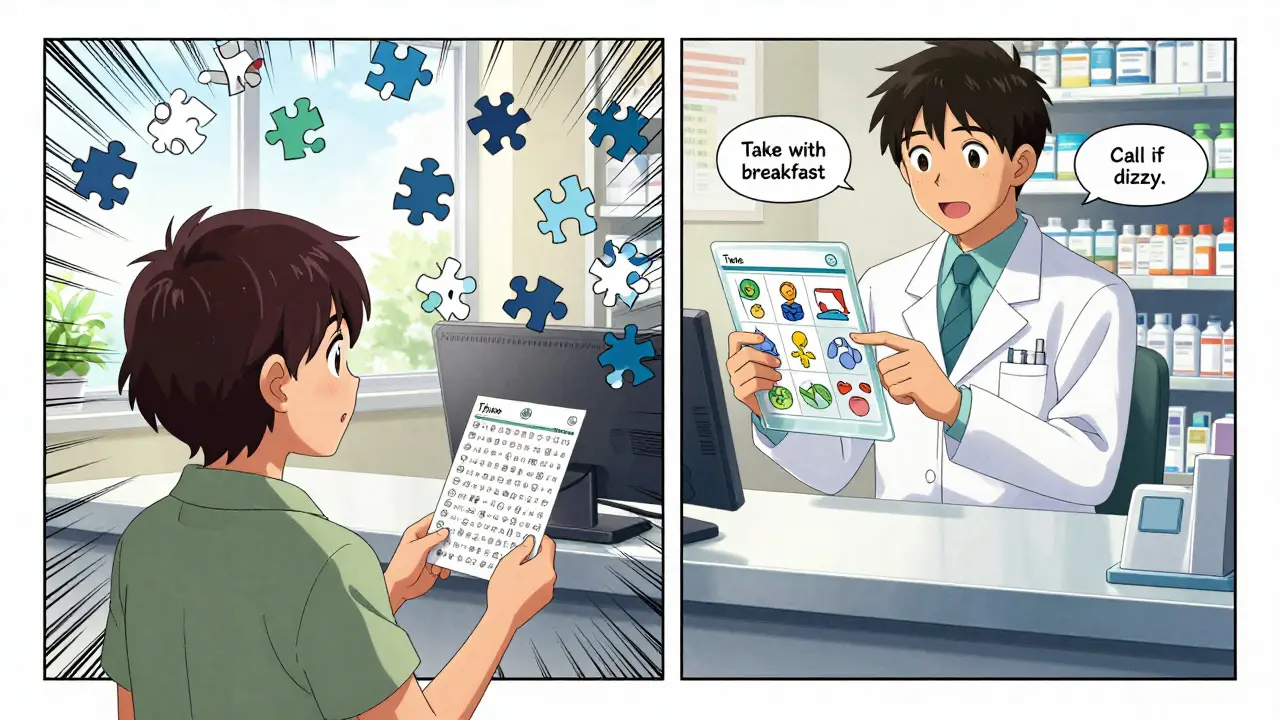
Getting a prescription filled shouldn’t feel like solving a puzzle in a language you don’t speak. Yet every day, people leave the pharmacy with a small paper slip full of medical jargon - take one tablet by mouth twice daily - and have no idea what it really means. Is twice daily before or after meals? Should you take it with food? What if you miss a dose? If you’ve ever stared at your medication label like it’s written in code, you’re not alone. And here’s the truth: you have the right to get instructions you can actually understand.
You Don’t Have to Guess What the Label Means
The U.S. healthcare system doesn’t legally require pharmacies to give you clear, written instructions with your prescriptions. That’s not a mistake - it’s a gap. A 2022 report from the Institute for Safe Medication Practices found that 63% of medication errors happen because patients didn’t understand how to take their drugs. These aren’t rare mistakes. They’re common, preventable, and often dangerous. You don’t need to wait for the system to fix itself. You have rights - and they’re backed by major health organizations, federal laws, and even pharmacy chains themselves. The American Medical Association says you have the right to ask questions and get answers you understand. The federal Office of Personnel Management says you’re entitled to accurate, easily understood information. Tennessee Oncology, CVS, Walgreens, and dozens of other providers list the same thing in their patient rights documents: you have the right to receive instructions in a way you can understand. This isn’t about being difficult. It’s about staying safe.What Clear Instructions Should Look Like
Clear instructions aren’t just shorter. They’re designed for real life. Here’s what they include:- Plain language: Instead of “take orally bid,” it says “take one pill by mouth two times a day.”
- Specific timing: “Take with breakfast and dinner,” not “twice daily.”
- Food notes: “Take on an empty stomach” or “Take with a full glass of water.”
- What to do if you miss a dose: “If you forget, take it as soon as you remember - unless it’s almost time for the next dose.”
- Warning signs: “Call your doctor if you feel dizzy, have trouble breathing, or get a rash.”
- Visual aids: Icons for morning, afternoon, night - or even pictures of pills.
How to Ask for Better Instructions (Step by Step)
Asking for help sounds simple. But if you’ve ever been brushed off with a shrug and a stack of tiny print, you know it’s not. Here’s how to make it work:- Ask to speak with the pharmacist - not the technician. Technicians fill prescriptions. Pharmacists are trained to explain them. In chain pharmacies, 73% of policies require technicians to hand off complex questions to a pharmacist.
- Use exact words from your rights. Don’t say, “Can you make this easier to read?” Say: “I’m exercising my right under the AmerisourceBergen Patient Rights document to receive education in a language I understand.” This triggers a legal and ethical obligation to respond.
- Ask for a visual schedule. Studies show patients who get picture-based schedules - like a calendar with icons for morning, noon, and night - are 42% more likely to take their meds correctly. Say: “Can you give me a one-page chart with pictures showing when to take each pill?”
- Do a read-back. After they explain, say: “Let me repeat it back to make sure I got it right.” Then say it in your own words. If you stumble, they’ll fix it. Johns Hopkins found this cuts errors by 63%.
- Document your request. Say: “I’m writing this down for my medical records.” Pharmacies are more likely to act when they know you’re keeping a record. A 2023 survey found 58% of pharmacies provided better instructions when patients said this.
When You Don’t Speak English
If English isn’t your first language, you have even stronger protections. Title VI of the Civil Rights Act of 1964 says any pharmacy receiving federal funds - that’s almost all of them - must provide translation services. You don’t need to ask nicely. You can say: “I need my medication instructions in Spanish, Mandarin, or [your language] per federal law.” A 2023 CMS report found 92% of pharmacies complied when patients used this exact phrase. Many pharmacies now offer translated leaflets, phone interpreters, or QR codes that link to videos in 20+ languages. CVS and Walgreens rolled out video instructions in 2024. Ask: “Do you have a video or audio version of this in [language]?”What to Do If They Say No
Sometimes, you’ll get a “we don’t do that” or “that’s not our policy.” That’s when you escalate.- Ask for the pharmacy manager.
- Call the toll-free number on the prescription bottle - most have one.
- File a complaint with your state’s Board of Pharmacy. Most have online forms.
- If you’re on Medicare, call 1-800-MEDICARE. They track complaints about patient communication.
What’s Changing - and What’s Coming
The system is slowly changing. The FDA is pushing for standardized icons on all prescription labels. Walgreens and CVS now use “Medi-Simplify” systems that generate pictogram guides. The federal government is considering the Patients’ Right to Know Their Medication Act (H.R. 1173), which would require every prescription to come with a one-page, plain-language guide - no exceptions. Right now, 32 states have introduced laws to improve medication instructions. Only 12 have passed them. But the trend is clear: patients are demanding better, and providers are starting to respond.Why This Matters More Than You Think
Poor medication understanding doesn’t just cause confusion. It causes hospital visits, emergency room trips, and even death. A 2023 JAMA Internal Medicine study found that $528 billion is spent each year in the U.S. on hospitalizations caused by medication mistakes - and 30% of those are because patients didn’t know how to take their pills. Getting clear instructions isn’t a luxury. It’s a safety net. It’s the difference between managing your health - and accidentally overdosing, skipping doses, or having a bad reaction because you thought “once daily” meant “when I remember.”What You Can Do Today
You don’t need to wait for a law to change. You don’t need to be an expert. You just need to speak up.- Next time you pick up a new prescription, ask for a simple, one-page summary.
- Ask for pictures or a calendar if your regimen is complex.
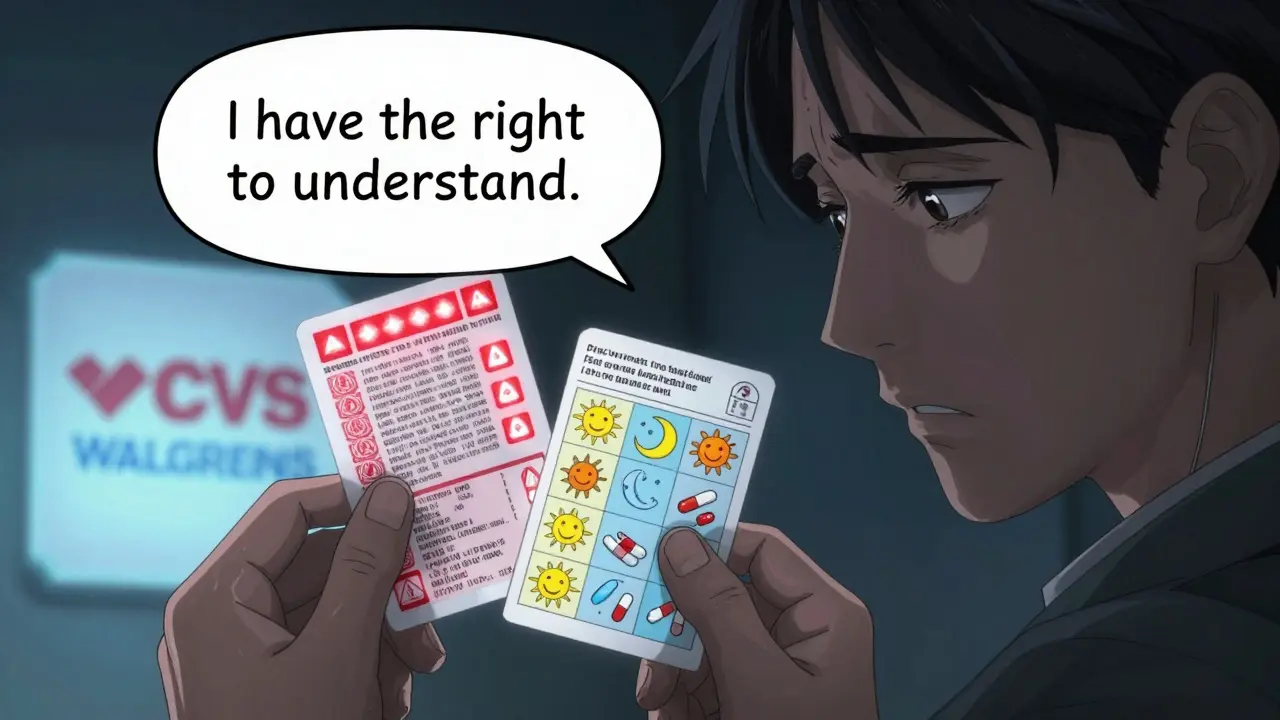
- Use the exact phrase: “I have the right to understand my medication instructions.”
- If you’re unsure, ask for a read-back.
- Write down what they say - and keep it with your meds.
Can I ask for medication instructions in a language other than English?
Yes. Under Title VI of the Civil Rights Act, any pharmacy that receives federal funding - which includes nearly all pharmacies in the U.S. - must provide translation services at no cost. You can say: “I need my medication instructions in [your language] per federal law.” Most pharmacies will provide printed translations, phone interpreters, or video instructions in over 20 languages. If they refuse, ask for the manager or file a complaint with Medicare at 1-800-MEDICARE.
What if the pharmacist says they don’t have time to explain?
Pharmacists are trained to explain medications - it’s part of their job. If they say they’re busy, say: “I understand you’re busy, but I need to make sure I take this correctly. Can you give me a printed summary I can review at home?” Most will agree. If not, ask to speak with the manager or call the pharmacy’s toll-free number listed on the bottle. You’re not being unreasonable - you’re protecting your health.
Are there apps or tools that can help me understand my prescriptions?
Yes. CVS Health and Walgreens now offer QR codes on prescriptions that link to video instructions in multiple languages. Apps like Medisafe, MyTherapy, and Meds 2.0 can generate plain-language summaries and send reminders. Some pharmacies also offer free phone counseling - just ask. You can also ask your doctor’s office for a printed medication list with clear instructions - many now provide this as part of care coordination.
Is it okay to ask for a visual schedule with pictures?
Absolutely. Visual schedules - like a calendar with icons for morning, noon, night, and a picture of each pill - are proven to improve adherence by 42%. You can say: “I have trouble remembering when to take my pills. Can you give me a picture chart?” Many pharmacies now use these for complex regimens, especially for seniors or people on multiple medications. If they don’t have one ready, they can often print one for you.
What should I do if I still don’t understand after asking?
Don’t guess. Call your doctor’s office and ask them to explain the instructions. You can also contact your insurance plan’s nurse line - most offer free health advice. If you’re on Medicare, call 1-800-MEDICARE. They can help you file a complaint or connect you with a patient advocate. Never start a new medication if you’re unsure how to take it. It’s safer to wait and get help than to risk a bad reaction.

15 Comments
Dylan SmithDecember 17, 2025 AT 07:15
Why do we still let pharmacies get away with this? I got my blood pressure med last week and the label said 'take one by mouth bid' like I'm supposed to be a doctor. I had to call my sister who's a nurse just to figure out if I was supposed to eat first. This isn't rocket science. Just write it like a human being talks.
Randolph RickmanDecember 18, 2025 AT 10:53
This is exactly why I started carrying a laminated card in my wallet that says 'I need clear written instructions in plain language per AMA and OPM guidelines.' I've used it three times. Twice they gave me a printed sheet with icons. Once they called the pharmacist over. It works. Don't be shy. You're not asking for a favor-you're demanding basic safety.
Kayleigh CampbellDecember 19, 2025 AT 04:36
So we’re telling people to yell ‘Title VI’ at the pharmacy like it’s a magic spell? Cute. Meanwhile, my grandma still gets confused because the font’s smaller than a mosquito’s eyelash. Maybe fix the damn label design before we make patients into legal ninjas.
Dave AlponvyrDecember 20, 2025 AT 03:36
Ask for pictures. Always. It’s that simple.
Colleen BigelowDecember 22, 2025 AT 02:19
They don’t want you to understand because if you did, you’d realize how much they’re overcharging you. The whole system’s rigged. Pharmacies, Big Pharma, the FDA-they all profit off confusion. That’s why they won’t change. You think they’re gonna give you a color-coded chart when they’re making bank off you forgetting your pills and ending up in the ER? Wake up.
Elizabeth BaumanDecember 23, 2025 AT 06:23
I love how we’re all acting like this is some new problem. I’ve been asking for plain-language labels since 2012. Every time, they give me a 20-page PDF with tiny text. The only thing that changed? Now they say ‘we’re compliant’ and hand you a QR code that links to a video in 14 languages you don’t speak. This isn’t progress. It’s performance art.
Billy PolingDecember 23, 2025 AT 20:39
It is imperative to underscore the systemic deficiencies inherent in the current pharmaceutical communication infrastructure, which, as a matter of professional and ethical obligation, must be rectified through legislative intervention and institutional accountability. The absence of standardized, linguistically accessible, and cognitively appropriate medication labeling constitutes a violation of both the Hippocratic Oath and the foundational tenets of patient autonomy as codified in the Patient Bill of Rights, and it is therefore incumbent upon all stakeholders-including pharmacists, physicians, and regulatory bodies-to implement mandatory plain-language protocols with enforceable compliance metrics, lest we continue to perpetuate preventable morbidity and mortality on a national scale.
Arun anaDecember 25, 2025 AT 01:28
Love this. I’m from India and my mom got her diabetes meds here last year. She didn’t speak English. The pharmacist pulled up a video in Hindi on his tablet. No big deal. Just ask. They can do it. They just need you to push a little.
Ron WilliamsDecember 25, 2025 AT 03:17
As someone who’s worked in community health for 15 years, I’ve seen this play out over and over. The real win isn’t just getting a better label-it’s changing the culture. When patients start saying ‘I need this in plain language’ without shame, the system starts listening. It’s not about being loud. It’s about being consistent. One person asking, then another, then another-that’s how change happens.
Kim HinesDecember 26, 2025 AT 03:01
I just use the Medisafe app now. It reads the label to me in my voice. I don’t even have to talk to anyone. Works great.
Kitty PriceDecember 26, 2025 AT 09:47
❤️ This should be mandatory. My aunt missed doses for months because she thought ‘once daily’ meant ‘once a day, whenever.’ She ended up in the hospital. We printed a color chart with emojis. She’s fine now. Just give people pictures.
Cassandra CollinsDecember 27, 2025 AT 15:17
they dont want you to know how to take it right because then you'd realize how many of these drugs are just for profit and not for healing... also i heard the barcodes on the bottles are tracking you... dont trust them
Joanna EbizieDecember 29, 2025 AT 07:43
Wow. So you’re telling me people still don’t know how to read a pill bottle? I thought we were past this. You’re not a child. Get a translator app. Or just ask your kid. This isn’t a crisis. It’s laziness.
Mike SmithDecember 29, 2025 AT 15:19
Thank you for this. As a former pharmacy technician, I can tell you-most of us want to help. But we’re understaffed, rushed, and not trained to explain. If you say, ‘Can you help me understand this?’-not ‘Can you explain this?’-we’ll drop everything. You’re not a burden. You’re a partner in care.
Aditya KumarDecember 30, 2025 AT 10:13
Yeah, whatever. I just Google it.