
Fish Oil & Aspirin Safety Calculator
Check Your Safety Threshold
Based on medical studies showing minimal bleeding risk below 3g EPA/DHA daily
Many people take fish oil for heart health and aspirin to protect against heart attacks. But when you put them together, does the risk of bleeding go up? It’s a common question-and one that’s been debated for years. The truth isn’t as scary as some websites make it seem, but it’s not simple either. If you’re taking both, you need to know what the science actually says-not the fear-based headlines.
How Fish Oil and Aspirin Work
Aspirin doesn’t just relieve headaches. At low doses-usually 81 mg daily-it works as a blood thinner by stopping platelets from clumping together. It does this by permanently blocking an enzyme called COX-1. Once a platelet is hit by aspirin, it’s out of commission for its entire 7- to 10-day life. That’s why doctors prescribe it for people at risk of heart attacks or strokes.
Fish oil works differently. It’s packed with omega-3 fatty acids-EPA and DHA. These get built into the membranes of your platelets, making them less sticky. They don’t shut down enzymes like aspirin does. Instead, they change the environment so platelets respond less strongly to signals that trigger clumping. This effect takes time. You need to take fish oil daily for at least two weeks before you see any measurable change in platelet behavior.
Here’s the key: aspirin cuts platelet activity by 70-90% in response to arachidonic acid. Fish oil, even at high doses, only reduces it by 20-40%. That’s a big difference in strength. One is a sledgehammer. The other is a gentle nudge.
Do They Combine to Cause More Bleeding?
Early studies raised alarms. Some small trials in the 2000s suggested fish oil might add to aspirin’s effect. One 2012 study of 56 people with type 2 diabetes found that combining 4 grams of fish oil with 81 mg of aspirin reduced platelet clumping more than aspirin alone. That sounds concerning-until you look at the bigger picture.
Large, long-term studies tell a different story. The ASCEND trial followed 15,480 diabetic adults for over seven years. Half took 1 gram of fish oil daily. The other half took a placebo. The results? No increase in bleeding events. Not even a hint. The same was true in the VITAL study, which tracked nearly 26,000 people. Those taking 1 gram of omega-3s daily had no higher risk of bleeding than those on placebo-even when many were also on aspirin.
Even in high-risk situations, like cardiac surgery, fish oil didn’t cause more bleeding. A 2010 study gave 8 grams of fish oil to patients before surgery. They had less irregular heart rhythms afterward-and no more bleeding than those who didn’t take it.
So why do people worry? Because theory doesn’t always match reality. Just because two things *could* add up doesn’t mean they *do* in real life. The body has backup systems. Platelets aren’t the only players in clotting. Your liver, your plasma proteins, your blood vessels-they all help keep things balanced.
What Dose Matters?
Not all fish oil is the same. The dose makes the difference.
Most over-the-counter supplements contain about 300-500 mg of EPA and DHA per capsule. Two capsules = 600-1,000 mg. That’s the standard dose. At this level, there’s virtually no evidence of added bleeding risk-even with aspirin. The American Heart Association, after reviewing 12 trials with over 33,000 people, concluded that omega-3 supplements don’t increase bleeding risk, even with blood thinners.
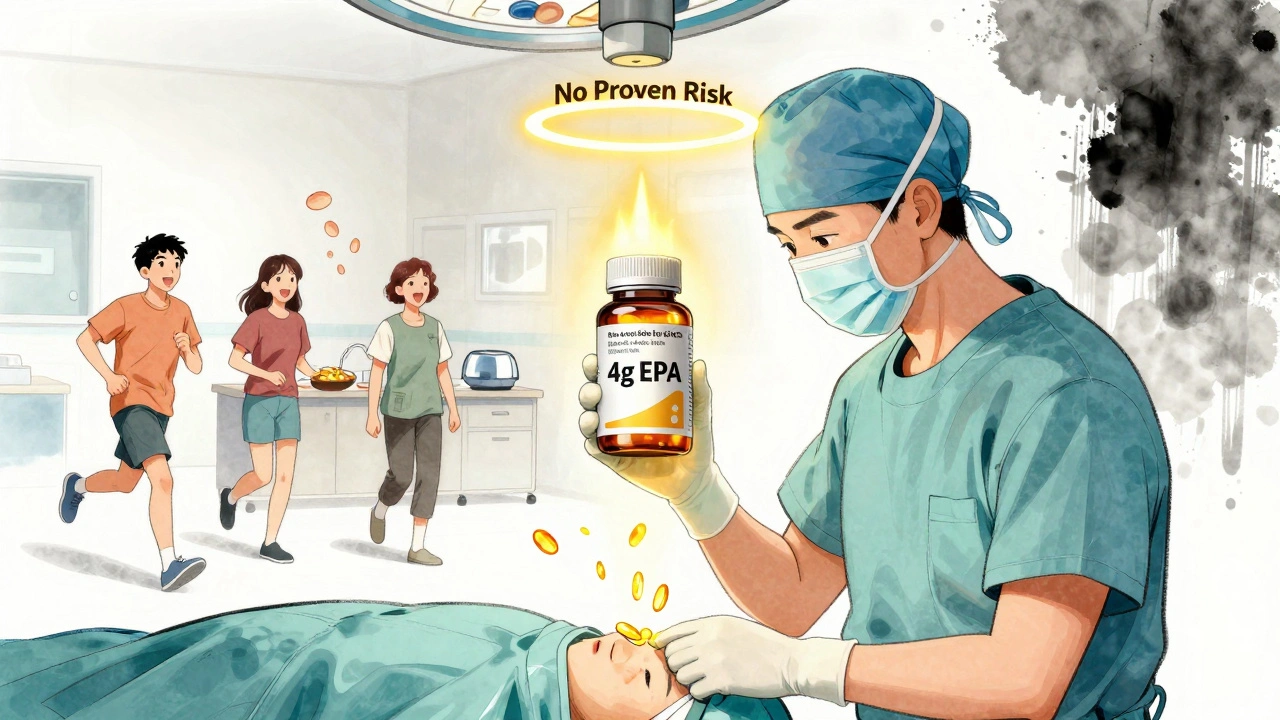
But what about higher doses? Prescription-grade omega-3s, like Vascepa, contain 4 grams of pure EPA daily. That’s way more than any supplement. The FDA issued a warning in 2019 about possible bleeding risk at doses above 4 grams-but that was based on isolated case reports, not solid data. Later studies, including a 2023 analysis from the STRENGTH trial, found no increased bleeding even with 4 grams of omega-3s plus aspirin.
So here’s the rule: if you’re taking less than 3 grams of EPA+DHA daily, you’re not adding meaningful bleeding risk by mixing it with aspirin. If you’re on 4 grams or more, talk to your doctor. But even then, the risk isn’t proven-it’s theoretical.

What About Surgery or Dental Work?
This is where confusion spikes. Surgeons and dentists often tell patients to stop fish oil a week before procedures. Why? Because it’s easier to say “stop everything” than to explain nuanced science. It’s precautionary, not evidence-based.
Real-world data shows most people don’t bleed more. A Drugs.com review of 1,247 patient reports found that 78% had no bleeding issues with fish oil and aspirin together-even after dental work. Only 4% reported significant bleeding, and many of those were on other blood thinners too.
Still, if you’re having major surgery-especially heart, brain, or spinal surgery-it’s smart to pause fish oil for 7-10 days. Not because it’s dangerous, but because it removes one variable. Your surgeon doesn’t want to wonder if a bleed was caused by fish oil, aspirin, or something else. It’s about clarity, not risk.
For routine dental cleanings or fillings? No need to stop. The bleeding risk from pulling a tooth is far more about technique and your own clotting ability than fish oil.
Who Should Be Extra Cautious?
Most people can safely take fish oil and aspirin together. But some groups should check in with their doctor:
- People on multiple blood thinners (like warfarin, clopidogrel, or apixaban) - even though fish oil alone isn’t a strong risk, stacking it with other drugs needs monitoring.
- Those with bleeding disorders (hemophilia, von Willebrand disease) - their systems are already fragile.
- People with very low platelet counts - fish oil won’t fix that, but it won’t help either.
- Anyone who notices unusual bruising, nosebleeds, or blood in stool or urine - stop both and get checked.
If you’re healthy, take low-dose aspirin for heart protection, and use fish oil for triglycerides or general wellness, you’re likely fine. The real danger isn’t the combination-it’s stopping something that’s helping you.
What Do Experts Really Say?
There’s no universal agreement, but the weight of evidence is clear. Dr. Deepak Bhatt, a leading cardiologist, says: “Over-the-counter fish oil at standard doses doesn’t meaningfully add to aspirin’s effect.” Dr. William Harris, a top omega-3 researcher, argues that higher doses (>2g daily) may offer extra benefit in high-risk patients-but still doesn’t claim it’s dangerous.
The American Heart Association says: “No increased bleeding risk.” The European Society of Cardiology says: “Theoretical risk at >3g/day, but no clinical evidence.” The Mayo Clinic advises stopping it before surgery, not because it’s risky, but because it’s easier to manage.
Bottom line? The medical community doesn’t agree on everything-but they all agree on this: the fear of bleeding from fish oil and aspirin is way out of proportion to the actual risk.
What Should You Do?
If you’re taking both:
- Check your fish oil label. How much EPA and DHA are you getting per serving? If it’s under 3 grams total, you’re fine.
- Don’t stop either without talking to your doctor. If aspirin is protecting your heart, don’t quit it. If fish oil lowers your triglycerides, don’t toss it.
- Watch for signs of unusual bleeding: gums that bleed easily, bruises without injury, dark or bloody stools, prolonged nosebleeds.
- Before any surgery or invasive procedure, tell your provider you take both. Let them decide whether to pause fish oil.
- Don’t self-prescribe high doses. 4 grams of omega-3s isn’t a supplement-it’s a drug. Get it through a prescription if you need it.
The biggest mistake people make is letting fear replace facts. Fish oil and aspirin aren’t a dangerous combo. They’re two tools that, for many, work well together. The key isn’t avoiding them-it’s understanding them.
Can I take fish oil and aspirin together safely?
Yes, for most people. If you’re taking standard doses-less than 3 grams of EPA and DHA daily from fish oil-and 81 mg of aspirin, there’s no strong evidence that this combination increases bleeding risk. Large studies involving tens of thousands of people have found no significant rise in bleeding events when the two are used together.
Does fish oil thin your blood as much as aspirin?
No. Aspirin reduces platelet clumping by 70-90% by permanently blocking an enzyme. Fish oil only reduces it by 20-40% at high doses, and it works differently-by changing the platelet membrane. Aspirin’s effect is strong and immediate. Fish oil’s effect is mild and takes weeks to build up.
Should I stop fish oil before surgery?
For major surgery-like heart, brain, or spine procedures-it’s common practice to stop fish oil 7-10 days beforehand. This isn’t because it’s proven dangerous, but to reduce uncertainty. For minor procedures like dental fillings or extractions, stopping isn’t necessary. Always tell your surgeon or dentist you’re taking fish oil and aspirin.
Can fish oil replace aspirin for heart protection?
No. Fish oil is not a substitute for aspirin in preventing heart attacks or strokes. Aspirin directly blocks platelet aggregation, which is critical for preventing clots in arteries. Fish oil helps lower triglycerides and may reduce inflammation, but it doesn’t reliably stop platelets from forming dangerous clots. Don’t stop aspirin without talking to your doctor.
What’s the safest dose of fish oil if I’m on aspirin?
Stick to doses under 3 grams of combined EPA and DHA per day. That’s what most over-the-counter supplements provide. Higher doses (4g+) are prescription-only and used for specific conditions like very high triglycerides. At standard doses, there’s no proven added risk with aspirin. Always check the label-many capsules contain only 250-300 mg of active omega-3s, so you may need two or three to reach 1 gram.
Are there signs I should stop taking fish oil and aspirin together?
Yes. If you notice unexplained bruising, frequent nosebleeds, blood in your urine or stool, or bleeding that won’t stop after minor cuts, stop both and contact your doctor. These aren’t common side effects, but they could signal an underlying issue. Also, if you’re scheduled for surgery, discuss your regimen with your provider-even if you feel fine.

14 Comments
Emily HaworthDecember 13, 2025 AT 06:19
I swear I read somewhere that fish oil is just Big Pharma’s way to get us hooked on supplements so they can sell us more drugs 😅💀Webster BullDecember 14, 2025 AT 16:58
Aspirin + fish oil = chill combo. My grandpa took both for 20 years and still hikes. No bleeding. Just vibes.Lauren ScrimaDecember 15, 2025 AT 12:58
Ohhh so THAT’S why my gums bleed every time I floss… 😏Yatendra SDecember 15, 2025 AT 23:11
The body is a symphony… and aspirin? It’s the tuba that plays too loud. Fish oil? A whispering flute. Together? They harmonize… if you listen deeply.Alvin MontanezDecember 17, 2025 AT 03:40
You people are so naive. The FDA warned about bleeding. The studies are funded by supplement companies. Wake up. This isn’t science-it’s marketing dressed in lab coats.Tom ZerkoffDecember 19, 2025 AT 00:34
The data is robust and reproducible. The ASCEND and VITAL trials, both randomized and double-blind, involved over 40,000 participants collectively. No statistically significant increase in major bleeding events was observed. The theoretical risk does not equate to clinical reality.Jamie ClarkDecember 19, 2025 AT 21:55
You’re all missing the point. If you’re taking aspirin, you’re already at risk. Adding fish oil is like adding gasoline to a smoldering fire. You’re not being cautious-you’re being reckless. Someone’s gonna die because someone thought ‘it’s probably fine.’Casey MellishDecember 20, 2025 AT 13:33
In Australia, we’ve got GPs who still tell patients to stop fish oil before surgery. It’s not because it’s dangerous-it’s because they don’t have time to explain the science. We’re stuck with outdated protocols because medicine moves slower than bureaucracy.Donna HammondDecember 21, 2025 AT 09:15
I’m a nurse and I’ve seen patients on both. One guy had a minor tooth extraction and bled for 45 minutes-turns out he was taking 4g of fish oil AND warfarin. That’s the real danger: stacking multiple anticoagulants. But fish oil alone? Not a problem. Always check the full list.Richard AyresDecember 22, 2025 AT 18:25
I appreciate how this breaks it down without fearmongering. I’ve been taking 1g of fish oil with my daily aspirin for five years now. No issues. My cardiologist said the same thing: the science says it’s fine. It’s the hype that’s dangerous.kevin morangaDecember 24, 2025 AT 18:11
I used to freak out every time I saw a bruise. Then I read the actual studies-not the blog posts. Now I take 2.4g of fish oil daily with my 81mg aspirin, and I feel way better. My triglycerides dropped, my joints don’t creak, and I haven’t bled out yet. Maybe the body knows what it’s doing? Just saying.Tyrone MarshallDecember 26, 2025 AT 09:14
There’s a quiet wisdom in trusting science over fear. We’ve spent centuries trying to control nature, but sometimes nature just… works. Aspirin and fish oil? They’re not enemies. They’re teammates. Let’s not turn allies into villains because someone made a scary headline.nina nakamuraDecember 28, 2025 AT 09:13
You all think you’re so smart because you read a study. But you didn’t read the fine print. The trials excluded people with bleeding disorders. They excluded people on multiple anticoagulants. So your ‘safe’ is someone else’s death sentence. You’re not informed-you’re lucky.Himmat SinghDecember 28, 2025 AT 21:53
The American Heart Association endorses this combination? How convenient. They are funded by pharmaceutical interests. The real truth is hidden behind institutional authority. Question everything.