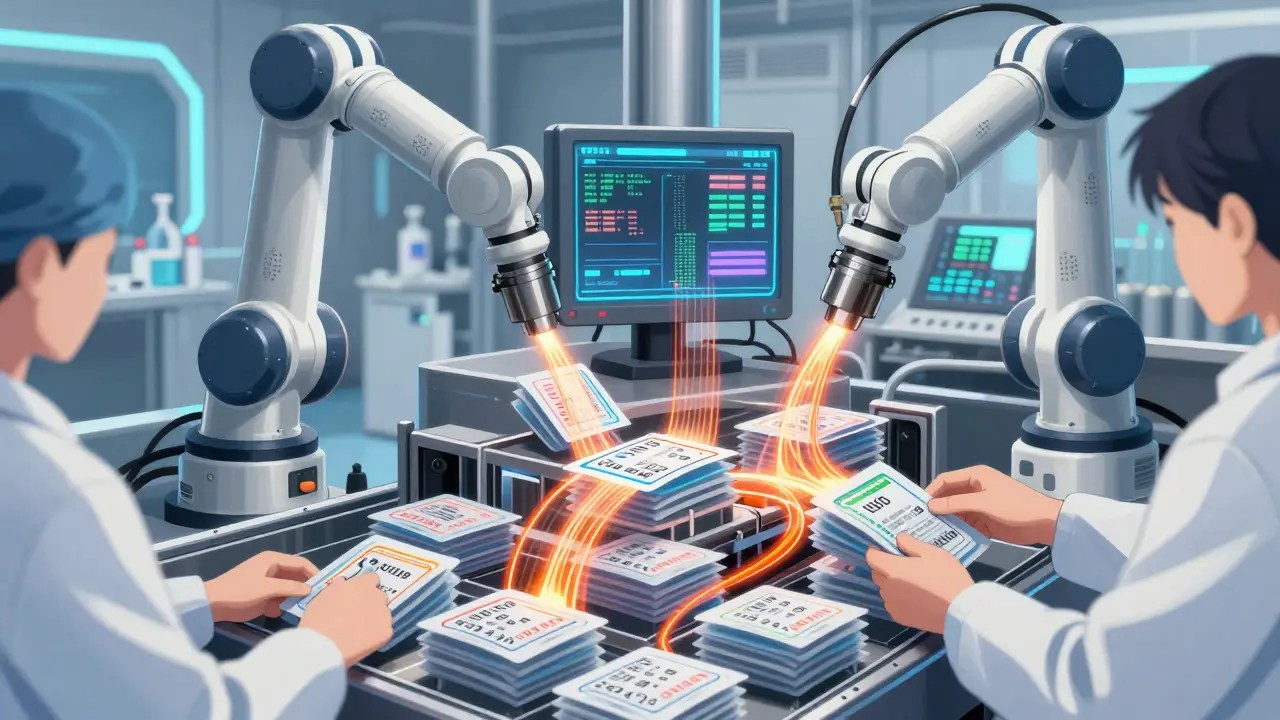
Every year, counterfeit drugs cost the U.S. healthcare system billions and put patients at serious risk. The Drug Supply Chain Security Act (DSCSA) was created to tackle this issue head-on. Here’s how it works.
Key Takeaways
- The DSCSA is a federal law passed in 2013 to track prescription drugs from manufacturer to patient, preventing counterfeit drugs from entering the supply chain.
- It requires unique serial numbers on each drug package, electronic transaction data sharing, and verification of legitimacy at every step.
- By November 2024, all trading partners must use electronic systems for full package-level traceability, replacing paper-based methods.
- While the system reduces counterfeit risk by up to 95%, implementation challenges like high costs and data mismatches remain.
- Pharmacies and distributors face significant costs ($100K-$500K per pharmacy) but benefit from faster recalls and reduced drug diversion.
What is the DSCSA?
Drug Supply Chain Security Act (DSCSA) is a federal law signed into law on November 27, 2013, as part of the Drug Quality and Security Act (DQSA). Administered by the U.S. Food and Drug Administration (FDA), the DSCSA creates an interoperable, electronic system to identify and trace prescription drugs as they move through the supply chain. Its primary goal is to prevent counterfeit, stolen, or contaminated drugs from reaching patients. Before the DSCSA, the U.S. had a patchwork of state-level regulations, making it difficult to track drugs nationwide. The law was a direct response to growing concerns about drug diversion and counterfeit medications entering the legitimate supply chain.
How the Track-and-Trace System Works
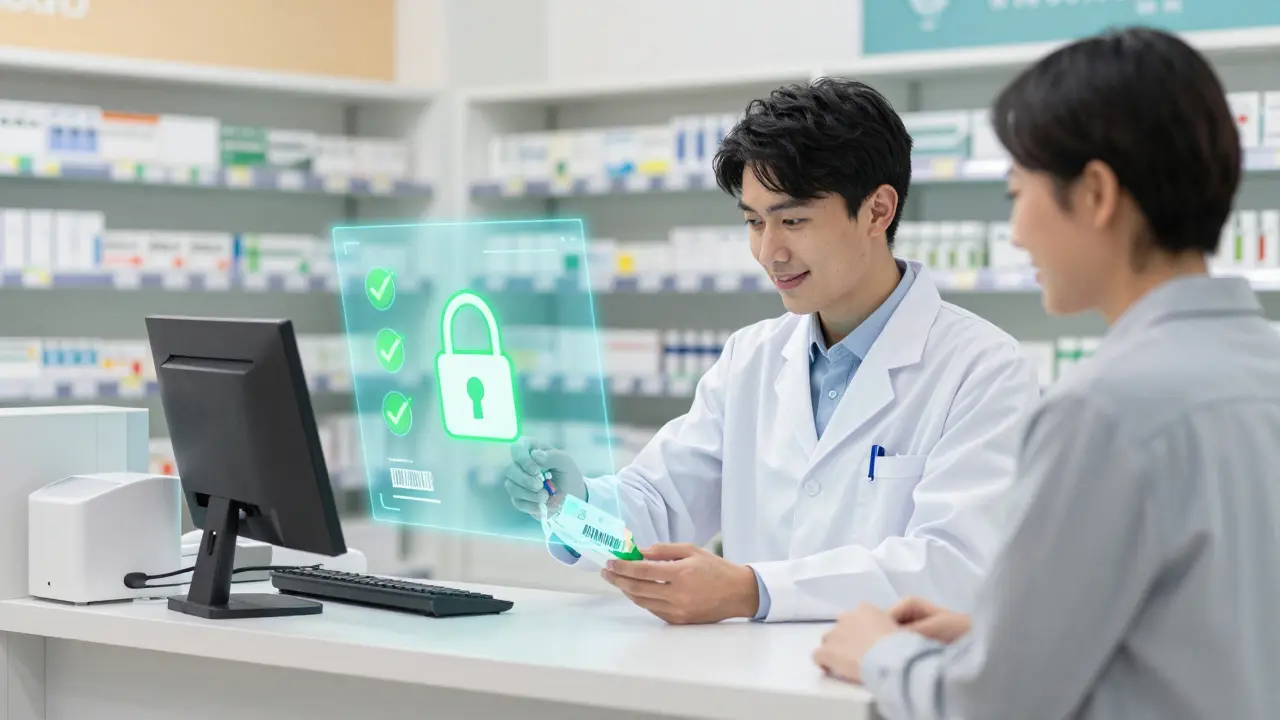
At its core, the DSCSA requires each drug package to have a unique identifier. This includes the National Drug Code (NDC), lot number, expiration date, and a serial number. Manufacturers and repackagers must print this information in both human-readable and machine-readable formats (like barcodes) on every package. When a drug moves from one entity to another-say, from a manufacturer to a wholesaler-the receiving party must verify the package’s legitimacy. This happens through three key pieces of electronic data: Transaction Information (TI), which includes product details; Transaction History (TH), documenting previous distribution; and Transaction Statement (TS), certifying the transaction is legitimate. These data points are shared using Electronic Product Code Information Services (EPCIS) standards, ensuring different systems can talk to each other. For example, if a pharmacy receives a shipment, it scans the barcode, checks the serial number against the manufacturer’s database, and verifies the transaction history before accepting the drugs. This process happens within seconds, stopping fake or diverted products before they reach patients.
Key Requirements for Compliance
By law, all trading partners must follow specific rules. Manufacturers must serialize every package with a unique serial number using GS1 standards, which specify 20-character alphanumeric codes. Wholesalers and pharmacies must verify each package’s legitimacy before accepting it. This means checking serial numbers against manufacturer databases and ensuring transaction data matches. The FDA requires all entities to maintain electronic records for at least six years. Since November 2017, the law has mandated that serialization be visible on all packages. By November 27, 2024, every trading partner must use fully electronic systems for tracking. This means no more paper-based records. For example, a pharmacy must scan a barcode to confirm a drug’s legitimacy before dispensing it to a patient. If the system flags a mismatch, the pharmacy must quarantine the product and investigate.
Benefits for Patient Safety
The DSCSA has already made the drug supply chain safer. The FDA estimates it reduces counterfeit drug risks by up to 95%. When a drug is recalled-say, due to contamination-the system allows companies to target only the affected lots instead of recalling entire product lines. This saves time and money while minimizing patient disruption. For instance, if a contaminated batch of insulin is found, pharmacists can quickly identify which patients received it using serial numbers. Drug diversion (when prescription drugs are stolen or sold illegally) has dropped by 40% since the DSCSA’s implementation, according to McKesson’s 2023 analysis. Hospitals and pharmacies report fewer incidents of counterfeit medications on their shelves. In 2022, CVS Health reduced suspect product investigations by 75% using automated verification systems. This means pharmacists spend less time chasing fake drugs and more time caring for patients.
Implementation Challenges
Despite the benefits, implementing the DSCSA isn’t easy. Small pharmacies face major hurdles. A 2023 National Community Pharmacists Association survey showed 68% of independent pharmacies report DSCSA compliance as their top technology challenge, with average costs of $185,000 per pharmacy. Larger chains like Walgreens spent $120 million on DSCSA upgrades in 2021-2022. Technical issues also persist. Data mismatches between trading partners-like discrepancies in serial numbers or lot codes-cause delays in drug verification. Reddit discussions in the r/pharmacy subreddit reveal common complaints about “2-3 day delays in product verification” due to inconsistent EPCIS implementation. A 2022 Healthcare Distribution Alliance survey found 42% of companies report “significant data mismatches” as their primary implementation hurdle. These issues slow down supply chains and increase compliance risks. For example, if a wholesaler’s system doesn’t recognize a manufacturer’s serial number format, the shipment gets stuck at the warehouse.
Current Status and the 2024 Deadline
The final deadline for full DSCSA compliance is November 27, 2024. As of Q2 2023, 98% of manufacturers and 95% of wholesale distributors have implemented serialization systems, but only 72% of pharmacies are fully compliant. The FDA has extended enforcement discretion until the deadline, meaning they’re not penalizing minor issues during this period. However, Commissioner Dr. Robert Califf stressed in September 2023 that “the agency will exercise enforcement discretion during the stabilization period but expects full compliance by November 2024.” Industry groups like the Healthcare Distribution Alliance report 85% of companies have completed system integration testing as of Q3 2023. The FDA is also exploring extending the DSCSA to over-the-counter medications, particularly high-risk products like pain relievers. PwC projects DSCSA-compliant systems will reduce counterfeit drug incidents by 90% by 2027 and save $2.3 billion annually through efficient recalls. But experts warn that without better interoperability between systems, the full benefits won’t be realized.
Comparison of DSCSA and EU FMD Requirements
| Feature | DSCSA (US) | EU FMD (Europe) |
|---|---|---|
| Central Repository | No | Yes |
| Serialization Requirements | Unique serial number on each package | Unique identifier with anti-tampering device |
| Data Sharing | Electronic transaction data between partners | Central repository for verification |
| Implementation Deadline | November 2024 | 2019 |
What happens if a pharmacy doesn’t comply with DSCSA by 2024?
The FDA can issue warning letters, impose fines, or even shut down non-compliant operations. For example, in 2022, the FDA issued a warning letter to a regional distributor for failing to investigate and report suspect products as required. Pharmacies that don’t verify drugs properly risk dispensing counterfeit medications, which could harm patients and lead to lawsuits. However, the FDA is currently exercising enforcement discretion during the stabilization period, focusing on education rather than penalties until the deadline.
How does DSCSA differ from the EU’s Falsified Medicines Directive?
The EU FMD requires a central repository where all drug data is stored, while the DSCSA uses decentralized data sharing between trading partners. The EU also mandates anti-tampering devices on packaging, which the DSCSA doesn’t require. Additionally, the EU FMD was fully implemented in 2019, whereas the DSCSA has a longer phased timeline ending in 2024. Both systems aim to prevent counterfeits, but the EU’s approach is more centralized and includes physical safety features.
What are the main challenges pharmacies face with DSCSA implementation?
High costs are the biggest hurdle. Independent pharmacies spend an average of $185,000 on system upgrades, which is tough for small businesses. Technical issues like data mismatches between vendors cause verification delays-some systems take 2-3 days to confirm a drug’s legitimacy. Many pharmacies also struggle with integrating legacy systems (like old pharmacy software) with new DSCSA-compliant tools. A 2022 survey found 42% of companies cite data mismatches as their primary implementation challenge.
How does serialization prevent counterfeit drugs?
Serialization assigns a unique code to every drug package, like a digital fingerprint. When a pharmacy receives a shipment, it scans the code and checks it against the manufacturer’s database. If the serial number doesn’t match or appears in a suspicious transaction history, the system flags it as counterfeit or diverted. For example, if a fake insulin package has a copied serial number from a legitimate product, the verification system will catch it because the database shows that serial was already used. This makes it nearly impossible for counterfeiters to replicate the system.
What role does the FDA play in enforcing DSCSA?
The FDA oversees the entire DSCSA system. They set the rules, issue guidance documents, and monitor compliance. For example, they defined “suspect products” as those that are counterfeit, diverted, or unfit for distribution. The FDA also conducts inspections and issues warning letters to non-compliant entities. However, during the current stabilization period (2023-2024), they’re focusing on helping companies fix issues rather than penalizing them. Commissioner Califf stated the agency will enforce the law strictly after the November 2024 deadline.

11 Comments
Kieran GriffithsFebruary 6, 2026 AT 01:59
The DSCSA is a crucial step in protecting patients from counterfeit drugs. While there are challenges like costs for small pharmacies, the benefits in safety and traceability are undeniable. It's about working together to make sure every drug is legitimate. We need more support for smaller players, but the system itself is sound.
Lisa ScottFebruary 7, 2026 AT 05:04
This DSCSA is a sham. They're using 'counterfeit drugs' as an excuse to control the supply chain. The 'unique serial numbers' are just a way to track us. Big pharma and the government are in cahoots.
Costs are insane for small pharmacies. It's all about control not safety. No real proof it works. Just a money grab.
They're lying to us. This system is broken. It's a scam. Trust me.
jan civilFebruary 8, 2026 AT 02:00
I see your concerns. Data shows DSCSA reduces counterfeits by 95%. Challenges exist but solutions are possible with better support for pharmacies.
Tehya WilsonFebruary 8, 2026 AT 11:58
DSCSA ineffective. High costs. Data mismatches. Doesn't solve problem. Just adds bureaucracy. Patient safety still at risk. The system is flawed. It's not working. They're wasting money. No real improvement. Just more paperwork. This is a failure. The FDA should do better. They're not helping. Just making things worse. The whole thing is a joke. It's not protecting anyone.
Jennifer AronsonFebruary 9, 2026 AT 07:05
While there are challenges, the DSCSA has significantly reduced counterfeit drugs. The FDA's enforcement discretion is reasonable during this phase. Let's focus on improving implementation rather than dismissing the system entirely.
Kate GileFebruary 10, 2026 AT 10:58
This is great progress! Working together, we can overcome the implementation hurdles. Patient safety is worth the effort. Let's keep pushing forward!
Gregory RodriguezFebruary 11, 2026 AT 16:25
Oh sure, DSCSA is amazing! $500k per pharmacy? What a bargain! Just kidding, but seriously, it's a lifesaver. Maybe next time they'll actually fund it properly. We're all just here to watch the chaos unfold.
Johanna PanFebruary 13, 2026 AT 15:01
This is really important for patient saftey. Even though there are challenges, it's a step forward. We need to keep working on it. The EU FMD is different but both aim to protect people. Great job everyone.
Jenna ElliottFebruary 15, 2026 AT 10:57
US should lead here. EU's system is better but we're doing it right. This is about national security. Anyone against DSCSA is against American healthcare.
Elliot AlejoFebruary 16, 2026 AT 03:11
DSCSA has its challenges but the benefits outweigh the costs. We need to work together to fix data mismatches and support small pharmacies. It's not about politics, it's about patient safety.
lance blackFebruary 17, 2026 AT 20:38
This saves lives. Period.