
| Feature | Fixed-Dose Combination (FDC) | De Facto Combination |
|---|---|---|
| Dosing Flexibility | Low (Fixed ratios) | High (Adjustable per drug) |
| Patient Adherence | Higher (Lower pill burden) | Lower (More pills to track) |
| Regulatory Testing | Rigorous stability & compatibility tests | Individual drug testing only |
| Cost | Can be higher (Branded) | Often lower (Multiple generics) |
The Mechanics of Fixed-Dose Combinations
To understand why some people avoid them, we first need to look at what they are. A Fixed-Dose Combination (or FDC) is a medicinal product containing two or more active substances combined in a fixed ratio in a single dosage form. The European Medicines Agency (EMA) sets strict rules for these: they must prove that every ingredient actually helps and that the combination is safer or more effective than the drugs alone. FDCs are designed to solve the "pill burden" problem. If you're treating HIV, for example, taking 10 different pills a day is a recipe for disaster. By combining them, manufacturers boost adherence. In fact, research shows that every extra pill added to a daily routine can drop patient adherence by about 16%. By using an FDC, adherence rates typically jump by 22%.Why Choose Separate Generics?
If FDCs are so efficient, why would a doctor prescribe separate generics? The answer usually comes down to precision. FDCs come in set ratios. Let's say an FDC pill offers 10mg of Amlodipine and 80mg of Valsartan. But what if you only need 5mg of Amlodipine? You can't just split the pill in half-that often ruins the medication's release profile. This is where de facto combinations shine. By using separate generic medications, a clinician can titrate the dose exactly. This is critical for patients with renal or hepatic impairment, where the body processes drugs slower. In type 2 diabetes, nearly 67% of patients require these kinds of individualized adjustments that a standard FDC pill simply can't provide. Beyond health, there's the wallet. In markets with heavy generic competition, buying two separate generic bottles is often cheaper than buying one branded FDC. While FDCs save money through manufacturing efficiency, the sheer volume of generic competitors for single-ingredient drugs can drive prices down further.
The Hidden Risks of the "Therapeutic Wild West"
It's not all sunshine and savings, though. When you take an approved FDC, the manufacturer has done the hard work of ensuring the chemicals don't react poorly to each other inside the pill. De facto combinations skip this step. Some experts, including those from the University of Pennsylvania, describe this as a "therapeutic Wild West" because the stability and interaction of these specific generics together haven't been formally tested as a single unit. There is also the very real issue of human error. A patient on a forum once mentioned switching to separate generics to save $15 a month, only to start missing doses because they couldn't remember which "blue pill" was which. When you increase the number of pills, you increase the chance of a mistake. For some, the cost savings aren't worth the risk of a hypertensive crisis because they forgot the second pill of the pair.Real-World Impact Across Diseases
Not all medical conditions handle these combinations the same way. In HIV treatment, FDCs are the gold standard; nearly 89% of patients use them because missing a single dose can lead to drug resistance. Here, the risk of a de facto combination is too high. In contrast, hypertension treatment is more flexible. About 43% of patients in this category use separate generics. Because blood pressure meds often require a "trial and error" phase to find the right dose, the flexibility of separate pills is more valuable than the convenience of a single one.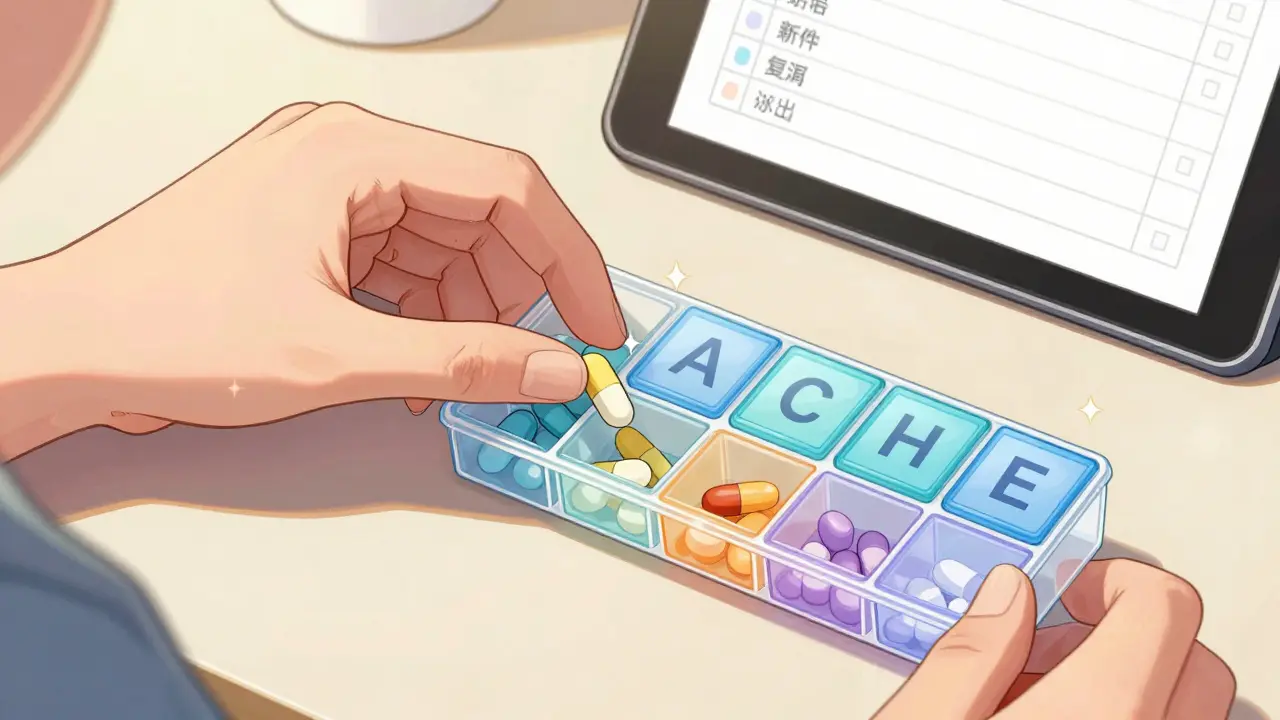
How to Manage Separate Generics Safely
If you or a loved one are using de facto combinations, you can't just wing it. You need a system to bridge the gap that an FDC normally provides. The Institute for Safe Medication Practices suggests a few concrete strategies:- Color-Coding: Use different colored pill organizers or markers to distinguish between the generics.
- Synchronized Refills: Set up your pharmacy to refill all separate components on the same day so you don't run out of one while having plenty of the other.
- Detailed Scheduling: Don't just rely on "morning" and "night." Use a written chart that lists the drug name, the dose, and exactly what it's treating.
The Future of Combination Therapy
We are moving toward a middle ground. The FDA and EMA are putting more pressure on "irrational" combinations-those that are put together for marketing reasons rather than medical ones. At the same time, companies are developing "modular" FDCs. Imagine a system where you can pick and choose the dose of each component while still having them delivered in a single, stable pill. In the next decade, we'll likely see a massive drop in unmonitored de facto combinations. Why? Because electronic prescribing systems are getting smarter. Soon, your doctor's software will automatically flag when a separate generic combo is risky or suggest an FDC that perfectly matches the required dose, removing the guesswork from the equation.What is a de facto combination?
A de facto combination occurs when a patient takes multiple separate generic drugs to achieve the same result as a Fixed-Dose Combination (FDC) pill. Instead of one pill with multiple active ingredients, the patient takes several pills, each containing one ingredient.
Are separate generics safer than FDCs?
Neither is universally "safer." FDCs are safer in terms of pharmaceutical stability and patient adherence (you're less likely to forget a dose). Separate generics are "safer" for patients who need precise dose adjustments, especially those with kidney or liver issues who cannot tolerate a fixed high dose.
Why do doctors prescribe separate generics instead of FDCs?
The main reasons are dosing flexibility and cost. FDCs have fixed ratios that might not suit every patient. Separate generics allow the doctor to increase or decrease one medication without changing the other. Additionally, separate generics can sometimes be cheaper than branded combination products.
Does taking more pills actually reduce how well a treatment works?
Indirectly, yes. While the drugs themselves work, the "pill burden" often leads to missed doses. Studies indicate that for every additional pill added to a regimen, adherence can drop by about 16%, which can compromise the overall effectiveness of the therapy.
Which health conditions most commonly use de facto combinations?
They are most common in the treatment of hypertension and type 2 diabetes, where individual dosing is often required to manage blood pressure or glucose levels effectively without causing adverse side effects.
