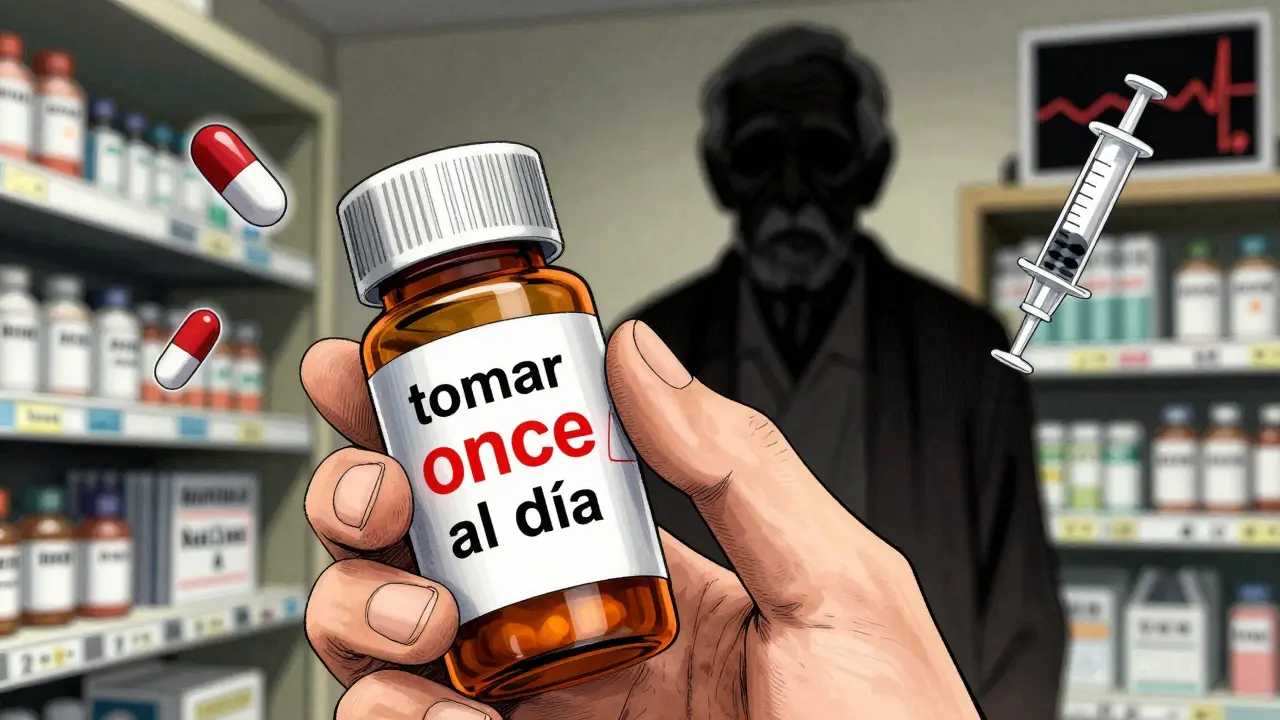
Imagine you’re given a pill bottle with instructions in a language you barely understand. One word is wrong - once becomes eleven - and suddenly, instead of taking your medicine once a day, you’re taking it eleven times. That’s not a hypothetical. It’s happened. And it’s not rare.
Across the U.S., millions of people rely on prescription labels translated by computers, not people. And those translations? They’re often dangerously wrong. A 2010 study in the Bronx found that half of all Spanish-language prescription labels had errors. Some patients took the wrong dose. Others skipped doses entirely. A few ended up in the emergency room. This isn’t just a language problem - it’s a public health crisis.
Why Computer Translations Fail on Prescription Labels
Most pharmacies use automated systems to translate labels. They’re cheap. They’re fast. And they’re full of mistakes.
These systems don’t understand medical context. They don’t know that the word once in English means one time, but in Spanish, it means eleven. So when your label says tomar una vez al día (take once a day), the machine might spit out tomar once al día - which means take eleven times a day. That’s not a typo. That’s a life-threatening error.
Even simple phrases get twisted. Take with food might become take with drink. Take as needed could turn into take always. These aren’t random glitches. They’re built into the systems because the software isn’t trained on medical terminology. It’s trained on general language - and medicine doesn’t follow everyday rules.
Worse, different pharmacies use different translation engines. One CVS might get it right. The Walgreens down the street might get it wrong - even for the same drug. That means if you switch pharmacies, your instructions change. No one warns you. No one checks. And you’re left guessing what to do.
The Human Cost of Bad Translations
People don’t just get confused - they get sick.
One Reddit user shared how their parent’s label said tome dos tabletas dos veces semanal - meaning take two tablets twice a week - instead of dos veces diario - twice a day. The result? Their blood pressure spiked. They ended up in the hospital. That kind of mistake isn’t unusual. Between 2021 and 2022, over 300 complaints were filed in California alone about prescription label errors.
A 2023 survey found that 63% of people with limited English proficiency said they didn’t fully understand their medication instructions. Nearly 3 in 10 admitted they’d taken the wrong dose because of the label. That’s not carelessness. That’s a system failure.
And it’s not just Spanish speakers. Chinese, Vietnamese, Arabic, and other languages face the same issues - but worse. Only 23% of major pharmacies offer translation in languages beyond Spanish. If you speak Tagalog or Haitian Creole, you’re often left with no label at all - just an English one you can’t read.
Dr. Yaffa Rashewsky from New York-Presbyterian says it plainly: “A single mistranslated word on a prescription label can transform therapeutic medication into a poison.” She’s not exaggerating. A wrong dosage on blood thinners, insulin, or seizure meds can kill.
Where the System Works - And Why
It’s not all bad. Some places have fixed this.
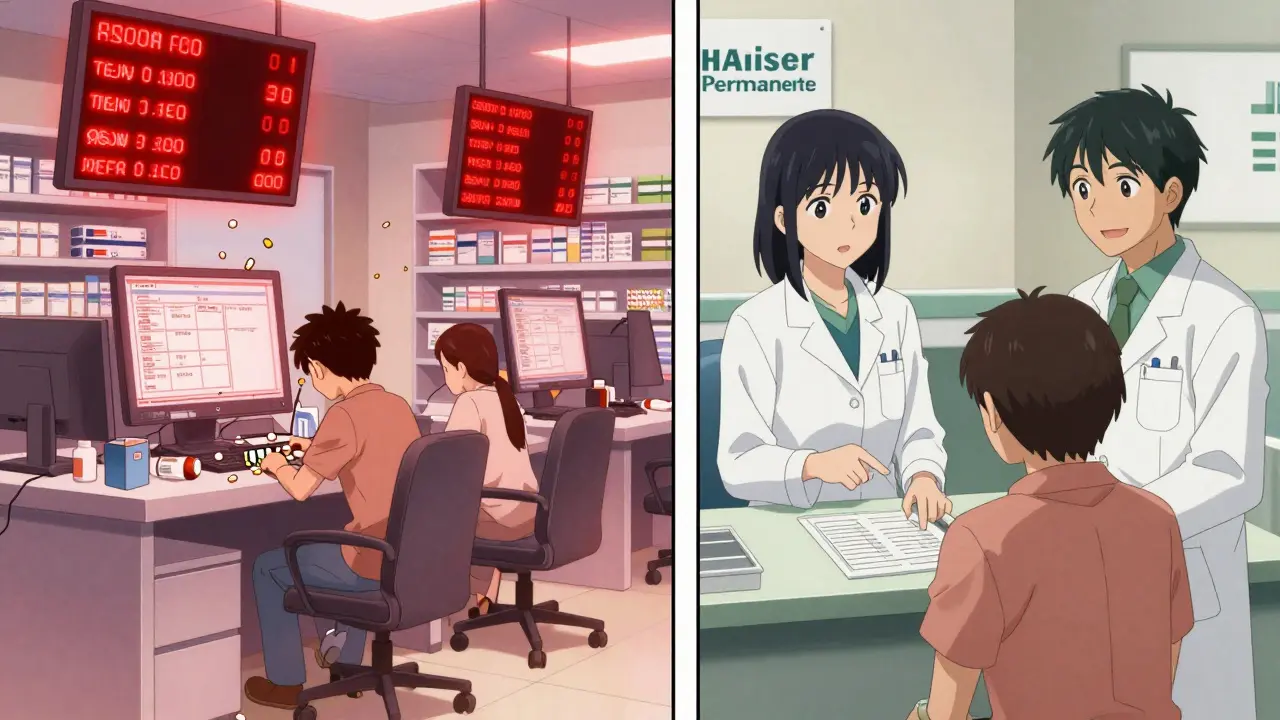
California passed a law in 2016 requiring pharmacies to use certified medical translators - not machines - for Spanish and other common languages. The results? A 32% drop in medication errors among Spanish-speaking patients. ER visits for drug-related problems fell by 27%.
How? They didn’t just hire translators. They built a system. Every label gets checked by two people - one who translates, one who verifies. Pharmacists review high-risk meds like warfarin or insulin. They use tools like SDL Trados Studio to keep translations consistent across drugs and locations.
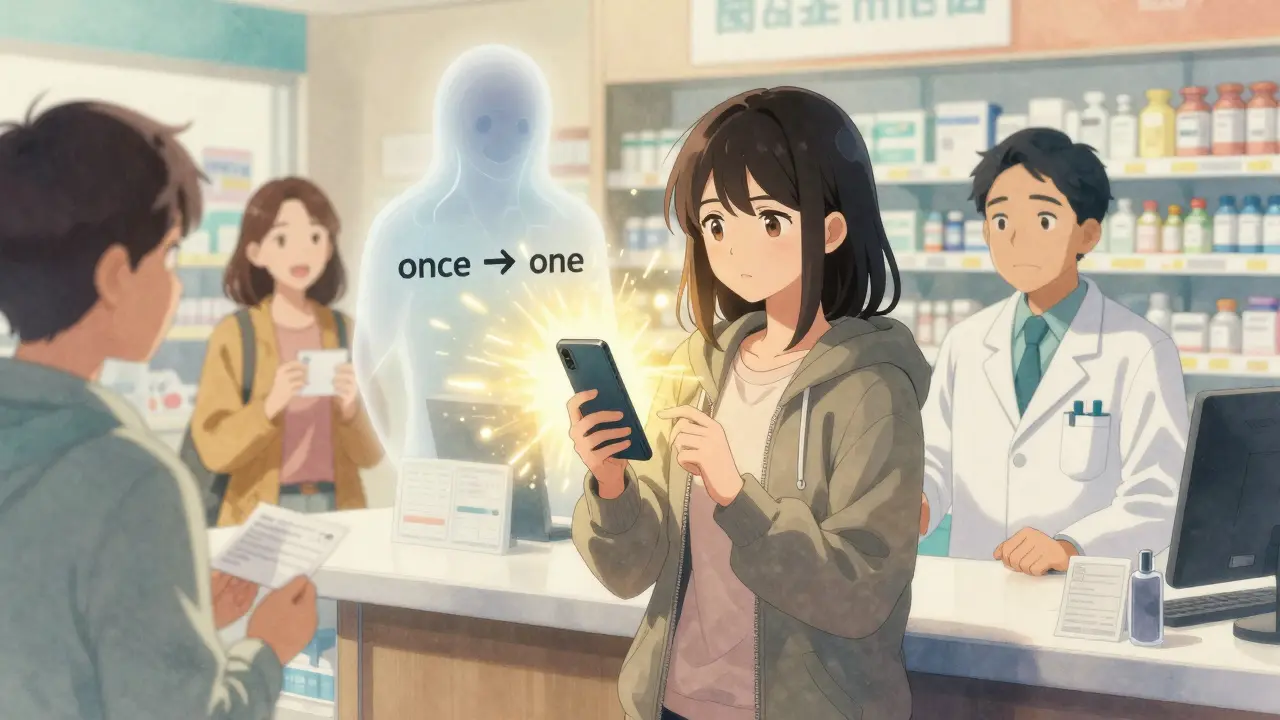
Walgreens and CVS have started testing AI tools that flag suspicious translations - but they still require a human to confirm. Walgreens’ MedTranslate system cut errors by 63% in pilot stores. CVS’s LanguageBridge does the same. These aren’t magic fixes. They’re smart upgrades: AI helps, but people decide.
Kaiser Permanente spent nearly $20,000 per pharmacy to overhaul their system. It took eight months. But they now report fewer errors, fewer calls from confused patients, and better health outcomes. The cost? About 25 cents more per prescription. The benefit? Lives saved.
What You Can Do If Your Label Doesn’t Make Sense
You don’t have to accept a bad translation. Here’s what to do:
- Ask for a human translator. Don’t settle for “the computer translated it.” Say: “Can I speak with a certified medical interpreter?” Most pharmacies have access to phone or video interpreters - even if they don’t offer printed labels.
- Compare labels. If you get the same prescription from two different pharmacies, check the instructions. If they’re different, trust the one that matches what your doctor told you - and report the mismatch.
- Use the pharmacy’s phone line. Call the pharmacy and ask them to read the label aloud in your language. Record it if you can. That way, you have proof if something goes wrong.
- Know your rights. Under Title VI of the Civil Rights Act, healthcare providers must offer language assistance. You don’t have to pay for it. You don’t have to ask twice. If they refuse, file a complaint with the U.S. Department of Health and Human Services.
- Bring a trusted person. If you’re unsure, ask a family member, friend, or community health worker to go with you to pick up your prescription. Two sets of eyes are better than one.
One woman in Miami told a Yelp reviewer that her Walgreens pharmacist had a certified Spanish translator on staff who verified her mother’s heart medication. That one step prevented a deadly overdose. It’s not expensive. It’s not complicated. It just takes care.
The Bigger Picture: Why This Isn’t Just a Pharmacy Problem
This isn’t just about labels. It’s about equity.
Over 25 million Americans have limited English proficiency. That’s 1 in 8 people. And yet, most pharmacies treat translation as an afterthought - a cost to cut, not a service to provide.
But the math is clear: every dollar spent on accurate translation saves $3.80 in avoided hospital visits, emergency care, and long-term complications. That’s not charity. That’s smart business.
States are starting to notice. Seventeen states are considering laws like California’s. The federal government launched a $25 million grant program in March 2024 to help pharmacies hire translators and upgrade systems. The FDA now recommends that all labels use plain language - no jargon, no confusing phrases - to make translation easier.
Change is coming. But it’s not here yet. And if you’re reading this because your label didn’t make sense - you don’t have to wait.
What’s Next? How to Push for Better Translation
If you’ve been affected by a bad translation, your voice matters.
- Report the error to the pharmacy. Ask for a written apology and a corrected label.
- File a complaint with your state’s board of pharmacy. They track these issues.
- Share your story with patient advocacy groups like the National Health Law Program or California Health Advocates. They use real stories to push for policy change.
- Ask your doctor to write a note on your prescription: “Patient requires verbal verification by certified medical interpreter.” That gives pharmacists legal cover to provide better service.
There’s no reason why a life-saving medicine should come with a label that could kill you. The tools exist. The proof is there. What’s missing is the will.
You have the right to understand your medicine. Don’t let a computer decide what you take - or how much.
What should I do if my prescription label is in a language I don’t understand?
Ask the pharmacy for a certified medical interpreter. You have the right to a free, accurate explanation of your medication in your language. Don’t accept a printed label you can’t read - insist on speaking with someone who can verify the instructions in person, over the phone, or via video.
Are pharmacies legally required to translate prescription labels?
Under federal law (Title VI of the Civil Rights Act), pharmacies receiving federal funds must provide language assistance. But only California and New York have specific laws requiring printed translated labels. In other states, pharmacies can choose whether to translate - but they still must offer verbal interpretation when asked.
Why do some pharmacies use computer translation instead of people?
It’s cheaper. Automated systems cost pennies per label. Professional translation adds 15 to 30 cents per prescription. For large chains handling millions of prescriptions, that adds up fast. But the cost of a mistake - hospitalization, ER visits, even death - is far higher.
Can I trust translation apps like Google Translate for my prescriptions?
No. Apps like Google Translate aren’t trained on medical terminology. They don’t know the difference between ‘once’ and ‘eleven’ in Spanish, or between ‘alcohol’ meaning rubbing alcohol versus drinking alcohol. These tools can mislead you into taking dangerous doses. Always verify with a certified medical interpreter.
What languages are most commonly translated on prescription labels?
Spanish is the most common, offered at 87% of major pharmacy chains. Chinese, Vietnamese, and Arabic are available at only about 23% of locations. For languages like Tagalog, Haitian Creole, or Korean, printed labels are rare - but verbal interpretation should still be available upon request.

9 Comments
Ambrose CurtisJanuary 28, 2026 AT 02:50
Y’all still letting pharmacies use Google Translate for life-or-death meds? Bro. I had my abuela’s blood pressure script say 'take eleven times a day' because 'una vez' got flipped to 'once'. She almost died. This ain’t a tech problem - it’s a moral one. Someone’s getting paid to gamble with lives.
James DwyerJanuary 29, 2026 AT 15:04
California’s law is the only real solution. Human translators + double-check system = fewer ER trips, less fear, and actual safety. Pharmacies that refuse to upgrade are putting profits over people. It’s not complicated. Stop outsourcing your ethics.
jonathan sobaJanuary 30, 2026 AT 23:25
Let’s be honest - this isn’t about translation. It’s about systemic neglect of non-English speakers. The fact that 77% of pharmacies don’t offer Tagalog or Haitian Creole labels isn’t an accident. It’s design. And the 'AI flagging' systems? They’re PR stunts. They still require human verification, which means they’re not actually solving the problem - just making it look like they are.
Irebami SoyinkaJanuary 31, 2026 AT 20:38
WTF is wrong with America? You got people here who can’t read their own medicine labels and you’re still using robots? 😒 We in Nigeria, we have village herbalists who know more about dosage than your average pharmacy AI. This is colonial thinking - you think poor folks don’t deserve clear instructions? I’m not even mad. I’m just disappointed. #MedicineIsNotAMeme
doug bFebruary 2, 2026 AT 08:41
If you’re unsure about your label, call the pharmacy. Ask them to read it out loud. Record it. Bring someone with you. You don’t need to be an expert - you just need to be persistent. This stuff is fixable. Don’t let them gaslight you into thinking it’s your fault.
Mel MJPSFebruary 3, 2026 AT 08:16
I work at a community clinic and we’ve had so many patients come in confused because their label said 'take with drink' instead of 'take with food'. One man thought he had to chug a soda with his insulin. He almost passed out. It breaks my heart. But when we step in - when someone just listens - it changes everything.
Kevin KennettFebruary 3, 2026 AT 16:22
My cousin’s mom got her diabetes meds from two different CVS locations - same script, same day. One said 'twice daily', the other said 'once daily'. She took it once for a week. Her HbA1c shot up to 11. She didn’t know which one was right. No one at either pharmacy apologized. They just said 'the computer says so'. That’s not service. That’s negligence. And if you’re not fighting for human translators, you’re part of the problem.
Jess BevisFebruary 5, 2026 AT 06:04
Spanish is covered. Everything else? You’re on your own. That’s not equity. That’s exclusion dressed up as convenience.
Rose PalmerFebruary 5, 2026 AT 20:14
While the systemic failures outlined in this post are deeply concerning, it is imperative to emphasize that adherence to Title VI of the Civil Rights Act mandates the provision of meaningful language assistance services. Pharmacies receiving federal funding are legally obligated to ensure comprehension, regardless of the medium. Failure to do so constitutes a violation of civil rights protections. Advocacy, documentation, and formal complaints to the Office for Civil Rights remain the most effective tools for accountability and systemic reform.