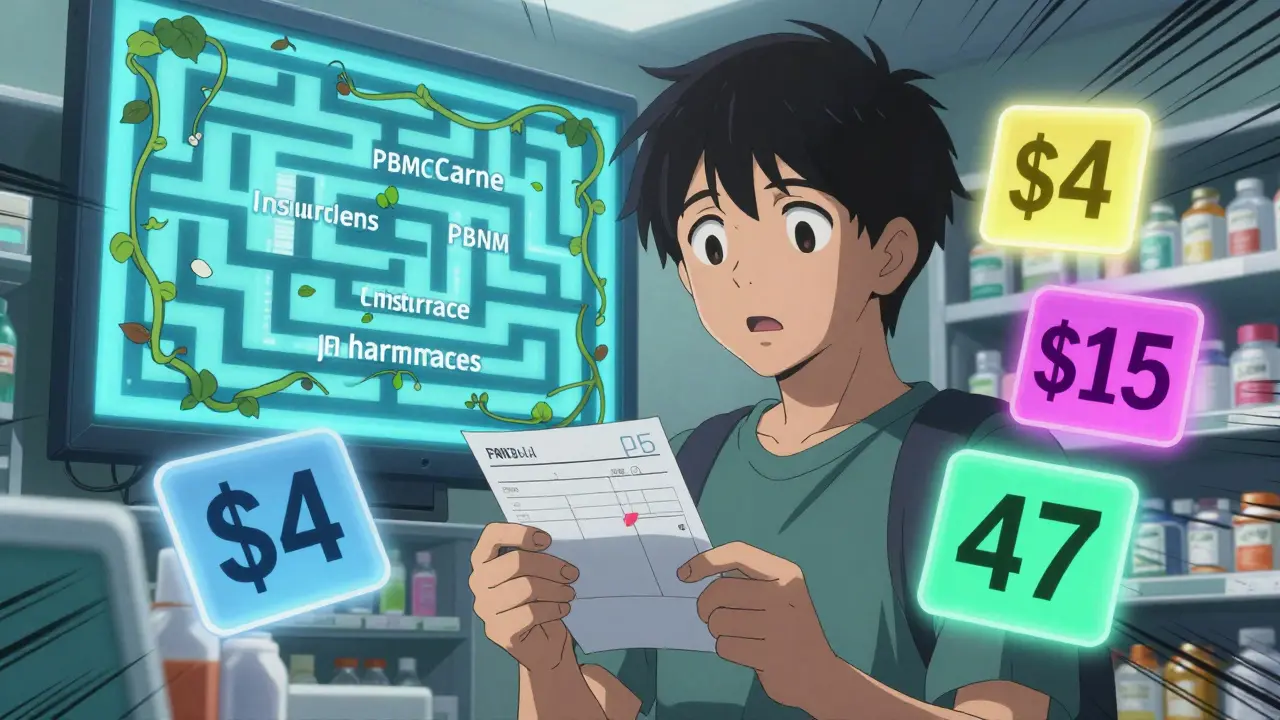
When you need a generic medication, you expect it to be cheap. But too often, the same pill costs $4 at one pharmacy and $47 at another-right down the street. Why? Because drug pricing in the U.S. isn’t just complicated. It’s intentionally opaque. Manufacturers set list prices, pharmacy benefit managers (PBMs) negotiate secret rebates, insurers design complex tiers, and pharmacies charge whatever their contracts allow. You’re left guessing. But you don’t have to. There are tools-real, working tools-that can show you the actual price before you hand over your card.
What’s Really Behind Generic Drug Prices?
Generic drugs are supposed to be affordable. They’re chemically identical to brand-name versions, but they cost a fraction because they don’t need expensive clinical trials. The problem isn’t the drug. It’s the system. The wholesale acquisition cost (WAC) is what manufacturers charge pharmacies. But that’s not what you pay. PBMs get rebates from manufacturers based on how much they push certain drugs. Those rebates aren’t passed to you. Instead, they’re used to lower the insurer’s bill-leaving you stuck with a high copay even if the drug’s true cost is low.Take a common generic like metformin. The WAC might be $0.20 per pill. But your copay? $15. Why? Because your insurance plan’s formulary puts it in a high tier. Or maybe the pharmacy’s contract with your PBM doesn’t cover the lowest price. You won’t know until you get to the counter. And if you’re uninsured? You’re at the mercy of whatever price the pharmacy decides to charge that day.
Real-Time Benefit Tools: For Doctors and Clinics
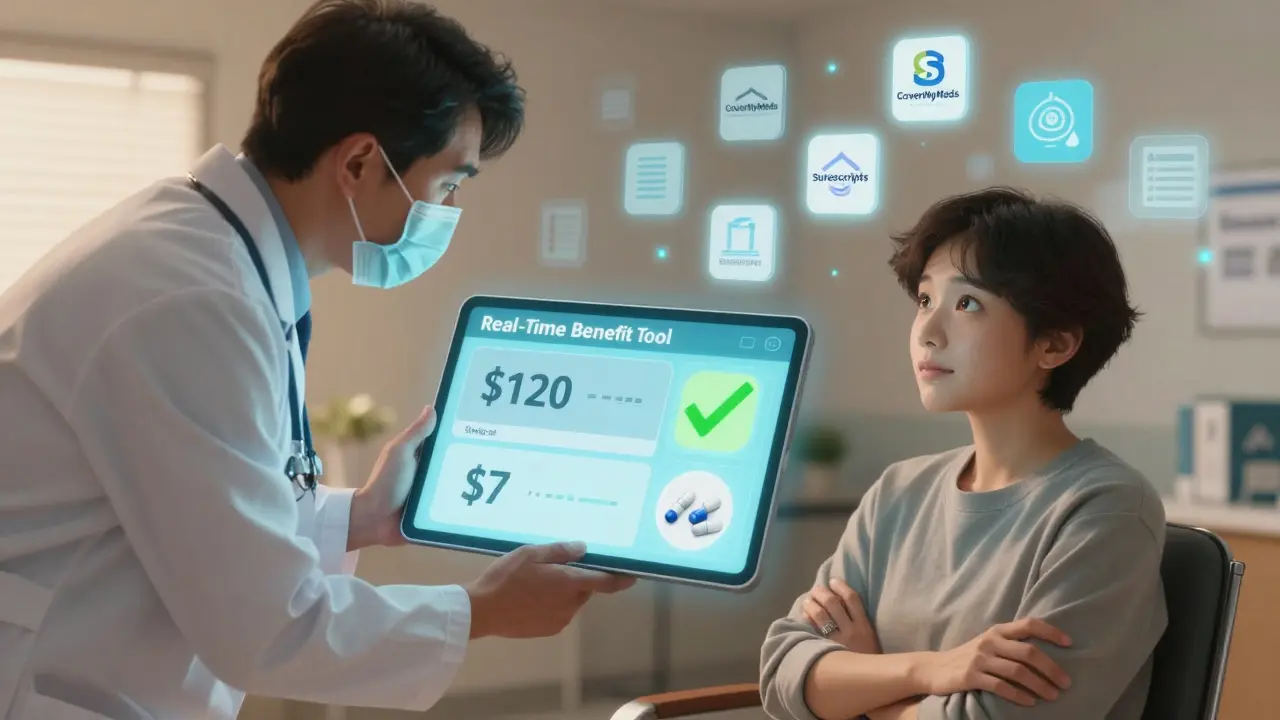
If you’re seeing a doctor, they might already be using a tool you’ve never heard of: a Real-Time Benefit Tool (RTBT). These are integrated into electronic health records like Epic and Cerner. When your doctor types in a prescription, the system pulls up your specific insurance details-your copay, deductible status, and alternatives-all in under two seconds.One study found that when doctors used RTBTs, patients switched to lower-cost generics 8.2% more often. That’s not just savings. That’s better adherence. If you can afford the medicine, you’re more likely to take it. CoverMyMeds and Surescripts are the two biggest platforms. CoverMyMeds connects with over 450,000 practices and shows you not just price, but also eligibility for manufacturer assistance programs. Surescripts works with 85% of U.S. pharmacies but has less adoption among doctors.
These tools don’t just show price. They show alternatives. Maybe your doctor prescribed a $120 generic. The tool suggests a $7 version with the same effect. Or maybe you’re on a high-deductible plan and the tool flags a $0 copay option through a patient assistance program. This isn’t theoretical. A physician in Minnesota reported a 37% drop in out-of-pocket costs for patients after using RTBTs regularly.
Apps for Patients: GoodRx, SingleCare, and Others
You don’t need a doctor’s office to use price transparency. Apps like GoodRx and SingleCare let you compare prices at local pharmacies before you leave home. GoodRx, used by 43% of U.S. pharmacies, shows you discounted cash prices-often lower than your insurance copay. It works by negotiating bulk deals with pharmacies and passing the savings to you.But here’s the catch: those prices aren’t guaranteed. A 2025 Trustpilot review from over 1,200 users complained: “The app says $4. I get there, and they say their system says $15.” Why? Because pharmacies sometimes don’t update their pricing in real time. Or the discount code doesn’t apply to your specific insurance plan. GoodRx is best if you’re paying cash, uninsured, or your insurance doesn’t cover the drug at all.
SingleCare works similarly but doesn’t require a coupon. It’s free to use, and the price it shows is the price you pay. No hidden steps. No registration. Just search the drug, pick a pharmacy, and show up. Other tools like RxSaver and WellRx also offer price comparisons, but GoodRx and SingleCare are the most reliable.
State Laws Are Changing the Game
As of 2025, 23 states have passed laws requiring drug price transparency. California forces manufacturers to report price hikes over 16% in two years. Minnesota went further: it created a Prescription Drug Affordability Board that can cap prices on high-cost generics. In 2025, a patient in Minnesota used the state’s online portal and found the same generic medication cost $287 less at a nearby pharmacy than at their usual one. That’s $24 a month saved-just by checking.These laws don’t just make prices visible. They force accountability. Manufacturers can’t hide behind “market forces” anymore. Pharmacies must post prices online. Insurers must report rebates. The goal? To break the cycle of surprise bills and hidden markups.
Why You Still Can’t See the Full Picture
Here’s the hard truth: no tool shows you the true net price. That’s the amount the pharmacy actually gets after rebates. That number is locked in contracts between PBMs and manufacturers. It’s secret. So even the best tools only show you the wholesale acquisition cost or a discounted cash price. They don’t show you what the pharmacy paid the distributor, or what rebate the PBM got.That’s why a $10 price on GoodRx might still be too high-if your insurance could have covered it for $3. Or why a $5 price at one pharmacy might be a trap-because their contract with your PBM doesn’t allow that rate for your plan. Transparency tools are getting better, but they’re still playing catch-up to a broken system.
How to Use These Tools Right
You don’t need to be a tech expert. Here’s how to save money, step by step:- Before your appointment, ask your doctor if they use a Real-Time Benefit Tool. If they do, insist on seeing the price options before they write the script.
- If you’re paying cash or your insurance won’t cover it, open GoodRx or SingleCare. Search your drug. Compare prices within 5 miles.
- Check RxAssist.org. It lists free or low-cost programs from drug makers. 78% of users who apply get help.
- If you’re on Medicare, use the Medicare Plan Finder. It shows what your Part D plan charges for each drug at each pharmacy.
- Call the pharmacy. Ask: “What’s the cash price for this generic? Is there a discount program?” Don’t assume the app price is final.
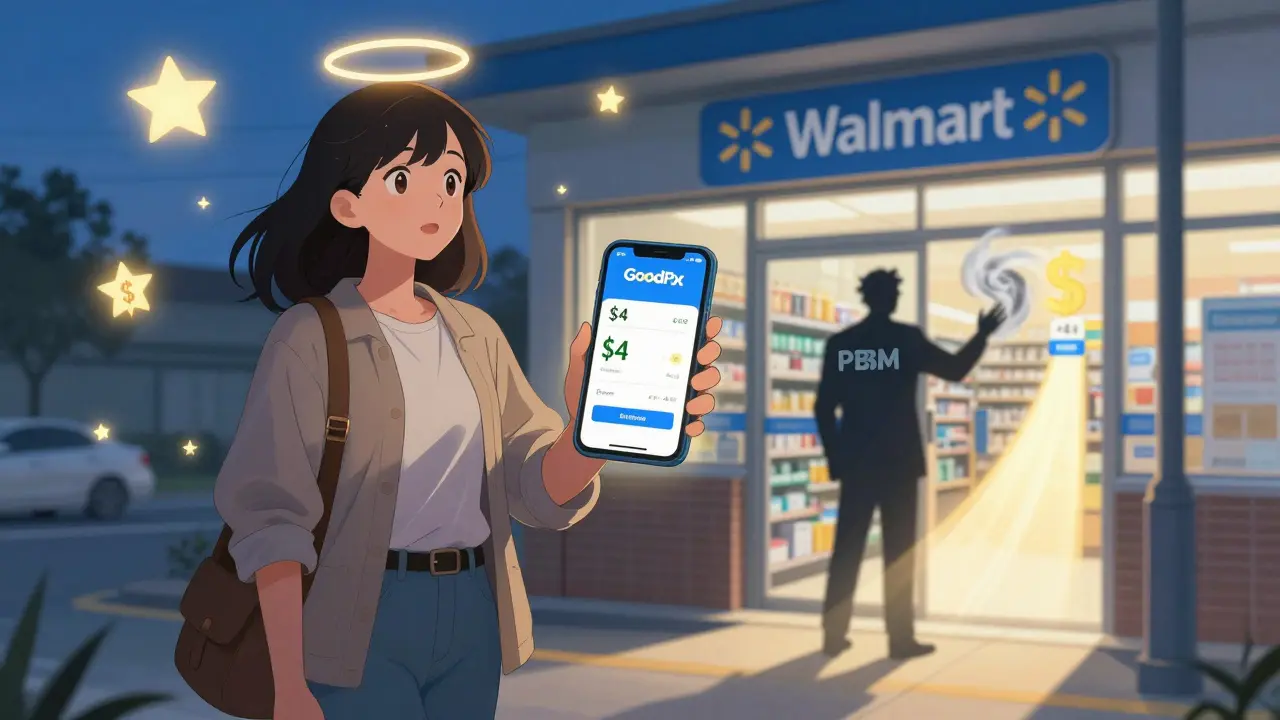
One woman in Alabama saved $312 a year by switching from her usual pharmacy to a Walmart that offered a $4 generic program. She didn’t know it existed until she used GoodRx. She didn’t need a doctor’s help. Just a phone and a few minutes.
What’s Coming Next?
In January 2025, the U.S. Senate introduced the Drug-price Transparency for Consumers Act (S.229). If passed, it would require drug ads on TV and online to show the wholesale cost of a 30-day supply. That’s huge. Right now, you see celebrities saying “Ask your doctor about [brand name]” with no mention of cost. Imagine if every ad said: “This drug costs $120 a month.” That could change everything.Meanwhile, CMS is expected to release final rules for the Prescription Drug File by the end of 2025. That could force insurers to report total spending on drugs after rebates. That data could expose which drugs are being overpriced-and why.
But experts warn: transparency alone won’t fix this. As Dr. Dan Arnold of Avalere Health says, “Without changing how rebates work, we’re just shining a light on a rigged game.” Still, knowing the price is the first step to demanding a better one.
What You Can Do Today
You don’t have to wait for Congress or your insurer to act. You have power right now:- Always ask: “Is there a cheaper generic?”
- Never accept the first price. Compare.
- Use GoodRx or SingleCare before you pay.
- If your doctor doesn’t use RTBT, ask them to start.
- Report price mismatches. If GoodRx says $5 and the pharmacy says $20, call the pharmacy’s corporate office. They’ll fix it.
Generic drugs aren’t supposed to be a lottery. They’re supposed to be the affordable option. With the right tools and a little persistence, you can make sure they are.
Why is the same generic drug so expensive at some pharmacies?
The price difference comes from how pharmacies negotiate with pharmacy benefit managers (PBMs). Some pharmacies have contracts that allow them to offer deep discounts on generics, especially if they’re part of a chain like Walmart or Costco. Others charge higher prices because their PBM doesn’t give them access to the lowest wholesale rates. Your insurance plan also plays a role-if the drug isn’t on your formulary, you may pay full price. Always compare cash prices using tools like GoodRx, even if you have insurance.
Can I use GoodRx if I have Medicare?
Yes, but only if you’re paying cash. Medicare Part D plans don’t allow you to combine GoodRx discounts with your coverage. However, if your Medicare copay is higher than the GoodRx price, you can choose to pay cash using the discount instead. This is especially helpful for drugs not covered by your plan or if you’re in the coverage gap (donut hole). Always check both prices before paying.
Do Real-Time Benefit Tools work for all medications?
Mostly yes, but not always. RTBTs work best for common generics and brand-name drugs covered by major insurers. They often don’t show accurate pricing for specialty medications, rare generics, or drugs with complex prior authorization requirements. Some small or independent pharmacies also don’t integrate with these systems. If the tool doesn’t show a price, call the pharmacy directly or use a consumer app like SingleCare.
Are patient assistance programs reliable?
Yes, and they’re free. Programs like RxAssist.org connect you directly with drug manufacturers who offer free or low-cost medications to people who qualify based on income. In 2024, 78% of applicants received the medication they requested. The downside? The application process can be confusing and time-consuming. Many people give up. But if you’re uninsured or underinsured, it’s worth the effort-some programs cover entire annual supplies.
Why doesn’t my insurance show the lowest price?
Insurance plans are designed to control costs for the insurer, not necessarily for you. They negotiate rebates with drugmakers and PBMs, but those savings aren’t always passed to you. Sometimes, your plan’s formulary pushes you toward a more expensive drug because the manufacturer gave them a bigger rebate. That’s why your copay might be $30 for a drug that’s $5 cash at Walmart. Always check both your insurance price and the cash price before paying.
Is it legal for pharmacies to charge different prices?
Yes. Pharmacies are allowed to set their own cash prices and negotiate different rates with PBMs. There’s no federal law requiring uniform pricing. However, some states now require pharmacies to disclose cash prices upfront or post them online. In states with transparency laws, pharmacies that mislead customers about prices can face fines. Always ask for the cash price before you pay-no one can refuse to tell you.
If you’re paying for prescriptions out of pocket, you’re not powerless. The tools exist. The data is there. You just need to use it.

9 Comments
Ashley PorterJanuary 26, 2026 AT 19:29
The PBM rebate arbitrage is the real villain here. It’s not just opaque-it’s a structural incentive to maximize insurer profit at the expense of patient affordability. The WAC is a fiction; the net price is the only number that matters, and it’s buried under layers of contractual secrecy. We’re treating healthcare like a derivatives market, and patients are the collateral.
Mohammed RizviJanuary 26, 2026 AT 22:44
So let me get this straight-some guy in Minnesota saves $287 on metformin because he checked a website, but the guy in Alabama still pays $47 because he trusts his ‘usual’ pharmacy? This isn’t capitalism. This is a rigged carnival game where the prize is your health and the ticket is your ignorance.
Nicholas MiterJanuary 28, 2026 AT 20:11
Been using GoodRx for my dad’s blood pressure meds for years. Sometimes the app price is off by a few bucks, but 9 times out of 10 it’s way cheaper than insurance. Just call the pharmacy first and say ‘what’s your cash price?’-they’ll tell you. No coupon needed. Simple. Also, Walmart’s $4 generics are real. Don’t let anyone tell you otherwise.
TONY ADAMSJanuary 30, 2026 AT 18:21
why do people still use insurance for generics?? just pay cash. its always cheaper. stop letting the system screw you. goodrx is free. why are you still crying?
George RahnJanuary 31, 2026 AT 18:14
The American pharmaceutical-industrial complex has become the most egregious example of market failure in modern history. The confluence of private equity-backed PBMs, monopolistic manufacturer pricing, and regulatory capture has transformed a public health imperative into a predatory financial instrument. Transparency tools are merely palliative-they do not address the systemic rot at the core of this enterprise.
Ashley KaranjaFebruary 1, 2026 AT 00:44
I love how we’re finally talking about this, but I also feel so much grief. Every time I help my mom navigate her Part D plan, I cry a little. She’s 72, on a fixed income, and still chooses between insulin and groceries. These tools? They’re lifelines. But they shouldn’t have to be. The fact that we’ve normalized ‘shopping’ for life-saving meds is a moral failure. And yet… I’m so grateful for GoodRx. I’ve saved her $200/month just by switching pharmacies. I wish we lived in a world where this wasn’t a hack.
Neil ThorogoodFebruary 2, 2026 AT 03:58
Let me be the first to say it: if your doctor doesn’t use RTBTs, fire them. Seriously. If they’re still writing scripts like it’s 2008, they’re not your ally-they’re part of the problem. I had a doc who refused to use it. I walked out. Got a new one. My copay dropped from $45 to $8. It’s not complicated. Demand better.
Angie ThompsonFebruary 3, 2026 AT 22:53
Just tried SingleCare for the first time for my thyroid med. Showed $3.99 at CVS. Walked in, handed them the code, and they said ‘oh we don’t accept that.’ I called the corporate number, they apologized, fixed it, and gave me a $10 gift card. 🙌 People, DO NOT assume. Always ask. Always call. Always check. This isn’t magic-it’s muscle. And you’ve got it.
rasna sahaFebruary 4, 2026 AT 14:06
As someone from India, I’m shocked. In my home country, even brand-name drugs are sold at near-WAC prices because of strict price controls. Here, a $0.20 pill becomes $15 because of… paperwork? Contracts? It’s insane. But I’m glad people are fighting back. Tools like GoodRx are small victories. Keep using them.