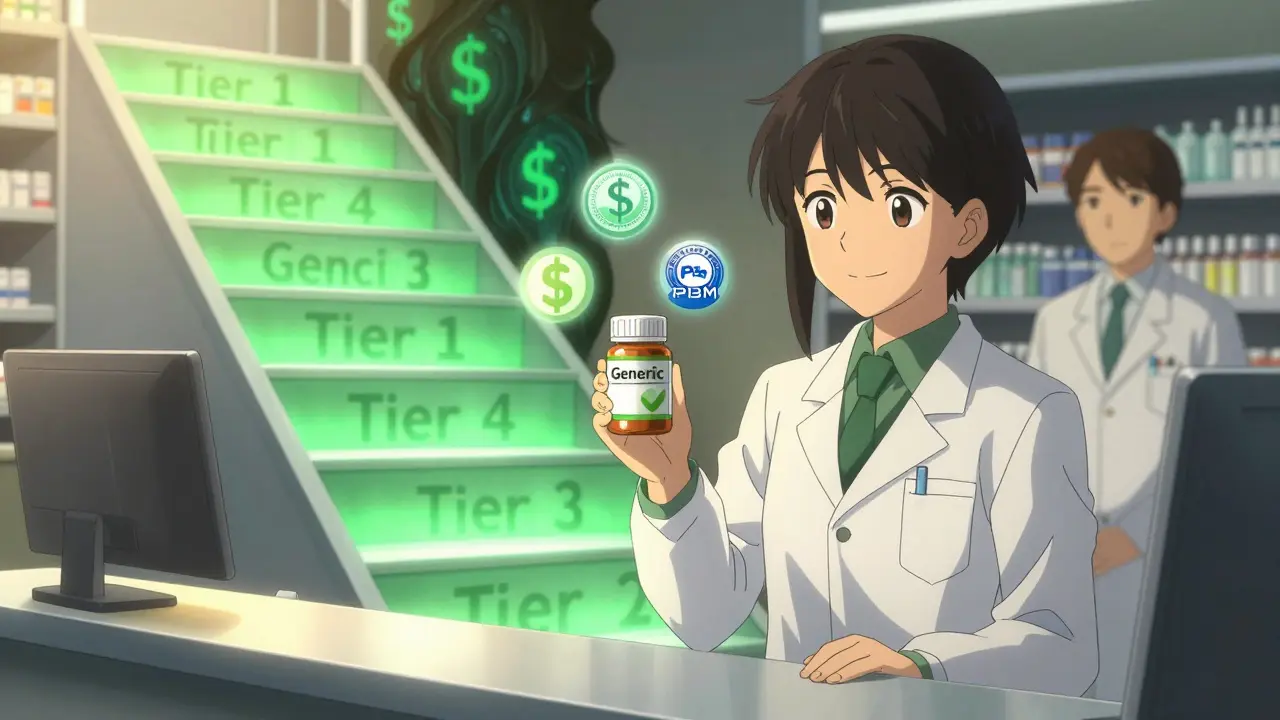
When you pick up a prescription at the pharmacy, you might not realize that the price you pay isn’t just about the drug itself-it’s shaped by a complex system your employer set up long before you ever saw a doctor. Most large employers offer health plans with prescription drug coverage, and nearly all of them use something called a formulary to decide which drugs are covered and how much you pay for them. At the heart of this system? A strong, deliberate preference for generic medications.
Why Generics Are the Default Choice
Generic drugs aren’t second-rate. The FDA confirms they’re just as safe and effective as brand-name versions. The only real difference? Price. Generics typically cost 80-85% less because they don’t need to repeat expensive clinical trials or run nationwide ad campaigns. That’s why employers love them. Every week, generic drugs save the U.S. healthcare system over $3 billion. That’s more than $150 billion a year. For employers, that’s not just savings-it’s a way to keep premiums and out-of-pocket costs from skyrocketing.Your plan doesn’t just encourage generics-it structures your costs around them. Most employer health plans use a tiered system, where medications are grouped into levels based on cost. Tier 1 is almost always reserved for generics. That means if you fill a generic prescription, you might pay just $10. Same drug, brand name? You could be looking at $40 or more. And if there’s no generic available? You could end up in Tier 3 or 4, where copays jump to $75 or higher.
How Formulary Tiers Work
Think of your drug coverage like a staircase. Each step costs more:- Tier 1: Generics - Lowest cost, usually $10 or less. This is where your plan wants you to start.
- Tier 2: Preferred Brand-Name Drugs - These are brand-name drugs your plan has negotiated a deal on. Copay: around $40.
- Tier 3: Non-Preferred Brand-Name Drugs - No deal. You pay more because your plan didn’t push for a discount. Copay: $75 or more.
- Tier 4: Specialty Drugs - Used for complex conditions like cancer, MS, or rheumatoid arthritis. These often require prior authorization and can cost hundreds or even thousands per month.
Here’s the twist: when a brand-name drug loses its patent and a generic hits the market, your plan doesn’t just add the generic-it moves the old brand to the highest tier. So if you’ve been taking a brand-name medication and suddenly a generic becomes available, your copay could jump from $40 to $75 overnight. The plan doesn’t ban the brand-it just makes it expensive enough that most people switch.
Who Controls What You Can Get?
Your employer doesn’t make these decisions alone. They hire a third party called a Pharmacy Benefit Manager (PBM) to manage drug coverage. The big three-OptumRx, CVS Caremark, and Express Scripts-control prescription access for most U.S. workers. These companies don’t just list drugs; they decide which ones to exclude entirely.In January 2024, each of these three PBMs removed over 600 drugs from their formularies. That’s more than 1,800 medications gone in one month. Why? It’s a negotiation tactic. Pharmaceutical companies pay PBMs huge rebates to keep their drugs on the list. If a company refuses to pay enough, the PBM drops the drug. That puts pressure on manufacturers to lower prices-or lose access to millions of patients.
But here’s the catch: the money saved doesn’t always reach you. PBMs use a system called gross-to-net (GTN) pricing. The list price of a drug might be $100, but after rebates and discounts, the actual cost is $45. That 55% difference? It’s kept by the PBM, not passed on to you. So even though your plan saves money, your copay might not go down.
What You Can Do
You don’t have to guess how your coverage works. Here’s what you can do right now:- Visit your insurer’s website and search for your plan’s formulary. Look for the drug you take.
- Check your Summary of Benefits and Coverage (SBC)-it’s required by law and explains your drug tiers.
- Call your insurer. Ask: “Is there a generic version of my medication? What tier is it on?”
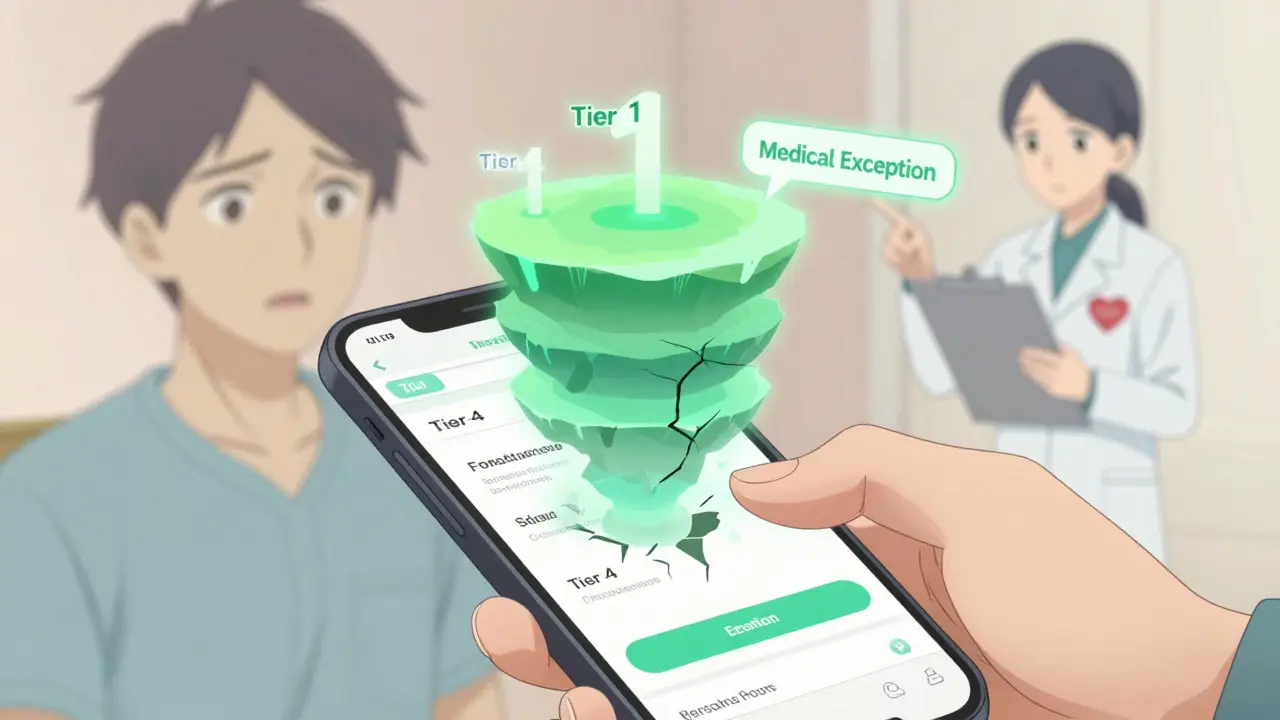
- If your drug was recently removed from the formulary, ask about a medical exception. Your doctor can submit paperwork to get it covered anyway.
Many employees don’t know they have options. A 2023 survey found that while 99% of large employer plans offer drug coverage, many workers don’t understand how to use it wisely. Some think generics are less effective. Others don’t realize their plan automatically switches them to cheaper options. Education matters. Employers who send out emails, payroll inserts, or even short videos explaining generics see higher adoption rates and lower costs.
When You Need More Than a Generic
Not everyone can switch to a generic. If you have chronic conditions like diabetes, asthma, or heart disease, your medication might be essential-and not available as a generic. In those cases, your plan may offer special programs. Some employers partner with organizations like HealthOptions.org to provide care managers who help you find affordable alternatives, apply for patient assistance, or navigate prior authorizations.Some plans even have a “Price Assure Program” that automatically lowers the cost of generics when filled at in-network pharmacies. That’s not magic-it’s negotiation. Your employer’s PBM has contracts with pharmacies to lock in lower prices. You just need to use the right one.
The Hidden Trade-Off
The system is designed to save money. And it works. But not always for you. PBMs save billions by excluding drugs and pushing generics. Employers save by offering these plans. But if your drug gets dropped and your doctor says you can’t switch, you’re stuck. You might have to pay full price, fight for an exception, or go without.There’s no easy fix. But awareness helps. If you know how your formulary works, you can anticipate changes. If your medication is suddenly more expensive, it’s not random-it’s a business decision. And you have the right to ask why.
What’s Next?
The trend isn’t slowing. More employers are adopting Consumer Driven Health Plans (CDHPs), which give you more control but also more responsibility. The more you know about your formulary, the better you can manage your care-and your budget. Expect more drug exclusions, more tier shifts, and more pressure to use generics. But also expect more tools: apps that show real-time copays, chatbots that explain formularies, and care teams that help you navigate the maze.Don’t wait until your prescription is denied. Check your formulary now. Know your tiers. Ask questions. Your health-and your wallet-depend on it.
Are generic drugs really as good as brand-name drugs?
Yes. The FDA requires generics to have the same active ingredient, strength, dosage form, and route of administration as the brand-name version. They must also meet the same strict manufacturing standards. The only differences are in inactive ingredients (like fillers or dyes) and cost. Generics are not cheaper because they’re inferior-they’re cheaper because they don’t need to repeat expensive clinical trials or marketing campaigns.
Why does my copay suddenly go up for a drug I’ve been taking for years?
It’s likely because a generic version became available. When that happens, your plan’s Pharmacy Benefit Manager (PBM) moves the brand-name drug to a higher tier-often Tier 3 or 4-while putting the generic in Tier 1. This encourages you to switch. If you keep the brand, you pay more. It’s not a mistake; it’s intentional cost-control design.
Can my employer change my drug coverage without telling me?
Yes. Formularies change frequently-sometimes monthly. PBMs negotiate new deals with drugmakers, and exclusions happen without advance notice. While your employer must give you a new Summary of Benefits and Coverage (SBC) if major changes occur, minor tier shifts or drug exclusions often aren’t flagged ahead of time. Always check your formulary before filling a prescription.
What if my medication isn’t on the formulary at all?
You’ll likely have to pay full price unless you qualify for a medical exception. Your doctor can submit paperwork to your insurer explaining why you need the drug and why no alternative works. These exceptions are common for chronic conditions, rare diseases, or when generics aren’t effective. Don’t assume you’re out of luck-ask your doctor or benefits administrator to help you file one.
Do PBMs really keep most of the savings from generic drugs?
Yes, in many cases. PBMs negotiate rebates from drug manufacturers, but they don’t always pass those savings to you or your employer. The difference between a drug’s list price and the net price after rebates is called the gross-to-net (GTN) spread. On average, it’s 55%. That means if a drug costs $100, the PBM might pay $45 after rebates-but your copay might still be $75. The rest stays with the PBM as profit.
Understanding your employer’s health plan isn’t just about reading fine print-it’s about taking control of your health spending. The system is built to save money, but only if you know how to use it.

14 Comments
Danielle ArnoldMarch 24, 2026 AT 13:28
So let me get this straight - my employer saves billions, I pay $10 for a generic that works just as well, and somehow the PBM pockets 55% of the savings? 😑
And they wonder why people hate healthcare.
At this point, I just assume every 'savings' is just a fancy word for 'corporate greed with a PowerPoint slide.'
Also, why do I have to be a detective just to get my damn insulin? This isn't a game. It's my life.
rebecca kladyMarch 26, 2026 AT 10:00
Appreciate the breakdown. I didn’t realize how much my plan was nudging me toward generics - thought it was just me being cheap.
Turns out, I was being manipulated by a spreadsheet.
Still, I’m glad I switched to the generic for my blood pressure med - no side effects, half the cost. Win?
Just wish they’d tell us these changes before we get to the pharmacy.
Namrata GoyalMarch 26, 2026 AT 14:30
Generics? Pfft. I mean, have you SEEN the filler in those things? I’ve read studies - not the ones the FDA publishes, the REAL ones - where generics have like 3x the inactive ingredients.
Also, why do you think brand-name drugs cost more? Because they have better bioavailability, dummy.
Also, PBMs? They’re just middlemen who got rich off the system. Capitalism is a scam.
Also, I don’t trust the FDA. Ever heard of thalidomide? Yeah. Exactly.
Blessing OgbosoMarch 27, 2026 AT 13:22
As someone from Nigeria where access to even basic medications is a daily struggle, I find this whole system both fascinating and heartbreaking.
Here, we dream of having generics at all - not debating whether they’re 'good enough.'
But I also see the human cost - people stuck between affordability and medical need.
Maybe the real issue isn’t generics vs. brands, but who gets to decide what 'affordable' means?
And why are we treating healthcare like a corporate negotiation, not a human right?
I wish more of us could see this beyond the U.S. lens - because the global truth is, we’re all just trying to survive with a pill in our hand and a price tag on our forehead.
Jefferson MoratinMarch 29, 2026 AT 07:00
The structural logic of formularies reveals a deeper epistemological contradiction: the system optimizes for cost-efficiency while simultaneously requiring patient autonomy.
But autonomy is impossible when information asymmetry is weaponized.
The PBM functions as a black box that redistributes surplus value without transparency.
Thus, the patient is not merely a consumer - they are an unwitting participant in a capitalist feedback loop designed to externalize risk while internalizing profit.
It is not irrational to prefer a brand-name drug - it is rational to distrust a system that hides its rebates behind legalese.
Knowledge is power, yes - but power is not equally distributed.
And that is the fundamental injustice.
Zola ParkerMarch 31, 2026 AT 02:49
So PBMs are just… middlemen who profit from our suffering? 😒
And we’re supposed to be grateful they don’t ban our meds outright?
Also, my plan just dropped my asthma inhaler. No warning. No email. Just 'oh btw, you’re paying $300 now.'
Thanks for nothing, capitalism.
Also, I’m not switching to generic - my lungs don’t care about your spreadsheets. 🤷♀️
florence matthewsApril 1, 2026 AT 14:45
I love how this post just… explains everything so clearly. No jargon, no fluff.
And I’m so glad I learned about formularies before my diabetes med got bumped to Tier 4.
Now I check my plan every month - like checking the weather before I leave the house.
Also, I just called my doctor and got an exception for my brand-name insulin - took 3 calls, 2 forms, and a tearful conversation with a benefits rep… but I got it.
Don’t give up. You’re not alone. 💛
Kenneth JonesApril 1, 2026 AT 17:24
Stop pretending this is about savings. This is about control.
Employers don’t care about your health. They care about their bottom line.
PBMs are corporate parasites.
Generics are fine. But don’t act like this system is fair.
You’re being played.
And if you don’t fight back, you’ll lose.
Check your formulary. Now.
Don’t wait.
Mihir PatelApril 2, 2026 AT 02:56
OMG so I’ve been paying $75 for my migraine med and I had NO IDEA there was a generic for $10??
My brain is literally melting right now.
Why didn’t anyone tell me??
I’ve been overpaying for THREE YEARS.
My bank account is crying.
And now I have to call my doctor to switch??
Ugh. I hate healthcare.
Also I just spilled coffee on my laptop. This is my life.
Rachele TycksenApril 2, 2026 AT 09:42
Wow, this is actually super helpful. I didn’t even know what a formulary was until now.
My plan switched me to a generic last month and I thought I was getting scammed.
Turns out I just got lucky.
Thanks for making it so easy to understand. I’m gonna share this with my mom - she’s always complaining about her meds.
Also, typo: 'pharmasist' - lol I’m not a grammar Nazi but I had to say it 😘
Korn DenoApril 3, 2026 AT 17:49
The system works because it’s designed to work - not for you, but for the architecture of capital.
Generics are not inherently better - they’re just cheaper to produce.
But the real power isn’t in the pill - it’s in the list.
Who controls the list? Who gets to decide what is 'necessary'?
That’s the question no one asks.
And until we answer it, we’re just rearranging deck chairs on the Titanic.
Knowledge is the first step - but action is the only thing that matters.
Aaron SimsApril 3, 2026 AT 23:22
Wait… so the government doesn’t regulate PBMs? And they’re privately owned? And they’re making billions off rebates that NEVER reach patients? And they’re the ones deciding which drugs are 'allowed'?!
That’s not a healthcare system.
That’s a cartel.
And your employer? They’re in on it.
They’re not your partner - they’re the landlord.
And your health? It’s just another asset they’re optimizing.
They’re not saving you money - they’re profiting from your desperation.
And they’ve got lawyers writing the rules.
Wake up.
It’s not a bug - it’s a feature.
Natasha Rodríguez LaraApril 4, 2026 AT 01:46
I love how this post doesn’t just dump facts - it invites you to think.
It’s rare to see something so clear-eyed about a system that’s built to confuse.
I’ve been working in public health for 15 years, and even I didn’t fully grasp how PBMs operate until now.
And I’m so glad someone finally said it: awareness matters.
But awareness alone isn’t enough.
We need policy change.
We need transparency laws.
We need to stop treating healthcare like a corporate game.
Thank you for lighting the candle.
Now let’s turn on the lights.
peter venckenApril 5, 2026 AT 01:10
For anyone confused about formularies - here’s the cheat code:
1. Go to your insurer’s website
2. Type in your drug name
3. Look for the tier number
4. If it’s Tier 1 - you’re golden
5. If it’s Tier 3 or 4 - call your doc and ask for a prior auth
6. If it’s gone completely - ask for a medical exception
7. If they say no - call again. And again.
And yes, generics work. I’ve been on them for 10 years. No issues.
But if you need the brand? Fight for it.
They can’t say no forever.
Also, use in-network pharmacies. Always.
That’s how you save extra.
Trust me - I’m a pharmacist. Been doing this since 2008.